

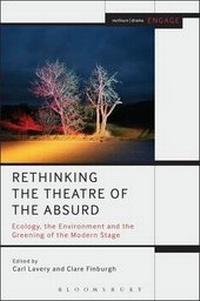
Rethinking the Theatre of the Absurd
Ecology, the Environment and the Greening of the Modern Stage
Published on 7. May 2015
Book
Paperback/Softback
272 pages
978-1-4725-9571-3 (ISBN)
Description
Rethinking the Theatre of the Absurd is an innovative collection of essays, written by leading scholars in the fields of theatre, performance and eco-criticism, which reconfigures absurdist theatre through the optics of ecology and environment. As well as offering strikingly new interpretations of the work of canonical playwrights such as Beckett, Genet, Ionesco, Adamov, Albee, Kafka, Pinter, Shephard and Churchill, the book playfully mimics the structure of Martin Esslin's classic text The Theatre of the Absurd, which is commonly recognised as one of the most important scholarly publications of the 20th century. By reading absurdist drama, for the first time, as an emergent form of ecological theatre, Rethinking the Theatre of the Absurd interrogates afresh the very meaning of absurdism for 21st-century audiences, while at the same time making a significant contribution to the development of theatre and performance studies as a whole.
The collection's interdisciplinary approach, accessibility, and ecological focus will appeal to students and academics in a number of different fields, including theatre, performance, English, French, geography and philosophy. It will also have a major impact on the new cross disciplinary paradigm of eco-criticism.
The collection's interdisciplinary approach, accessibility, and ecological focus will appeal to students and academics in a number of different fields, including theatre, performance, English, French, geography and philosophy. It will also have a major impact on the new cross disciplinary paradigm of eco-criticism.
Reviews / Votes
[CC] This collection of eight critical essays invites reinterpretation of a group of playwrights loosely fitting into a genre initially endorsed by Martin Esslin in his groundbreaking The Theatre of the Absurd (1961). Deviating from the existential and ontological focus associated with writings about this dramatic phenomenon of the 20th century, the contributors to this book attempt to recalibrate the historical excitement by framing readings with a 21st-century environmental and ecological lens and looking beyond Esslin's classic definition ... [T]he arguments and the connections made here are effective in bringing the ecological issues to the foreground ... Summing Up: Recommended. Lower-division undergraduates through faculty and professionals; general readers. * CHOICE *More details
Series
Language
English
Place of publication
London
United Kingdom
Publishing group
Bloomsbury Publishing PLC
Target group
Professional and scholarly
College/higher education
Product notice
Hardback (stationery)
Illustrations
12 bw illus
Dimensions
Height: 216 mm
Width: 138 mm
ISBN-13
978-1-4725-9571-3 (9781472595713)
DOI
CBID180955
Copyright in bibliographic data and cover images is held by Nielsen Book Services Limited or by the publishers or by their respective licensors: all rights reserved.
Schweitzer Classification
Persons
Carl Lavery teaches Theatre and Performance at Aberystwyth University, UK. His publications include Jean Genet Politics and Performance, with Clare Finburgh (2006), Sacred Theatre (2007), Walking, Writing and Performance: Autobiographical Texts by Dee Heddon, Carl Lavery and Phil Smith (2009), The Politics of Jean Genet's Late Theatre: Spaces of Revolution (2010), Contemporary French Theatre and Performance, with Clare Finburgh (2011), Good Luck Everybody. Lone Twin: Journeys, Performances and Conversations, with David Williams(2011), and the is he editor with Nick Whybrow of a special issue of Performance Research 'On Foot' (2012).
Clare Finburgh is a senior lecturer in the department of Literature, Film and Theatre Studies at the University of Essex, UK. He research focuses on French and UK contemporary performance, notably innovations in French modern and contemporary playwriting and directing; and representations of conflict in UK theatre. She has co-written Jean Genet (with David Bradby, 2011), and co-edited Genet: Performance and Politics (2006) and Contemporary French Theatre and Performance (2011).
Clare Finburgh is a senior lecturer in the department of Literature, Film and Theatre Studies at the University of Essex, UK. He research focuses on French and UK contemporary performance, notably innovations in French modern and contemporary playwriting and directing; and representations of conflict in UK theatre. She has co-written Jean Genet (with David Bradby, 2011), and co-edited Genet: Performance and Politics (2006) and Contemporary French Theatre and Performance (2011).
Content
Acknowledgements
Preface: David Williams
Introduction: Greening the Absurd
Chapter 1: 'Ruins true refuge'. Recycling Beckett by Joe Kelleher
Chapter 2: Beckett, Robert Wilson, and Mabou Mines
Chapter 3: 'Rare Butterflies, Persecution, and Pinball Machines: Environment, Subjectivity, and Society in Theatre of Arthur Adamov' by Franc Chamberlain
Chapter 4: 'Greening Ionesco: The Humanism of the Inhuman' by Carl Lavery
Chapter 5: 'Every object possesses its own magnificence, no greater or lesser than that of any other object'. The Ecological Aesthetics of Jean Genet's Theatre - Robert Wilson's Les Negres by Clare Finburgh
Chapter 6: Pinter and the Politics of Care by Una Chauduri
Chapter 7: The Garden in the Machine: Albee, Shepard, and the American Green Absurd by Steve Bottoms
Chapter 8: 'Mutant Bodies: The Absurd in Eastern European Experience' by Ralph Yarrow
Chapter 9: Caryl Churchill's 'Dark Ecology' by Elaine Aston
Index
Preface: David Williams
Introduction: Greening the Absurd
Chapter 1: 'Ruins true refuge'. Recycling Beckett by Joe Kelleher
Chapter 2: Beckett, Robert Wilson, and Mabou Mines
Chapter 3: 'Rare Butterflies, Persecution, and Pinball Machines: Environment, Subjectivity, and Society in Theatre of Arthur Adamov' by Franc Chamberlain
Chapter 4: 'Greening Ionesco: The Humanism of the Inhuman' by Carl Lavery
Chapter 5: 'Every object possesses its own magnificence, no greater or lesser than that of any other object'. The Ecological Aesthetics of Jean Genet's Theatre - Robert Wilson's Les Negres by Clare Finburgh
Chapter 6: Pinter and the Politics of Care by Una Chauduri
Chapter 7: The Garden in the Machine: Albee, Shepard, and the American Green Absurd by Steve Bottoms
Chapter 8: 'Mutant Bodies: The Absurd in Eastern European Experience' by Ralph Yarrow
Chapter 9: Caryl Churchill's 'Dark Ecology' by Elaine Aston
Index