

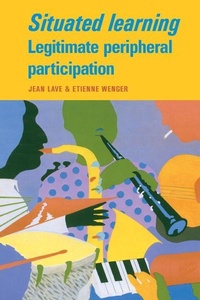
Situated Learning
Legitimate Peripheral Participation
Published on 27. September 1991
Book
Hardback
140 pages
978-0-521-41308-4 (ISBN)
Description
In this important theoretical treatist, Jean Lave, anthropologist, and Etienne Wenger, computer scientist, push forward the notion of situated learning - that learning is fundamentally a social process. The authors maintain that learning viewed as situated activity has as its central defining characteristic a process they call legitimate peripheral participation (LPP). Learners participate in communities of practitioners, moving toward full participation in the sociocultural practices of a community. LPP provides a way to speak about crucial relations between newcomers and old-timers and about their activities, identities, artefacts, knowledge and practice. The communities discussed in the book are midwives, tailors, quartermasters, butchers, and recovering alcoholics, however, the process by which participants in those communities learn can be generalised to other social groups.
Reviews / Votes
"...is undoubtedly worth reading. Lave and Wenger present an interesting and strong position on issues which are of basic interest to practice theory in a broader sense, and not just issues on learning and apprenticeship." Carsten Osterlund, NyhedsbrevMore details
Series
Language
English
Place of publication
Cambridge
United Kingdom
Target group
Professional and scholarly
Dimensions
Height: 235 mm
Width: 157 mm
Thickness: 12 mm
Weight
364 gr
ISBN-13
978-0-521-41308-4 (9780521413084)
Copyright in bibliographic data and cover images is held by Nielsen Book Services Limited or by the publishers or by their respective licensors: all rights reserved.
Schweitzer Classification
Other editions
Additional editions
E-Book
05/2013
1st Edition
Cambridge University Press
€32.49
Available for download
E-Book
09/1991
Cambridge University Press
€26.99
Available for download
Content
Acknowledgements; 1. Legitimate peripheral participation; 2. Practice, person, social world; 3. Midwives, tailors, quartermasters, butchers, non-drinking alcoholics; 4. Legitimate peripheral participation in communities of practice; 5. Conclusion; References; Index.