

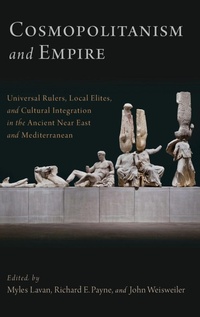
Cosmopolitanism and Empire
Universal Rulers, Local Elites, and Cultural Integration in the Ancient Near East and Mediterranean
Published on 3. November 2016
Book
Hardback
296 pages
978-0-19-046566-7 (ISBN)
Description
The empires of the ancient Near East and Mediterranean invented cosmopolitan politics. In the first millennia BCE and CE, a succession of territorially extensive states incorporated populations of unprecedented cultural diversity. Cosmopolitanism and Empire traces the development of cultural techniques through which empires managed difference in order to establish effective, enduring regimes of domination. It focuses on the relations of imperial elites with culturally distinct local elites, offering a comparative perspective on the varying depth and modalities of elite integration in five empires of the ancient Near East and Mediterranean. If cosmopolitanism has normally been studied apart from the imperial context, the essays gathered here show that theories and practices that enabled ruling elites to transcend cultural particularities were indispensable for the establishment and maintenance of trans-regional and trans-cultural political orders. As the first cosmopolitans, imperial elites regarded ruling over culturally disparate populations as their vocation, and their capacity to establish normative frameworks across cultural boundaries played a vital role in the consolidation of their power. Together with an introductory chapter which offers a theory and history of the relationship between empire and cosmopolitanism, the volume includes case studies of Assyrian, Seleukid, Ptolemaic, Roman, and Iranian empires that analyze encounters between ruling classes and their subordinates in the domains of language and literature, religion, and the social imaginary. The contributions combine to illustrate the dilemmas of difference that imperial elites confronted as well as their strategies for resolving the cultural contradictions that their regimes precipitated.
Reviews / Votes
Cosmopolitanism and Empire is unavoidable reading for any scholar whose research involves an ancient imperial context. But it deserves to be part of the discussion on contemporary cosmopolitanism too. * Nathanael Andrade, Bryn Mawr Classical Review * As a collection, Cosmopolitanism and Empire contributes immensely to the historical analysis of ancient empires, not least by providing a refreshing perspective on the mechanisms used to maintain the apparatus of empire. ... The editors arguably succeed in their mission to restore cosmopolitanism as a useful category of analysis for the ancient world. While this volume targets historians, its utility for archaeologists is evident in providing a new theoretical lens that can be used to examine material culture. * Matthew A. Winter, Archaeological Review from Cambridge *More details
Series
Language
English
Place of publication
New York
United States
Target group
College/higher education
Professional and scholarly
Illustrations
4 black-and-white line drawings
Dimensions
Height: 240 mm
Width: 161 mm
Thickness: 21 mm
Weight
614 gr
ISBN-13
978-0-19-046566-7 (9780190465667)
Copyright in bibliographic data and cover images is held by Nielsen Book Services Limited or by the publishers or by their respective licensors: all rights reserved.
Schweitzer Classification
Other editions
Additional editions
Myles Lavan | Richard E. Payne | John Weisweiler
Cosmopolitanism and Empire
Universal Rulers, Local Elites, and Cultural Integration in the Ancient Near East and Mediterranean
E-Book
09/2016
1st Edition
OUP eBook
€60.99
Available for download
Persons
Myles Lavan is Senior Lecturer in Ancient History at the University of St. Andrews and author of Slaves to Rome: Paradigms of Empire in Roman Culture.
Richard E. Payne is Neubauer Family Assistant Professor at the Oriental Institute and the Department of Near Eastern Languages and Civilizations at the University of Chicago and author of A State of Mixture: Christians, Zoroastrians, and Iranian Political Culture in Late Antiquity.
John Weisweiler is Assistant Professor in the Department of Ancient History at the University of Tuebingen.
Richard E. Payne is Neubauer Family Assistant Professor at the Oriental Institute and the Department of Near Eastern Languages and Civilizations at the University of Chicago and author of A State of Mixture: Christians, Zoroastrians, and Iranian Political Culture in Late Antiquity.
John Weisweiler is Assistant Professor in the Department of Ancient History at the University of Tuebingen.
Editor
Senior Lecturer in Ancient HistorySenior Lecturer in Ancient History, University of St. Andrews
Neubauer Family Assistant ProfessorNeubauer Family Assistant Professor, Oriental Institute, University of Chicago
Assistant Professor of Ancient HistoryAssistant Professor of Ancient History, University of Tuebingen
Content
Table of Contents
List of contributors
1. Cosmopolitan Politics: The Assimilation and Subordination of Elite Cultures
Myles Lavan, Richard Payne, John Weisweiler
2. Getting Confident: The Assyrian Development of Elite Recognition Ethics
Seth Richardson
3. Empire Begins at Home: Local Elites and Imperial Ideologies in Hellenistic Greece and Babylonia
Kathryn Stevens
4. Hellenism, Cosmopolitanism and the Role of Babylonian Elites in the Seleucid Empire
Johannes Haubold
5. Towards a Translocal Elite Culture in the Ptolemaic Empire
Christelle Fischer-Bovet
6. What is Imperial Cosmopolitanism?
Tamara Chin
7. "Father of the Whole Human Race": Ecumenical Language and the Limits of Elite Integration in the Early Roman Empire
Myles Lavan
8. Making Romans: Citizens, Subjects and Subjectivity in Republican Empire
Clifford Ando
9. From Empire to World State: Ecumenical Language and Cosmopolitan Consciousness in the Later Roman Aristocracy
John Weisweiler
10. Iranian Cosmopolitanism: World Religions at the Sasanian Court
Richard Payne
11. "Zum ewigen Frieden": Cosmopolitanism, Comparison and Empire
Peter Fibiger Bang
Works cited
Index
List of contributors
1. Cosmopolitan Politics: The Assimilation and Subordination of Elite Cultures
Myles Lavan, Richard Payne, John Weisweiler
2. Getting Confident: The Assyrian Development of Elite Recognition Ethics
Seth Richardson
3. Empire Begins at Home: Local Elites and Imperial Ideologies in Hellenistic Greece and Babylonia
Kathryn Stevens
4. Hellenism, Cosmopolitanism and the Role of Babylonian Elites in the Seleucid Empire
Johannes Haubold
5. Towards a Translocal Elite Culture in the Ptolemaic Empire
Christelle Fischer-Bovet
6. What is Imperial Cosmopolitanism?
Tamara Chin
7. "Father of the Whole Human Race": Ecumenical Language and the Limits of Elite Integration in the Early Roman Empire
Myles Lavan
8. Making Romans: Citizens, Subjects and Subjectivity in Republican Empire
Clifford Ando
9. From Empire to World State: Ecumenical Language and Cosmopolitan Consciousness in the Later Roman Aristocracy
John Weisweiler
10. Iranian Cosmopolitanism: World Religions at the Sasanian Court
Richard Payne
11. "Zum ewigen Frieden": Cosmopolitanism, Comparison and Empire
Peter Fibiger Bang
Works cited
Index