

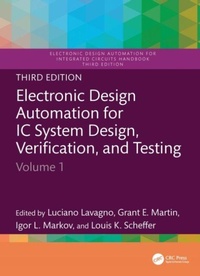
Electronic Design Automation for Integrated Circuits Handbook
Volume 1
3rd Edition
Will be published approx. on 30. June 2026
Book
Hardback
689 pages
978-1-041-00213-0 (ISBN)
Description
Electronic Design Automation for IC System Design, Verification, and Testing, the first of two volumes in the Electronic Design Automation for Integrated Circuits Handbook, Third Edition, thoroughly examines system-level design, microarchitectural design, logic verification, and testing. Chapters contributed by leading experts authoritatively discuss processor modeling and design tools, using performance metrics to select microprocessor cores for integrated circuit (IC) designs, design and verification languages, hardware acceleration and emulation, and much more.
New to This Edition:
Major updates appearing in the initial phases of the design flow, where the level of abstraction keeps rising to support more functionality with lower non-recurring engineering (NRE) costs
Significant revisions reflected in the final phases of the design flow, where the complexity due to smaller and smaller geometries is compounded by the slow progress of shorter wavelength lithography
New coverage of cutting-edge applications and approaches realized in the decade since the publication of the second edition-these are illustrated by updates including the impact of AI/ML, new high-level synthesis algorithms, and RISC-V in various chapters
Offering improved depth and modernity, this book provides a valuable, state-of-the-art reference for electronic design automation (EDA) students, researchers, and professionals.
New to This Edition:
Major updates appearing in the initial phases of the design flow, where the level of abstraction keeps rising to support more functionality with lower non-recurring engineering (NRE) costs
Significant revisions reflected in the final phases of the design flow, where the complexity due to smaller and smaller geometries is compounded by the slow progress of shorter wavelength lithography
New coverage of cutting-edge applications and approaches realized in the decade since the publication of the second edition-these are illustrated by updates including the impact of AI/ML, new high-level synthesis algorithms, and RISC-V in various chapters
Offering improved depth and modernity, this book provides a valuable, state-of-the-art reference for electronic design automation (EDA) students, researchers, and professionals.
More details
Edition
3rd edition
Language
English
Place of publication
London
United Kingdom
Publishing group
Taylor & Francis Ltd
Target group
College/higher education
General
Illustrations
19 farbige Abbildungen, 9 s/w Photographien bzw. Rasterbilder, 237 s/w Zeichnungen, 19 farbige Zeichnungen, 41 s/w Tabellen, 246 s/w Abbildungen
41 Tables, black and white; 19 Line drawings, color; 237 Line drawings, black and white; 9 Halftones, black and white; 19 Illustrations, color; 246 Illustrations, black and white
Dimensions
Height: 280 mm
Width: 210 mm
ISBN-13
978-1-041-00213-0 (9781041002130)
Copyright in bibliographic data and cover images is held by Nielsen Book Services Limited or by the publishers or by their respective licensors: all rights reserved.
Schweitzer Classification
Other editions
Additional editions
Luciano Lavagno | Grant E. Martin | Igor L. Markov
Electronic Design Automation for Integrated Circuits Handbook
Volume 1
E-Book
approx. 06/2026
3rd Edition
CRC Press
€231.99
Available for download
Luciano Lavagno | Grant E. Martin | Igor L. Markov
Electronic Design Automation for Integrated Circuits Handbook
Volume 1
E-Book
approx. 06/2026
3rd Edition
CRC Press
€231.99
Available for download
Previous edition
Luciano Lavagno | Igor L. Markov | Grant Martin
Electronic Design Automation for IC System Design, Verification, and Testing
Book
04/2016
2nd Edition
CRC Press
€326.83
Article not available for order
Persons
Luciano Lavagno received his Ph.D. in EECS from U.C. Berkeley in 1992 and from Politecnico di Torino in 1993. He co-authored two books on asynchronous circuit design, a book on hardware/software co-design of embedded systems, and over 250 scientific papers. Between 1993 and 2000 he was the architect of the POLIS project, a cooperation between U.C. Berkeley, Cadence Design Systems, Magneti Marelli and Politecnico di Torino, which developed a complete hardware/software co-design environment for control-dominated embedded systems. Between 2003 and 2014 he was one of the creators and architects of the Cadence CtoSilicon high-level synthesis system. Since 2011, Dr. Lavagno has been a full professor with Politecnico di Torino, Italy. He has served on the technical committees of several international conferences in his field (e.g. DAC, DATE, ICCAD, ICCD, ASYNC, CODES) as well as various workshops and symposia and is a senior member of IEEE. He has also been an associate editor of IEEE TCAS and ACM TECS. His research interests include the high-level synthesis of digital circuits and the acceleration of Machine learning algorithms using Field Programmable Gate Arrays.
Grant E. Martin retired from his position as a distinguished engineer at Cadence Design Systems, Inc., San Jose, California, USA, in 2023. Before that, Grant worked for Burroughs in Scotland for 6 years; Nortel/Bell-Northern Research in Canada for 10 years; Cadence Design Systems for 9 years, eventually becoming a fellow in their labs; and Tensilica for 9 years. He rejoined Cadence in 2013 when it acquired Tensilica, and has been there since, working in the Tensilica part of the Cadence Intellectual Property Group. He received his bachelor's and master's degrees in mathematics (combinatorics and optimization) from the University of Waterloo, Ontario, Canada, in 1977 and 1978. Grant has coauthored and coedited several books, including the first-ever book on system-on-chip (SoC) design published in Russian. He has also presented many papers, talks, and tutorials, and participated in panels at several major conferences. He cochaired the VSI Alliance Embedded Systems Study Group in the summer of 2001 and was co-chair of the Design Automation Conference Technical Program Committee for Methods for 2005 and 2006. He is a senior member of IEEE. Although retired, he continues to have an interest in system-level design, IP-based design of system-on-chip, platform-based design, DSP, baseband and image processing, and embedded software.
Grant E. Martin retired from his position as a distinguished engineer at Cadence Design Systems, Inc., San Jose, California, USA, in 2023. Before that, Grant worked for Burroughs in Scotland for 6 years; Nortel/Bell-Northern Research in Canada for 10 years; Cadence Design Systems for 9 years, eventually becoming a fellow in their labs; and Tensilica for 9 years. He rejoined Cadence in 2013 when it acquired Tensilica, and has been there since, working in the Tensilica part of the Cadence Intellectual Property Group. He received his bachelor's and master's degrees in mathematics (combinatorics and optimization) from the University of Waterloo, Ontario, Canada, in 1977 and 1978. Grant has coauthored and coedited several books, including the first-ever book on system-on-chip (SoC) design published in Russian. He has also presented many papers, talks, and tutorials, and participated in panels at several major conferences. He cochaired the VSI Alliance Embedded Systems Study Group in the summer of 2001 and was co-chair of the Design Automation Conference Technical Program Committee for Methods for 2005 and 2006. He is a senior member of IEEE. Although retired, he continues to have an interest in system-level design, IP-based design of system-on-chip, platform-based design, DSP, baseband and image processing, and embedded software.
Content
1. Overview. 2. Integrated Circuit Design Process and Electronic Design Automation. Section 1. System-Level Design. 3. Tools and Methodologies for System-Level Design. 4. System-Level Specification and Modeling Languages. 5. SoC Block-Based Design and IP Assembly. 6. Performance Evaluation Methods for Multiprocessor System-on-Chip Designs. 7. System-Level Power Management. 8. Processor Modeling and Design Tools. 9. Models and Tools for Complex Embedded Software and Systems. 10. System-Level Design. 11. High-Level Synthesis. Section II. Micro-Architecture Design. 12. SystemC Models and Annotations. 13. Micro-Architectural and System-Level Power Estimation and Optimization. 14. Design Planning. Section III. Logic Verification. 15. Design and Verification Languages. 16. Digital Simulation. 17. Gearing up with Digital Twins: From SoC Shift Left to System-of-Systems Quality. 18. Assertion-Based Verification. 19. Hardware-Assisted Verification and Software Development. 20. Formal Property Verification. Section IV. Test. 21. Design-for-Test. 22. Automatic Test Pattern Generation. 23. Analog and Mixed-Signal Test.