

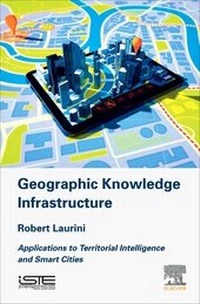
Geographic Knowledge Infrastructure
Applications to Territorial Intelligence and Smart Cities
Published on 24. March 2017
Book
Hardback
312 pages
978-1-78548-243-4 (ISBN)
Description
Geographic Knowledge Engineering: Applications to Territorial Intelligence and Smart Cities studies the specific nature of geographic knowledge and the structure of geographic knowledge bases. Geographic relations, ontologies, gazetteers and rules are detailed as the basic components of such bases, and these rules are defined to develop our understanding of the mechanisms of geographic reasoning. The book examines various problems linked to geovisualization, chorems, visual querying and interoperability to shape knowledge infrastructure for smart governance.
More details
Language
English
Place of publication
United Kingdom
Target group
Professional and scholarly
GIS researchers, GIS students, GIS specialists,
Specialists and students in information technology and artificial intelligence
Dimensions
Height: 229 mm
Width: 152 mm
Weight
630 gr
ISBN-13
978-1-78548-243-4 (9781785482434)
Copyright in bibliographic data and cover images is held by Nielsen Book Services Limited or by the publishers or by their respective licensors: all rights reserved.
Schweitzer Classification
Other editions
Additional editions
Robert Laurini
Geographic Knowledge Infrastructure
Applications to Territorial Intelligence and Smart Cities
E-Book
04/2017
Elsevier
€91.95
Available for download
Person
Robert Laurini is a world-renowned specialist in geographic information systems on which he has written several books and more than 200 papers. His research focuses on geographic knowledge and rule engineering for smart cities and territorial intelligence.
Content
1. From Geodata to Geographic Knowledge
2. Knowledge Representation
3. Towards Geographic Knowledge Systems
4. Geographic Objects
5. Geographic Relations
6. Geographic Ontologies
7. Complex Geographic Objects and Structures
8. Gazetteers and Multilingualism
9. Geographic Knowledge Discovery and Data Mining
10. Geographic Applicative Rules
11. Geovisualization and Chorems
12. GKS: Querying and Interoperability
13. Conclusion: Knowledge as Infrastructure for Smart Governance
2. Knowledge Representation
3. Towards Geographic Knowledge Systems
4. Geographic Objects
5. Geographic Relations
6. Geographic Ontologies
7. Complex Geographic Objects and Structures
8. Gazetteers and Multilingualism
9. Geographic Knowledge Discovery and Data Mining
10. Geographic Applicative Rules
11. Geovisualization and Chorems
12. GKS: Querying and Interoperability
13. Conclusion: Knowledge as Infrastructure for Smart Governance