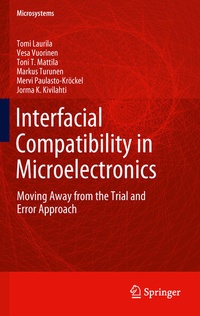
Interfaces between dissimilar materials are met everywhere in microelectronics and microsystems. In order to ensure faultless operation of these highly sophisticated structures, it is mandatory to have fundamental understanding of materials and their interactions in the system. In this difficult task, the "traditional" method of trial and error is not feasible anymore; it takes too much time and repeated efforts. In
Interfacial Compatibility in Microelectronics
, an alternative approach is introduced.
In this revised method four fundamental disciplines are combined: i) thermodynamics of materials ii) reaction kinetics iii) theory of microstructures and iv) stress and strain analysis. The advantages of the method are illustrated in
Interfacial Compatibility in Microelectronics
which includes:
solutions to several common reliability issues in microsystem technology,
methods to understand and predict failure mechanisms at interfaces between dissimilar materials and
an approach to DFR based on deep understanding in materials science, rather than on the use of mechanistic tools, such as FMEA.
Interfacial Compatibility in Microelectronics provides a clear and methodical resource for graduates and postgraduates alike.
Series
Edition
Language
Place of publication
Target group
Professional and scholarly
Research
Illustrations
Dimensions
Height: 235 mm
Width: 155 mm
Thickness: 13 mm
Weight
ISBN-13
978-1-4471-6068-7 (9781447160687)
DOI
10.1007/978-1-4471-2470-2
Schweitzer Classification
Aloke Paul is an associate professor in the Department of Materials Engineering, Indian Institute of Science (IISc), Bangalore, India. Professor Aloke Paul is currently running an active research group working on diffusion related problems with major areas of research including developing new phenomenological models in solid-state diffusion, materials in electronic packaging, bond coat in jet engine applications and growth of A15 intermetallic superconductors. He teaches a postgraduate level course on diffusion in solids and has guided several PhD and ME students. He has co-authored more than 80 articles in various international journals.
Professor Tomi Laurila received his D.Sc. degree (with honours) in electronics production technology from the Helsinki University of Technology in 2001. He presently works as a teaching scientist in the group of Electronics Integration and Reliability and holds an adjunct professorship on Electronics Reliability and Manufacturing. His research currently involves the study of interfacial reactions between dissimilar materials used in micro and bioelectronics. He has published extensively, including around 70 scientific papers, book chapters and a text book, on topics such as the thermodynamic-kinetic analysis of interfacial reactions, electrochemical detection of biomolecules and issues related to reliability testing of electronic devices. Professor Laurila is also responsible for the teaching of material science, electronics reliability and bio-adaptive technology to undergraduate, postgraduate and postdoctoral students.
Dr. Vesa Vuorinen received a D.Sc. degree in electronics production technology from the Helsinki University of Technology in 2006. Since then he has been working as a research scientist and full-time teacher in the group of Electronics Integration and Reliability at Aalto University. His research includes manufacturing and reliability of high-density electronics assemblies with emphasis on soldering metallurgy and thermodynamics of materials.
Dr. Sergiy Divinski is a Privat-Docent at the Institute of Materials Physics, University of Münster, Germany, where he leads the radiotracer laboratory. He teaches graduate and postgraduate courses on diffusion in solids, numerical methods in material science and different aspects of materials science. He has co-authored more than 150 articles in various international journals and several book chapters in the field of diffusion in solids.