

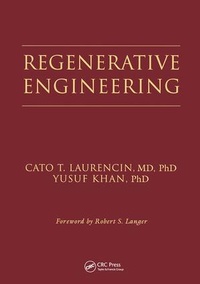
Regenerative Engineering
1st Edition
Published on 20. June 2013
Book
Hardback
436 pages
978-1-4398-1412-3 (ISBN)
Description
Distinct from tissue engineering, which focuses primarily on the repair of tissues, regenerative engineering focuses on the regeneration of tissues: creating living, functional tissue that has the ability to replace organs that are dysfunctional. The challenge of working in an area like regenerative engineering lies, in part, in the breadth of information required to truly appreciate and begin to think about this field. Regenerative Engineering introduces the field through the presentation of fundamental concepts of cell biology, stem cell science, materials science, and cell-material interactions. It also focuses on specific organ and tissue types and presents up-to-date examples of ongoing work, often in the context of a specific clinical need.
Regenerative medicine focuses on the biological aspects of tissue regeneration via stem cells, factors, and cytokines, while tissue engineering focuses on the integration of materials science and life sciences. This book integrates these two areas, presenting each concept in the framework of regenerative engineering.
Features:
Covers a number of cutting-edge topics related to regenerative medicine and tissue engineering
Includes an introductory chapter on materials science
Features a number of the contributors who are world-class researchers, one of whom is Dr. Anthony Atala, whose work dealing with organ regenerative engineering was featured on Sixty Minutes
Incorporates problem-based learning throughout the text, which is not hypothetical but based on actual biological, engineering, or clinical scenarios
Combining science, engineering and medicine, Regenerative Engineering incorporates all of the essential elements needed for further advancement in this field. The book explores the development and examination of vital organs and tissue types and addresses concerns as it relates to the regenerative engineering of various organ tissues, vascular tissues, bone, ligament, neural tissue, and the interfaces between tissues.
Regenerative medicine focuses on the biological aspects of tissue regeneration via stem cells, factors, and cytokines, while tissue engineering focuses on the integration of materials science and life sciences. This book integrates these two areas, presenting each concept in the framework of regenerative engineering.
Features:
Covers a number of cutting-edge topics related to regenerative medicine and tissue engineering
Includes an introductory chapter on materials science
Features a number of the contributors who are world-class researchers, one of whom is Dr. Anthony Atala, whose work dealing with organ regenerative engineering was featured on Sixty Minutes
Incorporates problem-based learning throughout the text, which is not hypothetical but based on actual biological, engineering, or clinical scenarios
Combining science, engineering and medicine, Regenerative Engineering incorporates all of the essential elements needed for further advancement in this field. The book explores the development and examination of vital organs and tissue types and addresses concerns as it relates to the regenerative engineering of various organ tissues, vascular tissues, bone, ligament, neural tissue, and the interfaces between tissues.
Reviews / Votes
"This is a good book to have on your bookcase so that it can be easily handed to a student or young investigator. I foresee this book as a stepping off point to stimulate interest in a field that is rapidly evolving and is likely to have a significant impact on our ability to treat disease, disfigurement and trauma in the future."-Biomaterials Forum, Fourth Quarter 2013
"This book gives historical precedence for tissue engineering while providing the most up-to-date clinical examples. It is nice to see tissue engineering strategies that are tissue-specific, as the design requirements of clinical solutions will depend largely on the tissue of interest. This book is ideal for introductory coursework or reference for the initiate in the field of tissue engineering. ... The authors are leaders in their respective fields and have knowledge of both the breadth and depth of tissue engineering strategies. The text is well-organized and will fit well into most introductory biomaterials/tissue engineering courses around the country."-Laura Suggs, University of Texas at Austin, USA
"The text is well written and succinct. The references are up to date. Given the background of the senior editor as an orthopaedic surgeon, clinical details are provided in most of the chapters in a highly readable manner, and this can be useful for the non-clinician user."
-The Journal of Histotechnology, March 2014 "This is a good book to have on your bookcase so that it can be easily handed to a student or young investigator. I foresee this book as a stepping off point to stimulate interest in a field that is rapidly evolving and is likely to have a significant impact on our ability to treat disease, disfigurement and trauma in the future."
-Biomaterials Forum, Fourth Quarter 2013
"This book gives historical precedence for tissue engineering while providing the most up-to-date clinical examples. It is nice to see tissue engineering strategies that are tissue-specific, as the design requirements of clinical solutions will depend largely on the tissue of interest. This book is ideal for introductory coursework or reference for the initiate in the field of tissue engineering. ... The authors are leaders in their respective fields and have knowledge of both the breadth and depth of tissue engineering strategies. The text is well-organized and will fit well into most introductory biomaterials/tissue engineering courses around the country."-Laura Suggs, University of Texas at Austin, USA
"The text is well written and succinct. The references are up to date. Given the background of the senior editor as an orthopaedic surgeon, clinical details are provided in most of the chapters in a highly readable manner, and this can be useful for the non-clinician user."
-The Journal of Histotechnology, March 2014
More details
Language
English
Place of publication
Bosa Roca
United States
Publishing group
Taylor & Francis Inc
Target group
College/higher education
Students in tissue engineering, biomaterials and regenerative medicine, scientist and researchers in regenerative engineering.
Illustrations
114 farbige Abbildungen, 10 farbige Tabellen
10 Tables, color; 114 Illustrations, color
Dimensions
Height: 254 mm
Width: 178 mm
Weight
1086 gr
ISBN-13
978-1-4398-1412-3 (9781439814123)
Copyright in bibliographic data and cover images is held by Nielsen Book Services Limited or by the publishers or by their respective licensors: all rights reserved.
Schweitzer Classification
Other editions
Additional editions
Cato T. Laurencin | Yusuf Khan
Regenerative Engineering
Book
11/2018
1st Edition
CRC Press
€95.63
Shipment within 10-20 days
Cato T. Laurencin | Yusuf Khan
Regenerative Engineering
E-Book
06/2013
1st Edition
CRC Press
€80.49
Available for download
Cato T. Laurencin | Yusuf Khan
Regenerative Engineering
E-Book
06/2013
CRC Press
€80.49
Available for download
Persons
Cato T. Laurencin, MD, PhD, earned his BSE in chemical engineering from Princeton University, his PhD in biochemical engineering/biotechnology from the Massachusetts Institute of Technology, and his MD magna cum laude from Harvard Medical School. Dr. Laurencin is currently the chief executive officer of the Connecticut Institute for Clinical and Translational Science and director of the Institute for Regenerative Engineering at the University of Connecticut. He previously served as the vice president for health affairs and dean of the School of Medicine. He is a university professor and holds the Van Dusen Endowed Chair in the Department of Orthopaedic Surgery.
Yusuf Khan
, PhD, earned his master's degree and PhD from Drexel University in biomedical engineering. He is currently an assistant professor at the Institute for Regenerative Engineering and the Department of Orthopaedic Surgery at the University of Connecticut Health Center. He has an appointment in the Department of Chemical, Materials, and Biomolecular Engineering and is part of the Department of Biomedical Engineering within the School of Engineering at the University of Connecticut. His research interests include musculoskeletal tissue regeneration using implantable biodegradable scaffolds, development of composite structures for bone regeneration, and the development of clinically relevant healing modalities using ultrasound.
Yusuf Khan
, PhD, earned his master's degree and PhD from Drexel University in biomedical engineering. He is currently an assistant professor at the Institute for Regenerative Engineering and the Department of Orthopaedic Surgery at the University of Connecticut Health Center. He has an appointment in the Department of Chemical, Materials, and Biomolecular Engineering and is part of the Department of Biomedical Engineering within the School of Engineering at the University of Connecticut. His research interests include musculoskeletal tissue regeneration using implantable biodegradable scaffolds, development of composite structures for bone regeneration, and the development of clinically relevant healing modalities using ultrasound.
Content
Regenerative Engineering: The Future of Medicine. Cell Biology. Stem Cells and Tissue Regeneration. Introduction to Materials Science. Biomaterials. In Vitro Assessment of Cell-Biomaterial Interactions. Host Response to Biomaterials and Its Implications in Regenerative Engineering. Organ Regenerative Engineering: Cell Sources, Considerations, and Strategies. Cardiovascular Regenerative Engineering. Bone Regenerative Engineering. Engineering Tissue-to-Tissue Interfaces. Neural Regenerative Engineering. Ligament Regenerative Engineering. Skeletal Muscle Regenerative Engineering. Engineering Limb Regeneration: Lessons from Animals That Can Regenerate. Index.