

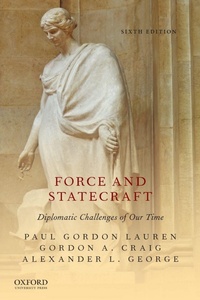
Force and Statecraft
Diplomatic Challenges of Our Time
6th Edition
Published on 24. June 2021
Book
Paperback/Softback
352 pages
978-0-19-006263-7 (ISBN)
Description
Force and Statecraft: Diplomatic Challenges of Our Time, Sixth Edition, is a stimulating, highly readable, and insightful analysis of humanity's quest for peace and security. Its unique interdisciplinary approach combines history, political science, international law, and philosophy in order to explore the rich experience of the past and consider how it can be brought to bear on the diplomatic challenges that we confront in our world today.
This new edition makes a classic even better. It provides an up-to-date treatment of the most recent and significant international developments, including:
- the profound impact of the foreign policies of three individuals: Donald Trump of the United States, Xi Jinping of China, and Vladimir Putin of Russia
- growing fears of nuclear proliferation in North Korea and Iran, "Brexit" and divisions within the European Union and NATO, the civil war in Syria, the Islamic State (ISIS), and other terrorist groups
- updated and thought-provoking coverage of the instruments of statecraft, the multiple dimensions of power, the nature of security (including "the security dilemma" and the "indivisibility of security"), the changing features of sovereignty, and the role of normative values as seen in ethical restraints, concepts of legitimacy, international law, and norms of human rights
- evolving challenges for force and statecraft presented by weapons of mass destruction, the diplomatic revolution, the "digital revolution," cyberattacks, climate change, and the global pandemic of COVID-19
This new edition makes a classic even better. It provides an up-to-date treatment of the most recent and significant international developments, including:
- the profound impact of the foreign policies of three individuals: Donald Trump of the United States, Xi Jinping of China, and Vladimir Putin of Russia
- growing fears of nuclear proliferation in North Korea and Iran, "Brexit" and divisions within the European Union and NATO, the civil war in Syria, the Islamic State (ISIS), and other terrorist groups
- updated and thought-provoking coverage of the instruments of statecraft, the multiple dimensions of power, the nature of security (including "the security dilemma" and the "indivisibility of security"), the changing features of sovereignty, and the role of normative values as seen in ethical restraints, concepts of legitimacy, international law, and norms of human rights
- evolving challenges for force and statecraft presented by weapons of mass destruction, the diplomatic revolution, the "digital revolution," cyberattacks, climate change, and the global pandemic of COVID-19
Reviews / Votes
This is the best book in terms of its organization, writing, and quality of ideas as well as a superb framing of the problems and issues in the field. * John D. Stempel, University of Kentucky * Force and Statecraft is the best book available for the study of diplomacy as a topic within political science. It does a very good job of offering rich history, theory, and details to the subject matter. * James Ketterer, Bard College* Force and Statecraft is well-written, clear, and insightful. It is an exemplary textbook, and provides a wonderful historical rounding for students of international politics. * Stephen Macekura, Indiana University
* Force and Statecraft is a great book. It puts diplomacy front and center in the analysis and examines how individual state leaders navigate the challenges of international politics. * Steven Weber, University of California, Berkeley *
More details
Edition
6th Revised edition
Language
English
Place of publication
New York
United States
Target group
College/higher education
Edition type
Revised edition
Dimensions
Height: 234 mm
Width: 156 mm
Thickness: 20 mm
Weight
538 gr
ISBN-13
978-0-19-006263-7 (9780190062637)
Copyright in bibliographic data and cover images is held by Nielsen Book Services Limited or by the publishers or by their respective licensors: all rights reserved.
Schweitzer Classification
Persons
Paul Gordon Lauren is Regents Professor Emeritus and Distinguished Mansfield Fellow at the University of Montana. He is an internationally acclaimed teacher and scholar of diplomacy, issues of security and peace, and human rights, whose work has been translated into numerous languages and nominated for a Pulitzer Prize.
The late Gordon A. Craig was the J.E. Wallace Sterling Professor of Humanities at Stanford University, a renowned scholar and gifted teacher of diplomatic history, German history, and international relations, who served as the president of the American Historical Association.
The late Alexander L. George was the Graham H. Stuart Professor of International Relations at Stanford University, widely known for his pioneering and award-winning work in political science, psychology, influence, and foreign policy, and former president of the International Studies Association.
The late Gordon A. Craig was the J.E. Wallace Sterling Professor of Humanities at Stanford University, a renowned scholar and gifted teacher of diplomatic history, German history, and international relations, who served as the president of the American Historical Association.
The late Alexander L. George was the Graham H. Stuart Professor of International Relations at Stanford University, widely known for his pioneering and award-winning work in political science, psychology, influence, and foreign policy, and former president of the International Studies Association.
Content
Preface to the Sixth Edition
Introduction PART ONE: FROM THE PAST TO THE PRESENT Chapter 1: The Emergence of Diplomacy and the Great Powers The Early Practices, Techniques, and Ideas of Diplomacy
War, States, and Raison d'etat in the Seventeenth Century
War and Competition in the Eighteenth Century Chapter 2: The Classical System of Diplomacy, 1815-1914 Building a System with a Balance of Power and a Concert
Change and an Experiment with a Defensive Alliance System
Further Change and an Experiment with Bipolar Alignment
Characteristics of the System Chapter 3: The Diplomatic Revolution Begins, 1919-1939 Attempts at Peacemaking and System Building
Public Opinion and "Public Diplomacy"
Economics and "Economic Diplomacy"
A Dialogue des Sourds with Contrasting Norms and Objectives Chapter 4: A Postwar System of Security: Great Power Directorate or United Nations? Lessons from the Past and Plans for the Future
Force and Statecraft as Envisioned by the UN Charter
Changing World Conditions and Readjustments Chapter 5: The Cold War The Origins and Escalation of the Cold War
Seeking Restraints Through Deterrence, Diplomacy, and Detente
Persistent Problems and the Final Demise of the Cold War Chapter 6: The Evolving International System
"A World in a Rapid State of Transition"
Challenges to Nation-States and National Sovereignty
Terrorists and the "Global War on Terror"
Partners and/or Rivals? PART TWO: HISTORY, THEORY, AND PRACTICE Chapter 7: Lessons of History and Knowledge for Statecraft Classical Writers on the Importance of Historical Lessons
The Historical Habit of Mind
The Challenges of Learning and Applying Lessons of History
Structured, Focused Comparisons Chapter 8: Negotiation Principles of Negotiation
The Congress of Vienna, 1814-1815
The Conference on Security and Cooperation in Europe, 1972-1975
Contemporary Negotiations Over Nuclear Weapons in North Korea
Analysis Chapter 9: Deterrence Principles of Deterrence
Collective Security for the Post-1815 Settlement
British and French Attempts to Deter Hitler, 1939
Contemporary American Deterrence Over Taiwan
Analysis Chapter 10: Coercive Diplomacy Principles of Coercive Diplomacy
American "Gunboat Diplomacy," 1852-1854
The Cuban Missile Crisis, 1962
Contemporary Coercion Against Iran and Its Nuclear Program
Analysis Chapter 11: Crisis Management Principles of Crisis Management
Bismarck as an "Honest Broker" in the Crisis of 1878
The "Guns of August," 1914
Terrorism and the Mumbai Crisis, 2008
Analysis PART THREE: RESTRAINTS AND REFLECTIONS Chapter 12: Ethics and Other Restraints on Force and Statecraft Practical, Structural, and Political Restraints
Ethics and International Politics
Ethical Restraints for Statecraft
Ethical Restraints for Armed Force Conclusion: Reflections on Force and Statecraft and the Challenges of Our Time Credits
Index
Introduction PART ONE: FROM THE PAST TO THE PRESENT Chapter 1: The Emergence of Diplomacy and the Great Powers The Early Practices, Techniques, and Ideas of Diplomacy
War, States, and Raison d'etat in the Seventeenth Century
War and Competition in the Eighteenth Century Chapter 2: The Classical System of Diplomacy, 1815-1914 Building a System with a Balance of Power and a Concert
Change and an Experiment with a Defensive Alliance System
Further Change and an Experiment with Bipolar Alignment
Characteristics of the System Chapter 3: The Diplomatic Revolution Begins, 1919-1939 Attempts at Peacemaking and System Building
Public Opinion and "Public Diplomacy"
Economics and "Economic Diplomacy"
A Dialogue des Sourds with Contrasting Norms and Objectives Chapter 4: A Postwar System of Security: Great Power Directorate or United Nations? Lessons from the Past and Plans for the Future
Force and Statecraft as Envisioned by the UN Charter
Changing World Conditions and Readjustments Chapter 5: The Cold War The Origins and Escalation of the Cold War
Seeking Restraints Through Deterrence, Diplomacy, and Detente
Persistent Problems and the Final Demise of the Cold War Chapter 6: The Evolving International System
"A World in a Rapid State of Transition"
Challenges to Nation-States and National Sovereignty
Terrorists and the "Global War on Terror"
Partners and/or Rivals? PART TWO: HISTORY, THEORY, AND PRACTICE Chapter 7: Lessons of History and Knowledge for Statecraft Classical Writers on the Importance of Historical Lessons
The Historical Habit of Mind
The Challenges of Learning and Applying Lessons of History
Structured, Focused Comparisons Chapter 8: Negotiation Principles of Negotiation
The Congress of Vienna, 1814-1815
The Conference on Security and Cooperation in Europe, 1972-1975
Contemporary Negotiations Over Nuclear Weapons in North Korea
Analysis Chapter 9: Deterrence Principles of Deterrence
Collective Security for the Post-1815 Settlement
British and French Attempts to Deter Hitler, 1939
Contemporary American Deterrence Over Taiwan
Analysis Chapter 10: Coercive Diplomacy Principles of Coercive Diplomacy
American "Gunboat Diplomacy," 1852-1854
The Cuban Missile Crisis, 1962
Contemporary Coercion Against Iran and Its Nuclear Program
Analysis Chapter 11: Crisis Management Principles of Crisis Management
Bismarck as an "Honest Broker" in the Crisis of 1878
The "Guns of August," 1914
Terrorism and the Mumbai Crisis, 2008
Analysis PART THREE: RESTRAINTS AND REFLECTIONS Chapter 12: Ethics and Other Restraints on Force and Statecraft Practical, Structural, and Political Restraints
Ethics and International Politics
Ethical Restraints for Statecraft
Ethical Restraints for Armed Force Conclusion: Reflections on Force and Statecraft and the Challenges of Our Time Credits
Index