

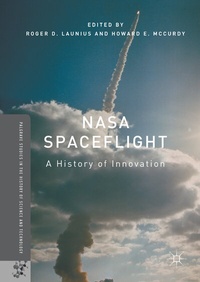
NASA Spaceflight
A History of Innovation
Published on 23. October 2017
Book
Hardback
XXIII, 402 pages
978-3-319-60112-0 (ISBN)
Description
This book presents the first comprehensive history of innovation at NASA, bringing together experts in the field to illuminate how public-private and international partnerships have fueled new ways of exploring space since the beginning of space travel itself. Twelve case studies trace the messy, risky history of such partnerships, exploring the role of AT&T in the early development of satellite technology, the connections between the Apollo program and Silicon Valley, the rise of SpaceX, and more. Some of these projects have succeeded, and some have failed; all have challenged conventional methods of doing the public's business in space. Together, these essays offer new insights into how innovation happens, with invaluable lessons for policymakers, investors, economists, and members of the space community.
Reviews / Votes
"This book offers an amazingly comprehensive, exquisitely detailed history of our space program, told in a series of programmatic vignettes. Launius and McCrudy have done a masterful job of pulling together a narrative that touches on technology milestones and decision points that shaped our nation's past and pending future in space. It is especially noteworthy in that key technology developments are discussed in the broader context of national policy, highlighting not only the engineering considerations, but also the sometimes larger-than-life personalities behind some of our space program's greatest accomplishments. It should be required reading for all students of aerospace history and space policy." (Mark J. Lewis, Director of the Science and Technology Policy Institute, Institute for Defense Analyses, USA)"This book is a virtual singularity. Launius and McCurdy are the gold standard of space history and space policy scholarship, and they have assembled a notable group of historians and policy analysts to trace NASA's role in the development of high technology. They offer fascinating commentary on what has been done to date, as well as an indispensable reference for managers, administrators, and practitioners planning the next stage in America's space enterprise. Pointing to future trends in aerospace policy and scholarship, it will be an authority for decades to come." (Richard P. Hallion, Florida Polytechnic University, USA)
More details
Series
Edition
1st ed. 2018
Language
English
Place of publication
Cham
Switzerland
Publishing group
Springer International Publishing
Target group
Professional and scholarly
Illustrations
8 s/w Abbildungen, 33 farbige Abbildungen
XXIII, 402 p. 41 illus., 33 illus. in color.
Dimensions
Height: 216 mm
Width: 153 mm
Thickness: 28 mm
Weight
663 gr
ISBN-13
978-3-319-60112-0 (9783319601120)
DOI
10.1007/978-3-319-60113-7
Schweitzer Classification
Other editions
Additional editions
Book
08/2018
Palgrave Macmillan
€139.09
Shipment within 10-15 days
E-Book
10/2017
Palgrave Macmillan
€128.39
Available for download
Persons
Roger D. Launius has written or edited more than thirty books on aerospace history, most recently
Historical Analogs for the Stimulation of Space Commerce
(2014), and
Space Shuttle Legacy: How We Did It and What We Learned
(2013).
Howard E. McCurdy is Professor in the School of Public Affairs at American University, USA. He is the author of numerous works on the national space program, including Inside NASA (1993), Faster, Better, Cheaper (2001), and Space and the American Imagination (rev. ed. 2011).
Howard E. McCurdy is Professor in the School of Public Affairs at American University, USA. He is the author of numerous works on the national space program, including Inside NASA (1993), Faster, Better, Cheaper (2001), and Space and the American Imagination (rev. ed. 2011).
Content
1. Introduction: Partnerships for Innovation.- 2. The Origins and Flagship Project of NASA's International Program-The Ariel Case Study.- 3. Global Instantaneous Telecommunications and the Development of Satellite Technology.- 4. The Other Side of Moore's Law-The Apollo Guidance Computer, the Integrated Circuit, and the Mircoelectronics Revolution, 1962-1975.- 5. NASA's Mission Control Center-The Space Program's Capitol as Innovative Capital.- 6. Lessons of Landsat-From Experimental Program to Commercial Land Imaging, 1969-1989.- 7. Selling the Space Shuttle-Early Developments.- 8. Something Borrowed, Something Blue-Re-purposing NASA's Spacecraft.- 9. Encouraging New Space Firms.- 10. The Discovery Program-Competition, Innovation, and Risk in Planetary Exploration.- 11. Partnerships for Innovation-The X-33/VentureStar.- 12. Microgravity, Macro Investment-Overcoming International Space Station Utilization Challenges through Managerial Innovation.- 12. NASA, Industry, and the CommercialCrew Development Program-The Politics of Partnership.- 13. Conclusion-What Matters?