

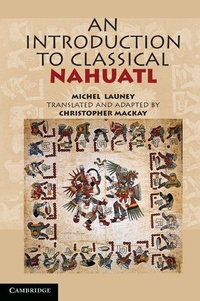
An Introduction to Classical Nahuatl
1st Edition
Published on 11. July 2011
Book
Paperback/Softback
474 pages
978-0-521-73229-1 (ISBN)
Description
Now available to an English-speaking audience, this book is a comprehensive grammar of classical Nahuatl, the literary language of the Aztecs. It offers students of Nahuatl a complete and clear treatment of the language's structure, grammar and vocabulary. It is divided into 35 chapters, beginning with basic syntax and progressing gradually to more complex structures. Each grammatical concept is illustrated clearly with examples, exercises and passages for translation. A key is provided to allow students to check their answers. By far the most approachable textbook of Nahuatl available, this book will be an excellent teaching tool both for classroom use and for readers pursuing independent study of the language. It will be an invaluable resource to anthropologists, ethnographers, historians, archaeologists and linguists alike.
Reviews / Votes
'An Introduction to Classical Nahuatl is an excellent language-learning textbook. Launey has written many articles about classical Nahuatl ... his expertise is evident in the details in each lesson. The textbook is very thorough in detailing classical Nahuatl grammar, and the examples and exercises are well-suited to reinforce concepts introduced in each lesson.' Dibella Wdzenczny, Linguist ListMore details
Language
English
Place of publication
Cambridge
United Kingdom
Target group
College/higher education
Professional and scholarly
Product notice
Paperback (trade)
Illustrations
1465 exercises
Worked examples or Exercises
Dimensions
Height: 229 mm
Width: 152 mm
Thickness: 28 mm
Weight
763 gr
ISBN-13
978-0-521-73229-1 (9780521732291)
Copyright in bibliographic data and cover images is held by Nielsen Book Services Limited or by the publishers or by their respective licensors: all rights reserved.
Schweitzer Classification
Other editions
Additional editions
Michel Launey
An Introduction to Classical Nahuatl
Book
07/2011
1st Edition
Cambridge University Press
€122.20
Shipment within 15-20 days
Persons
Michel Launey, now retired, was a professor at the Universite Denis Diderot, Paris and the Institut de Recherches pour le Developpement, Cayenne. He was a visiting professor at the Universidad de Guadalajara, Universidad Nacional Autonoma de Mexico and Yale University, among others. His other books include Introduction a la langue et a la literature azteques (the French edition of this book, published in 1979), Une grammaire omnipredicative (1994) and Awna Parikwaki: Introduction a la langue palikur de Guyane et de l'Amapa (2003).
Content
Preliminary lesson: phonology and orthography; 1. Intransitive verbs, word order, absolutive suffix; 2. Nouns and nominal predicates, the plural of nouns, questions and negation; 3. Transitive verbs; 4. Emphatic, interrogative, demonstrative and negative pronouns; 5. Irregular verbs, introduction to locatives; 6. Directional and reflexive prefixes; 7. Quantifiers, zan, ye, oc; 8. Preterite tense; 9. Imperative/optative, vocative, future, imperfect; 10. Possessed forms of the noun; 11. Inherent possession, the suffix -yo, 'to have', possessive nouns; 12. Nominal suffixes, 'adjectives'; 13. The principal locative suffixes; 14. Coordination, phrases of time and manner; 15. Impersonal and passive verb forms; Review exercises; 16. Agent nouns, the -ni form; 17. Compound nouns, verbal incorporation; 18. Bitransitive verbs, ambitransitive verbs; 19. Causative verbs; 20. Applicative verbs; 21. Honorific and deprecatory verbs; 22. Pluperfect, counterfactual, vetitive, directional conjugations; 23. Morphological peculiarities of certain nouns and verbs; 24. More on locatives; 25. More on quantifiers; 26. Details about number and person, indefinite pronouns and adverbs; 27. Compound verbs; 28. Reduplication outside of the plural, more on verbs; 29. Derivative verbs; 30. Derivative nouns; 31. Noun clauses; 32. Attributives, relative clauses, predicative verbs, predicative constructions, semi-auxiliaries; 33. Comparisons, clauses of result, purpose and cause; 34. Conditions, more particles; 35. Temporal clauses, particles, interjections; Appendix 1. Traditional orthography; Appendix 2. The Aztec calendar; Appendix 3. Paradigms; Appendix 4. Key to the exercises; Reading passages; Vocabulary.