

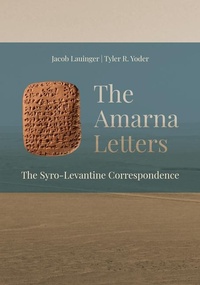
The Amarna Letters
The Syro-Levantine Correspondence
Published on 30. June 2025
Book
Hardback
590 pages
978-1-957454-83-2 (ISBN)
Description
During Egypt's Eighteenth Dynasty (ca. 1550-1292 BCE), the New Kingdom pharaohs campaigned repeatedly in Syria and the Levant, establishing political control over much of the region. As a result of these conquests, the rulers of Levantine city-states sent letters written in Akkadian in the cuneiform script on clay tablets to the Egyptian pharaohs. So, too, did the kings of the other great geopolitical powers of the time--Assyria, Babylonia, Hatti, and Mittani--maintain an active diplomatic correspondence with Egypt's pharaohs.
Beginning in the nineteenth century CE, local farmers and, later, archaeologists working at Akhetaten (modern Tell el-Amarna), the one-time Egyptian capital, discovered remnants of this correspondence, mostly dating to the reigns of Amenhotep III (ca. 1388-1350 BCE) and his son and successor Akhenaten (ca. 1350-1333 BCE), with some dating to Tutankhamun (ca. 1333-1323). This is a period of increasing friction as the great powers sought to extend their borders. The Amarna Letters thus illuminate a pivotal point in Egypt's foreign relations during the Late Bronze Age. Even though they provide us with a narrow window of only about thirty years time (1358-1325 BCE), they are an important witness to the general nature of Egypt's diplomatic relations during the Eighteenth and Nineteenth Dynasties.
This new, digitally borne edition of the Amarna Letters offers the first complete collection of the letters with responsible transliterations that have been checked against available photographs and hand copies; clear and consistent translations; and an up-to-date and extensive bibliography. As such it is, and will remain, an essential resource.
Beginning in the nineteenth century CE, local farmers and, later, archaeologists working at Akhetaten (modern Tell el-Amarna), the one-time Egyptian capital, discovered remnants of this correspondence, mostly dating to the reigns of Amenhotep III (ca. 1388-1350 BCE) and his son and successor Akhenaten (ca. 1350-1333 BCE), with some dating to Tutankhamun (ca. 1333-1323). This is a period of increasing friction as the great powers sought to extend their borders. The Amarna Letters thus illuminate a pivotal point in Egypt's foreign relations during the Late Bronze Age. Even though they provide us with a narrow window of only about thirty years time (1358-1325 BCE), they are an important witness to the general nature of Egypt's diplomatic relations during the Eighteenth and Nineteenth Dynasties.
This new, digitally borne edition of the Amarna Letters offers the first complete collection of the letters with responsible transliterations that have been checked against available photographs and hand copies; clear and consistent translations; and an up-to-date and extensive bibliography. As such it is, and will remain, an essential resource.
More details
Language
English
Place of publication
Atlanta
United States
Target group
College/higher education
Dimensions
Height: 260 mm
Width: 185 mm
Thickness: 39 mm
Weight
1400 gr
ISBN-13
978-1-957454-83-2 (9781957454832)
Copyright in bibliographic data and cover images is held by Nielsen Book Services Limited or by the publishers or by their respective licensors: all rights reserved.
Schweitzer Classification
Persons
Jacob Lauinger is professor of Assyriology at Johns Hopkins University.
Tyler Yoder is instructor of history at University School, Cleveland, Ohio
Tyler Yoder is instructor of history at University School, Cleveland, Ohio