

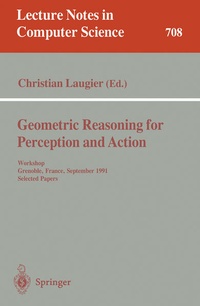
Geometric Reasoning for Perception and Action
Workshop. Grenoble, France, September 16-17, 1991. Selected Papers
Published on 30. August 1993
Book
Paperback/Softback
VIII, 288 pages
978-3-540-57132-2 (ISBN)
Description
Geometry is a powerful tool to solve a great number of
problems in robotics and computer vision. Impressive results
have been obtained in these fields in the last decade. It is
a new challenge to solve problems of the actual world which
require the ability to reason about uncertainty and complex
motion constraints by combining geometric, kinematic, and
dynamic characteristics. A necessary step is to develop
appropriate geometric reasoning techniques with reasonable
computational complexity.
This volume is based on a workshop held in Grenoble,
France,in September 1991. It contains selected
contributions on several important areas in the field of
robotics and computer vision. The four chapters cover the
following areas:
- motion planning with kinematic and dynamic constraints,
- motion planning and control in the presence of
uncertainty,
- geometric problems related to visual perception,
-numerical problems linked to the implementation of
practical algorithms for visual perception.
More details
Series
Edition
1993 ed.
Language
English
Place of publication
Berlin
Germany
Publishing group
Springer Berlin
Target group
Professional and scholarly
Research
Illustrations
VIII, 288 p.
Dimensions
Height: 235 mm
Width: 155 mm
Thickness: 17 mm
Weight
452 gr
ISBN-13
978-3-540-57132-2 (9783540571322)
DOI
10.1007/3-540-57132-9
Schweitzer Classification
Content
Shortest paths of bounded curvature in the plane.- Kinodynamic planning in a structured and time-varying workspace.- Motion planning for a non-holonomic mobile robot on 3-dimensional terrains.- Optimal motion planning of a mobile robot on a triangulated terrain model.- Landmark-based robot motion planning.- Using genetic algorithms for robot motion planning.- Fast mobile robots in unstructured environments.- A new approach to visual servoing in robotics.- Geometric solutions to some 3D vision problems.- Geometrical representation of shapes and objects for visual perception.- Perceptual grouping for scene interpretation in an active vision system.- Incremental free-space modelling from uncertain data by an autonomous mobile robot.- Matching 3-D smooth surfaces with their 2-D projections using 3-D distance maps.- A new physically based model for efficient tracking and analysis of deformations.- From splines and snakes to snake splines.