


Globalizing the Library
Librarians and Development Work, 1945-1970
1st Edition
Published on 1. March 2019
Book
Hardback
182 pages
978-0-8153-7003-1 (ISBN)
Description
Globalizing the Library focuses on the globalization of information and the library in the period following the Second World War. Providing an examination of the ideas and aspirations surrounding information and the library, as well as the actual practices and actions of information professionals from the United States, Britain, and those working with organizations such as Unesco to develop library services, this book tells an important story about international history that also provides insight into the history of information, globalization, and cultural relations.
Exploring efforts to help build library services and train a cohort of professional librarians around the globe, the book examines countries in Asia, Africa, and the Pacific during the period of the Cold War and decolonization. Using the ideas of 'library diplomacy' and 'library imperialism' to frame Anglo-American involvement in this work, Laugesen examines the impact library development work had on various countries. The book also considers what might have motivated nations in the global South to use foreign aid to help develop their library services and information infrastructure.
Globalizing the Library prompts reflection on the way in which library services are developed and the way professional knowledge is transferred, while also illuminating the power structures that have shaped global information infrastructures. As a result, the book should be essential reading for academics and students engaged in the study of libraries, development, and information. It should also be of great interest to information professionals and information historians who are reflecting critically on the way information has been transferred, consumed, and shaped in the modern world.
Exploring efforts to help build library services and train a cohort of professional librarians around the globe, the book examines countries in Asia, Africa, and the Pacific during the period of the Cold War and decolonization. Using the ideas of 'library diplomacy' and 'library imperialism' to frame Anglo-American involvement in this work, Laugesen examines the impact library development work had on various countries. The book also considers what might have motivated nations in the global South to use foreign aid to help develop their library services and information infrastructure.
Globalizing the Library prompts reflection on the way in which library services are developed and the way professional knowledge is transferred, while also illuminating the power structures that have shaped global information infrastructures. As a result, the book should be essential reading for academics and students engaged in the study of libraries, development, and information. It should also be of great interest to information professionals and information historians who are reflecting critically on the way information has been transferred, consumed, and shaped in the modern world.
More details
Series
Language
English
Place of publication
New York
United States
Publishing group
Taylor & Francis Inc
Target group
Professional and scholarly
College/higher education
Dimensions
Height: 240 mm
Width: 161 mm
Thickness: 15 mm
Weight
455 gr
ISBN-13
978-0-8153-7003-1 (9780815370031)
Copyright in bibliographic data and cover images is held by Nielsen Book Services Limited or by the publishers or by their respective licensors: all rights reserved.
Schweitzer Classification
Other editions
Additional editions
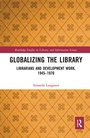
Book
09/2020
1st Edition
Routledge
€55.70
Shipment within 15-20 days
E-Book
03/2019
Routledge
€0.00
Available for download
E-Book
03/2019
1st Edition
Routledge
€0.00
Available for download
Person
Amanda Laugesen is an Associate Professor and senior fellow in the School of Literature, Languages and Linguistics, and director of the Australian National Dictionary Centre at the Australian National University.
Content
Acknowledgments; Introduction: Libraries for the World; Chapter 1: Imagining the Global Library; Chapter 2: Identifying the 'Library Problem'; Chapter 3: Making the Modern Library; Chapter 4: Making the Modern Librarian; Chapter 5: Libraries as Foreign Policy; Chapter 6: Library Diplomacy and Exchange; Conclusion; Bibliography; Index