

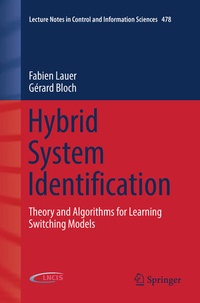
Hybrid System Identification
Theory and Algorithms for Learning Switching Models
Published on 10. December 2019
Book
Paperback/Softback
XXI, 253 pages
978-3-030-13091-6 (ISBN)
Description
Hybrid System Identification
helps readers to build mathematical models of dynamical systems switching between different operating modes, from their experimental observations. It provides an overview of the interaction between system identification, machine learning and pattern recognition fields in explaining and analysing hybrid system identification. It emphasises the optimization and computational complexity issues that lie at the core of the problems considered and sets them aside from standard system identification problems. The book presents practical methods that leverage this complexity, as well as a broad view of state-of-the-art machine learning methods.
The authors illustrate the key technical points using examples and figures to help the reader understand the material. The book includes an in-depth discussion and computational analysis of hybrid system identification problems, moving from the basic questions of the definition of hybrid systems and system identification to methods of hybrid system identification and the estimation of switched linear/affine and piecewise affine models. The authors also give an overview of the various applications of hybrid systems, discuss the connections to other fields, and describe more advanced material on recursive, state-space and nonlinear hybrid system identification.
Hybrid System Identification includes a detailed exposition of major methods, which allows researchers and practitioners to acquaint themselves rapidly with state-of-the-art tools. The book is also a sound basis for graduate and undergraduate students studying this area of control, as the presentation and form of the book provides the background and coverage necessary for a full understanding of hybrid system identification, whether the reader is initially familiar with system identification related to hybrid systems or not.
The authors illustrate the key technical points using examples and figures to help the reader understand the material. The book includes an in-depth discussion and computational analysis of hybrid system identification problems, moving from the basic questions of the definition of hybrid systems and system identification to methods of hybrid system identification and the estimation of switched linear/affine and piecewise affine models. The authors also give an overview of the various applications of hybrid systems, discuss the connections to other fields, and describe more advanced material on recursive, state-space and nonlinear hybrid system identification.
Hybrid System Identification includes a detailed exposition of major methods, which allows researchers and practitioners to acquaint themselves rapidly with state-of-the-art tools. The book is also a sound basis for graduate and undergraduate students studying this area of control, as the presentation and form of the book provides the background and coverage necessary for a full understanding of hybrid system identification, whether the reader is initially familiar with system identification related to hybrid systems or not.
More details
Series
Edition
Softcover Reprint of the Original 1st 2019 ed.
Language
English
Place of publication
Cham
Switzerland
Publishing group
Springer International Publishing
Target group
Professional and scholarly
Illustrations
1 s/w Abbildung, 34 farbige Abbildungen
XXI, 253 p. 35 illus., 34 illus. in color.
Dimensions
Height: 235 mm
Width: 155 mm
Thickness: 16 mm
Weight
423 gr
ISBN-13
978-3-030-13091-6 (9783030130916)
DOI
10.1007/978-3-030-00193-3
Schweitzer Classification
Other editions
Additional editions
Fabien Lauer | Gérard Bloch
Hybrid System Identification
Theory and Algorithms for Learning Switching Models
Book
10/2018
Springer
€149.79
Shipment within 7-9 days
Persons
Fabien Lauer
obtained his Ph.D. in Control Engineering from the University Henri Poincaré Nancy 1, France, in 2008. He was then a post-doctoral fellow at the Heidelberg Collaboratory for Image Processing, Germany, and is now an Associate Professor of Computer Science at the Université de Lorraine, France, since 2009. He published 18 peer-reviewed journal papers, 2 book chapters and 17 conference papers on hybrid system identification and machine learning.
Gérard Bloch has been Associate Professor at the University Henri Poincaré Nancy 1, France, then Full Professor, at the Université de Lorraine, France, from 1991 until 2017, where he took several pedagogical or administrative positions. He coauthored one book and one book chapter, published 35 peer-reviewed journal papers, and 65 conference papers on system identification, machine learning and intelligent control applications.
Gérard Bloch has been Associate Professor at the University Henri Poincaré Nancy 1, France, then Full Professor, at the Université de Lorraine, France, from 1991 until 2017, where he took several pedagogical or administrative positions. He coauthored one book and one book chapter, published 35 peer-reviewed journal papers, and 65 conference papers on system identification, machine learning and intelligent control applications.
Content
Introduction.- System Identification.- Classification.- Hybrid System Identification.- Exact Methods for Hybrid System Identification.- Estimation of Switched Linear/Affine Models.- Estimation of Piecewise Affine Models.- Recursive and State-space Identification of Hybrid Systems.- Nonlinear Hybrid System Identification.