

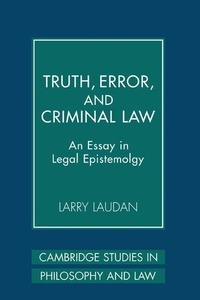
Truth, Error, and Criminal Law
An Essay in Legal Epistemology
Published on 5. June 2006
Book
Hardback
256 pages
978-0-521-86166-3 (ISBN)
Description
Beginning with the premise that the principal function of a criminal trial is to find out the truth about a crime, Larry Laudan examines the rules of evidence and procedure that would be appropriate if the discovery of the truth were, as higher courts routinely claim, the overriding aim of the criminal justice system. Laudan mounts a systematic critique of existing rules and procedures that are obstacles to that quest. He also examines issues of error distribution by offering the first integrated analysis of the various mechanisms - the standard of proof, the benefit of the doubt, the presumption of innocence and the burden of proof - for implementing society's view about the relative importance of the errors that can occur in a trial.
Reviews / Votes
'Laudan has written an estimable book, one that deserves a wide audience. His arguments are of consistently high calibre and his conclusions are provocative.' Criminal Law and PhilosophyMore details
Series
Language
English
Place of publication
Cambridge
United Kingdom
Target group
College/higher education
Dimensions
Height: 235 mm
Width: 157 mm
Thickness: 20 mm
Weight
571 gr
ISBN-13
978-0-521-86166-3 (9780521861663)
Copyright in bibliographic data and cover images is held by Nielsen Book Services Limited or by the publishers or by their respective licensors: all rights reserved.
Schweitzer Classification
Other editions
Additional editions
E-Book
08/2006
1st Edition
Cambridge University Press
€27.99
Available for download
Person
Larry Laudan is Principal Investigator at the Instituto de Investigaciones Filosoficas, Universidad Nacional Autonoma de Mexico and president-elect of the Peirce Society. He is the author of many books, most recently Beyond Positisms and Relativism, and The Book of Risks.
Content
1. Thinking about error in the law; 2. The unraveling of reasonable doubt; 3. Fixing the standard of proof; 4. Innocence, the burden of proof, and the puzzle of affirmative defenses; 5. Evaluating evidence and procedures; 6. Silent defendants, silent witnesses, and lobotomized jurors; 7. Confessions, poison fruit, and other exclusions; 8. Double jeopardy and false acquittals: letting felons and judges off the hook?; 9. Dubious motives for flawed rules: the clash between values.