

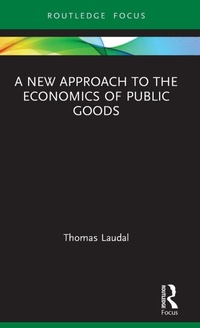
A New Approach to the Economics of Public Goods
1st Edition
Published on 3. September 2019
Book
Hardback
86 pages
978-0-367-32104-8 (ISBN)
Description
Public goods are typically defined only in reference to the good itself but, as this book argues, the public goods can be better understood if contextual variables are incorporated. This book discusses the production and provision of public goods. It asserts that changes related to public goods are better understood if the category of goods are not decided solely by the properties of the good itself. We also need to focus on how the enabled utility of a good is influenced by the production and the provision of the good.
The book opens with a brief introduction to common conceptions of public goods and a review of the existing literature - highlighting the limitations of current definitions of public goods. It presents a new multi-layered approach to public goods. This has implications for the discourse on public goods and for our understanding of the societal and environmental impact of public goods. The implications are illustrated in several areas; public goods in ancient history, privatization, innovation, competitiveness and prices, democracy and political standards, and economic growth.
The book provides a provocative argument for a new way to analyze public goods which will appeal to scholars and students interested in the economic analysis of public goods, arguments regarding the privatizing or nationalizing of production and services, and method of modelling and measuring sustainable business activities.
The book opens with a brief introduction to common conceptions of public goods and a review of the existing literature - highlighting the limitations of current definitions of public goods. It presents a new multi-layered approach to public goods. This has implications for the discourse on public goods and for our understanding of the societal and environmental impact of public goods. The implications are illustrated in several areas; public goods in ancient history, privatization, innovation, competitiveness and prices, democracy and political standards, and economic growth.
The book provides a provocative argument for a new way to analyze public goods which will appeal to scholars and students interested in the economic analysis of public goods, arguments regarding the privatizing or nationalizing of production and services, and method of modelling and measuring sustainable business activities.
More details
Series
Language
English
Place of publication
London
United Kingdom
Publishing group
Taylor & Francis Ltd
Target group
College/higher education
Illustrations
3 s/w Tabellen, 14 s/w Abbildungen, 14 s/w Zeichnungen
3 Tables, black and white; 14 Line drawings, black and white; 14 Illustrations, black and white
Dimensions
Height: 222 mm
Width: 145 mm
Thickness: 9 mm
Weight
263 gr
ISBN-13
978-0-367-32104-8 (9780367321048)
Copyright in bibliographic data and cover images is held by Nielsen Book Services Limited or by the publishers or by their respective licensors: all rights reserved.
Schweitzer Classification
Other editions
Additional editions
Thomas Laudal
A New Approach to the Economics of Public Goods
Book
03/2021
1st Edition
Routledge
€36.60
Shipment within 15-20 days
Thomas Laudal
A New Approach to the Economics of Public Goods
E-Book
08/2019
1st Edition
Routledge
€32.99
Available for download
Thomas Laudal
A New Approach to the Economics of Public Goods
E-Book
08/2019
1st Edition
Routledge
€32.99
Available for download
Person
Thomas Laudal is Associate Professor of international business strategy at the University of Stavanger Business School, Norway.
Content
1. Introduction. 2. The economic literature on public goods. 3. Advantages of studying public goods with reference to a utility-layer and a supply-layer. 4. The value-added process linking the utility-layer and the supply-layer. 5. Descriptive and predictive value of a multi-layered approach to public goods. 6. Public good trends. 7 A multi-layered approach to public goods.