

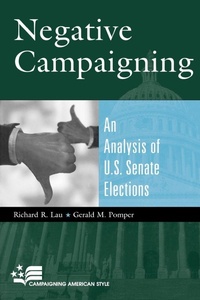
Negative Campaigning
An Analysis of U.S. Senate Elections
Published on 13. July 2004
Book
Paperback/Softback
224 pages
978-0-7425-2732-4 (ISBN)
Description
Negative campaigning is frequently denounced, but it is not well understood. Who conducts negative campaigns? Do they work? What is their effect on voter turnout and attitudes toward government? Just in time for an assessment of election 2004, two distinguished political scientists bring us a sophisticated analysis of negative campaigns for the Senate from 1992 to 2002. The results of their study are surprising and challenge conventional wisdom: negative campaigning has dominated relatively few elections over the past dozen years, there is little evidence that it has had a deleterious effect on our political system, and it is not a particularly effective campaign strategy. These analyses bring novel empirical techniques to the study of basic normative questions of democratic theory and practice.
Reviews / Votes
A timely analysisssss * Bookwatch * This work is a valuable addition to the research on negative campaigning. It is also a valuable addition to research into the effects of a host of more traditional factors on the outcome of elections and voting behavior. The use of an extended data set on Senate elections and survey data on voter behavior/attitudes provides a worthwhile addition to research in those areas. Negative Campaigning is thought provoking and would be an excellent supplemental reader for upper-level undergraduates and graduate students in courses on campaigning, voter behavior, and democratic theory. Indeed, it is a worthwhile read for anyone interested in the forces that shape the American electoral landscape. * Perspectives on Politics * Negative Campaigning is a timely and important book written by two leading political scientists. Using sound evidence and much good sense, these scholars have truly advanced our understanding of attack politics in Senate elections. Political observers of all stripes should, after reading this book, be less worried about the pernicious effects of negativity on our political system. There is far too much negativity about negativity and this book provides a much-needed corrective to such views. -- John G. Geer, Vanderbilt University A timely analysis * Bookwatch *More details
Series
Language
English
Place of publication
United States
Publishing group
Bloomsbury Publishing Plc
Dimensions
Height: 229 mm
Width: 152 mm
Thickness: 10 mm
Weight
284 gr
ISBN-13
978-0-7425-2732-4 (9780742527324)
Copyright in bibliographic data and cover images is held by Nielsen Book Services Limited or by the publishers or by their respective licensors: all rights reserved.
Schweitzer Classification
Persons
Richard R. Lau is professor of political science and director of the Walt Whitman Center for the Study of Elections, Campaigns, and Democracy at Rutgers University in New Brunswick. He is also a member of the Institute of Health, Health Care Policy, and Aging Research at Rutgers. Gerald M. Pomper is Board of Governors Professor of Political Science Emeritus at Rutgers University and the Eagleton Institute of Politics in New Brunswick.
Content
Chapter 1 The Problem of Negative Campaigning
Chapter 2 The Literature of Negative Campaigning
Chapter 3 Who Uses Negative Campaigning?
Chapter 4 The Effectiveness of Negative Campaigning
Chapter 5 Negative Campaigning in Open-Seat Contests
Chapter 6 Effects of Negative Campaigning on the Political System
Chapter 7 Normative Thoughts on Negative Campaigning
Chapter 8 Appendix A. Description of Studies Included in the Meta-Analysis
Chapter 9 Appendix B. Data and Methods
Chapter 2 The Literature of Negative Campaigning
Chapter 3 Who Uses Negative Campaigning?
Chapter 4 The Effectiveness of Negative Campaigning
Chapter 5 Negative Campaigning in Open-Seat Contests
Chapter 6 Effects of Negative Campaigning on the Political System
Chapter 7 Normative Thoughts on Negative Campaigning
Chapter 8 Appendix A. Description of Studies Included in the Meta-Analysis
Chapter 9 Appendix B. Data and Methods