

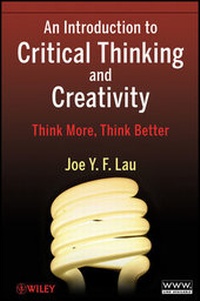
An Introduction to Critical Thinking and Creativity
Think More, Think Better
Published on 6. May 2011
Book
Paperback/Softback
272 pages
978-0-470-19509-3 (ISBN)
Description
This book is about the basic principles that underlie critical thinking and creativity. The majority of the content is on critical thinking since more topics are naturally involved and since they can be discussed readily and systematically. The last few chapters are devoted to creativity and research methodology, not typical the book's plethora of competition. Each chapter introduces a specific topic, usually by introducing the relevant theories in conjunction with realistic examples that show how the theories can be applied. Each chapter concludes with a set of exercises whose solutions are detailed at the rear of the book. While the writing style is purposefully informal, the presentation is complete, at least with respect to the intended introductory level.
More details
Product info
Paperback
Edition
1. Auflage
Language
English
Place of publication
New York
United States
Target group
Adult education
Product notice
Paperback (trade)
Unsewn / adhesive bound
Illustrations
Charts: 25 B&W, 0 Color; Photos: 2 B&W, 0 Color; Graphs: 15 B&W, 0 Color
Dimensions
Height: 234 mm
Width: 156 mm
Thickness: 16 mm
Weight
424 gr
ISBN-13
978-0-470-19509-3 (9780470195093)
Schweitzer Classification
Other editions
Additional editions
E-Book
12/2011
Wiley
€72.99
Available for download
E-Book
04/2011
Wiley
€72.99
Available for download
Person
Joe Y. F. Lau, PhD, is Associate Professor of Philosophy at The University of Hong Kong. Dr. Lau teaches critical thinking, the philosophy of mind, and cognitive science. He has authored and coauthored numerous books and articles in philosophy, and he was awarded a university teaching fellowship for teaching excellence.
Content
Preface.
1. Introduction.
2. Thinking and writing clearly.
3. Definitions.
4. Necessary and sufficient conditions.
5. Linguistic pitfalls.
6. Truth.
7. Basic logic.
8. Identifying arguments.
9. Valid and sound arguments.
10. Inductive reasoning.
11. Argument mapping.
12. Argument analysis.
13. Scientific reasoning.
14. Mill's methods.
15. Reasoning about causation.
16. Diagrams of causal processes.
17. Statistics and probability.
18. Thinking about values.
19. Fallacies.
20. Cognitive biases.
21. Analogical reasoning.
22. Making rational decisions.
23. What is creativity?
24. Creative thinking habits.
Solutions to exercises.
Bibliography.
Index.