

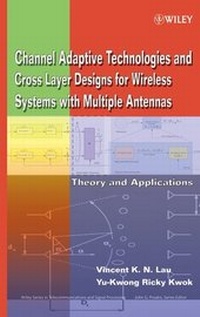
Channel-Adaptive Technologies and Cross-Layer Designs for Wireless Systems with Multiple Antennas
Theory and Applications
Published on 3. March 2006
Book
Hardback
544 pages
978-0-471-64865-9 (ISBN)
Description
This innovative book sets forth two promising wireless approaches that support high-quality, high-speed data and multimedia service-multiple antenna technologies and cross layer transmitter adaptation designs-while highlighting the relationships and interactions between them. The latest advanced technologies of channel adaptation techniques for wireless communication systems with multiple antennas are thoroughly investigated.
The book is divided into three parts, first giving readers a good foundation in underlying theory, then exploring applications as well as advanced topics:
* Part 1 examines theoretical aspects of channel adaptation in wireless communications for point-to-point and multi-user systems with multiple antennas
* Part 2 focuses on the applications of the channel-adaptive technologies in practical systems such as UMTS
* Part 3 delves into topics such as multi-user scheduling for wideband systems, combined queuing theory and information theory, and ad hoc routing
Using a hands-on, practical approach, Channel Adaptive Technologies and Cross Layer Designs for Wireless Systems with Multiple Antennas thoroughly covers detailed design considerations that help readers understand how to apply theory to real-world systems. Emphasis throughout the book is on joint optimization across different layers of a communications system based on an integrated approach. Examples of popular wireless systems, such as TDMA, wideband CDMA (UMTS), and HSDPA, are used throughout as practical illustrations. Each chapter ends with a summary that reviews key points and a set of problems that lets readers test their knowledge and continue to develop their skills as they progress to new topics. Figures and tables are also used extensively to help readers visualize complex theory and systems.
Combining theory, design, and application into one integrated approach, this is a superior reference for advanced communications theory courses.
Reviews / Votes
"...helpful in both research and future wireless standards planning." (IEEE Communications Magazine, September 2006)More details
Product info
gebunden
Series
Edition
1. Auflage
Language
English
Place of publication
United States
Publishing group
John Wiley & Sons Inc
Target group
Professional and scholarly
Product notice
sewn/stitched
Cloth over boards
Dimensions
Height: 240 mm
Width: 161 mm
Thickness: 34 mm
Weight
977 gr
ISBN-13
978-0-471-64865-9 (9780471648659)
Schweitzer Classification
Other editions
Additional editions
Vincent K. N. Lau | Yu-Kwong Ricky Kwok
Channel-Adaptive Technologies and Cross-Layer Designs for Wireless Systems with Multiple Antennas
Theory and Applications
E-Book
02/2006
Wiley
€141.99
Available for download
Persons
Vincent K.N. Lau, PhD, is Associate Professor in the Department of Electrical Engineering at the Hong Kong University of Science and Technology. He is also a technology consultant and senior manager of ASTRI, leading the Advanced Technology Team of the Wireless Access Group in wireless LAN systems. Additionally, Dr. Lau was the chief technical officer and co-founder of DAX Group Ltd. He is a Senior IEEE Member, has published more than 42 papers in IEEE Transactions and journals, and has received two best paper awards (IEE and HKIE). Dr. Lau's current research focus is on the cross layer optimization between the wireless MAC (scheduling) layer and adaptive physical layer.
Yu-Kwong Ricky Kwok, PhD, is Associate Professor in the Department of Electrical and Electronic Engineering at the University of Hong Kong. He holds additional positions including Program Director of the Master of Science and Director of the High Performance Computing Research Laboratory. A Senior Member of the IEEE, he has published more than 130 technical papers in various leading journals, research books, and refereed international conference proceedings on topics including parallel and distributed computing research, mobile computing, wireless networking, grid computing infrastructure technologies, and analysis of distributed algorithms.
Content
List of Figures.
List of Tables.
Preface.
Acknowledgments.
PART 1: THEORY.
Chapter 1. Basic Concepts in Wireless Communications.
Exercises.
Chapter 2. MIMO Link with Perfect Channel State Information.
Exercises.
Chapter 3. MIMO Link with Imperfect Channel State Information.
Exercises.
Chapter 4. Spacetime Coding and Layered Spacetime Coding for MIMO with Perfect Channel State Information.
Exercises.
Chapter 5. MIMO Constellation Design with Imperfect Channel State Information.
Chapter 6. Cross-Layer Scheduling for Multiuser Systems with Multiple Antennas.
Appendix 6A: Proof of Lemma 6.2.
Appendix 6B: Calculation of Weights.
Appendix 6C: Proof of Lemma 6.3.
Appendix 6D: Proof of Lemma 6.4.
Appendix 6E: Proof of Lemma 1.10.
Appendix 6F: Proof of Lemma 6.5.
Appendix 6G: Optimal Power Allocation for Network Capacity Utility.
Appendix 6H: Asymptotic Distribution of Sk .
Exercises.
PART 2: DESIGN EXAMPLES AND APPLICATIONS.
Chapter 7. Review of MAC Layer Design for Wireless Systems.
Exercises.
Chapter 8. Channel-Adaptive Wireless Fair Scheduling.
Exercises.
Chapter 9. Packet-Switched Data Services in W-CDMA Systems.
Exercises.
PART 3: ADVANCED TOPICS.
Chapter 10. Cross-Layer Scheduling for Wideband Systems.
Exercises.
Chapter 11. Cross-Layer Scheduling Design Based on Queueing Theory and Information Theory.
Appendix 11A: Proof of Theorem 11.1 on Stability Region of Deterministic Physical Layer.
Appendix 11B: Proof of Theorem 11.2 on Stability Region of Stochastic Physical layer.
Appendix 11C: Proof of Theorem 11.3 on Throughput Optimality of MW Scheduling.
Appendix 11D: Proof of Theorem 11.5 on Throughput Optimality of EXP Scheduling.
Appendix 11E: Conditions for Stability of a Stochastic Process.
Appendix 11F: Proof of Theorem 11.6 on Throughput Optimality of Tse-Hanly Policy.
Exercises.
Chapter 12. Channel-Adaptive Ad Hoc Routing.
Exercises.
References.
Topic Index.