

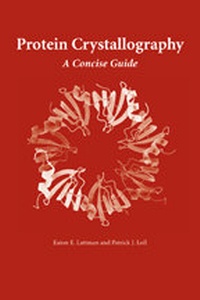
Protein Crystallography
A Concise Guide
Published on 23. June 2008
Book
Paperback/Softback
152 pages
978-0-8018-8808-3 (ISBN)
Description
The proteome remains a mysterious realm. Researchers have determined the structures of only a small fraction of the proteins encoded by the human genome. Crystallography continues to be the primary method used to determine the structures of the remaining unknown proteins. This imaging technique uses the diffraction of X-rays to determine a protein's three-dimensional molecular structure. Drawing on years of research and teaching experience, Eaton E. Lattman and Patrick J. Loll use clear examples and abundant illustrations to provide a concise and accessible primer on protein crystallography. Discussing the basics of diffraction, the behavior of two- and three-dimensional crystals, phase determination (including MIR and MAD phasing and molecular replacement), the Patterson function, and refinement, Lattman and Loll provide a complete overview of this important technique, illuminated by physical insights. The crisp writing style and simple illustrations will provide beginner crystallographers with a guide to the process of unraveling protein structure.
Reviews / Votes
A useful source. Recommended. Choice 2008 It is gratifying to see such a nice piece of work and the book is highly recommended. -- Eddie Snell Reflexions: Newsletter of the American Crystallographic Association 2008 One of the main assets of the book is its many illustrations. Without exception the figures are straightforward to interpret, and the visual support enables the newcomers to the field to follow the presented material easily. -- Linda Schuldt and Manfred S. Weiss Crystallography Reviews 2009More details
Language
English
Place of publication
Baltimore, MD
United States
Target group
College/higher education
Product notice
Paperback (trade)
Illustrations
46 s/w Abbildungen
46 Illustrations, black and white
Dimensions
Height: 229 mm
Width: 152 mm
Thickness: 10 mm
Weight
227 gr
ISBN-13
978-0-8018-8808-3 (9780801888083)
DOI
10.56021/9780801888069
Copyright in bibliographic data and cover images is held by Nielsen Book Services Limited or by the publishers or by their respective licensors: all rights reserved.
Schweitzer Classification
Other editions
Additional editions
Book
06/2008
Johns Hopkins University Press
€101.23
Article exhausted; check different version
E-Book
06/2008
Johns Hopkins University Press
€29.99
Available for download
Persons
Eaton E. Lattman is chair of the Department of Biophysics at the Johns Hopkins University and editor-in-chief of the journal Proteins: Structure, Function, and Genetics. Patrick J. Loll is the director of the Biochemistry Graduate Program at Drexel University College of Medicine.
Content
Preface
1. Introduction
1.1. What Is X-ray Crystallography?
1.2. A Quick Look at Protein Crystals
1.3. Noncrystalline Specimens
1.4. Summary
Further Reading
2. A Physical Understanding of Diffraction
2.1. What Is Diffraction?
2.2. Diffraction from One-Dimensional Crystals
2.3. Reconstructing Images from Diffraction Patterns
2.4. Summary
Further Reading
3. Diffraction from Three-Dimensional Crystals
3.1. The Electron Density Function in Three Dimensions
3.2. Calculating the Diffraction Pattern from a Known Structure
3.3. Summary
Further Reading
4. Phase Determination by Isomorphous Replacement
4.1. Measuring the Phases
4.2. MAD Phasing
4.3. Fitting Models to Experimental Electron Density Maps
4.4. Summary
Further Reading
5. The Patterson Function
5.1. Definition of the Patterson Function
5.2. Using the Patterson Function to Locate Atoms
5.3. Summary
Further Reading
6. Phasing with Partially Known Structures
6.1. Difference Fourier Maps
6.2. Molecular Replacement
6.3. Summary
Further Reading
7. Crystallographic Refinement
7.1. Refinement Improves the Model
7.2. Least-Squares Refinement
7.3. Summary
Further Reading
Glossary
Index
1. Introduction
1.1. What Is X-ray Crystallography?
1.2. A Quick Look at Protein Crystals
1.3. Noncrystalline Specimens
1.4. Summary
Further Reading
2. A Physical Understanding of Diffraction
2.1. What Is Diffraction?
2.2. Diffraction from One-Dimensional Crystals
2.3. Reconstructing Images from Diffraction Patterns
2.4. Summary
Further Reading
3. Diffraction from Three-Dimensional Crystals
3.1. The Electron Density Function in Three Dimensions
3.2. Calculating the Diffraction Pattern from a Known Structure
3.3. Summary
Further Reading
4. Phase Determination by Isomorphous Replacement
4.1. Measuring the Phases
4.2. MAD Phasing
4.3. Fitting Models to Experimental Electron Density Maps
4.4. Summary
Further Reading
5. The Patterson Function
5.1. Definition of the Patterson Function
5.2. Using the Patterson Function to Locate Atoms
5.3. Summary
Further Reading
6. Phasing with Partially Known Structures
6.1. Difference Fourier Maps
6.2. Molecular Replacement
6.3. Summary
Further Reading
7. Crystallographic Refinement
7.1. Refinement Improves the Model
7.2. Least-Squares Refinement
7.3. Summary
Further Reading
Glossary
Index