

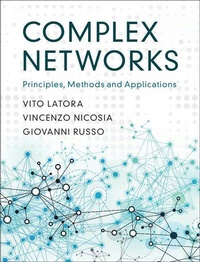
Complex Networks
Principles, Methods and Applications
Published on 28. September 2017
Book
Hardback
584 pages
978-1-107-10318-4 (ISBN)
Description
Networks constitute the backbone of complex systems, from the human brain to computer communications, transport infrastructures to online social systems and metabolic reactions to financial markets. Characterising their structure improves our understanding of the physical, biological, economic and social phenomena that shape our world. Rigorous and thorough, this textbook presents a detailed overview of the new theory and methods of network science. Covering algorithms for graph exploration, node ranking and network generation, among others, the book allows students to experiment with network models and real-world data sets, providing them with a deep understanding of the basics of network theory and its practical applications. Systems of growing complexity are examined in detail, challenging students to increase their level of skill. An engaging presentation of the important principles of network science makes this the perfect reference for researchers and undergraduate and graduate students in physics, mathematics, engineering, biology, neuroscience and the social sciences.
Reviews / Votes
'This is a substantial text which will serve a broad section of readers who wish to gain insights into complex networks. Some effort will be needed to get the most out of this book but the reader who expends that effort will be well-rewarded. In turn, the authors are to be congratulated for the effort that they have made to produce such a delightful text.' K. Alan Shore, Contemporary Physics 'Thanks to its colloquial style, the extensive use of examples and the accompanying software tools and network data sets, this book is the ideal university-level textbook for a first module on complex networks. It can also be used as a comprehensive reference for researchers in mathematics, physics, engineering, biology and social sciences, or as a historical introduction to the main findings of one of the most active interdisciplinary research fields of the moment.' Mathematical Reviews ClippingsMore details
Language
English
Place of publication
Cambridge
United Kingdom
Target group
Professional and scholarly
College/higher education
Illustrations
Worked examples or Exercises; 25 Tables, black and white; 87 Halftones, black and white; 133 Line drawings, black and white
Dimensions
Height: 260 mm
Width: 208 mm
Thickness: 36 mm
Weight
1458 gr
ISBN-13
978-1-107-10318-4 (9781107103184)
Copyright in bibliographic data and cover images is held by Nielsen Book Services Limited or by the publishers or by their respective licensors: all rights reserved.
Schweitzer Classification
Other editions
Additional editions
E-Book
09/2017
Cambridge University Press
€55.49
Available for download
Vito Latora | Vincenzo Nicosia | Giovanni Russo
Complex Networks
Principles, Methods and Applications
E-Book
09/2017
Cambridge University Press
€64.99
Available for download
Persons
Vito Latora is Professor of Applied Mathematics and Chair of Complex Systems at Queen Mary University of London. Noted for his research in statistical physics and in complex networks, his current interests include time-varying and multiplex networks, and their applications to socio-economic systems and to the human brain. Vincenzo Nicosia is a Lecturer in Networks and Data Analysis at the School of Mathematical Sciences at Queen Mary University of London. His research spans several aspects of network structure and dynamics, and his recent interests include multi-layer networks and their applications to big data modelling. Giovanni Russo is Professor of Numerical Analysis in the Department of Mathematics and Computer Science at the Universit... degli Studi di Catania, Italy, focusing on numerical methods for partial differential equations, with particular application to hyperbolic and kinetic problems.
Content
Preface; Introduction; 1. Graphs and graph theory; 2. Centrality measures; 3. Random graphs; 4. Small-world networks; 5. Generalised random graphs; 6. Models of growing graphs; 7. Degree correlations; 8. Cycles and motifs; 9. Community structure; 10. Weighted networks; Appendix; References; Author index; Index.