

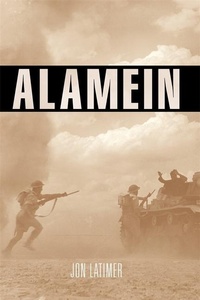
Alamein
Published on 30. March 2004
Book
Paperback/Softback
448 pages
978-0-674-01376-6 (ISBN)
Description
In this compelling account of the decisive World War II battle of El Alamein, Jon Latimer brings to life the harsh desert conflict in North Africa. In October 1942, after a two-year seesaw campaign across the wasteland of western Egypt and eastern Libya, the British Eighth Army not only achieved a significant military victory over the combined German-Italian Panzer Army but also provided an enormous psychological boost for the Allies.
This is the story of two of the most intriguing commanders of the war. Latimer offers remarkably balanced portraits of Bernard Law Montgomery, whose real achievement was overshadowed by his prickly ego, and Erwin Rommel, whose tactical brilliance could not overcome his disdain for the administrative side of war. Alamein, Latimer notes, was a victory for modern armaments, with concentrated artillery used on a scale not seen since 1918. Equally important were the critical contributions of naval and air forces in cutting off the German supply lines and supporting the ground troops, roles largely overlooked in standard accounts.
But Alamein is at heart the story of the infantry soldiers who fought in a scorched wilderness. Often using their own words, Latimer vividly describes the experiences of the gunners, sappers, cavalrymen, and airmen--Britons, Canadians, Australians, Indians, Germans, Italians, and others--who struggled in the heat, sand, and dust of this brutal environment.
With their success at El Alamein, the British forces would drive Rommel's army into Tunisia--and ultimate destruction in the North African Campaign of 1943.
This is the story of two of the most intriguing commanders of the war. Latimer offers remarkably balanced portraits of Bernard Law Montgomery, whose real achievement was overshadowed by his prickly ego, and Erwin Rommel, whose tactical brilliance could not overcome his disdain for the administrative side of war. Alamein, Latimer notes, was a victory for modern armaments, with concentrated artillery used on a scale not seen since 1918. Equally important were the critical contributions of naval and air forces in cutting off the German supply lines and supporting the ground troops, roles largely overlooked in standard accounts.
But Alamein is at heart the story of the infantry soldiers who fought in a scorched wilderness. Often using their own words, Latimer vividly describes the experiences of the gunners, sappers, cavalrymen, and airmen--Britons, Canadians, Australians, Indians, Germans, Italians, and others--who struggled in the heat, sand, and dust of this brutal environment.
With their success at El Alamein, the British forces would drive Rommel's army into Tunisia--and ultimate destruction in the North African Campaign of 1943.
Reviews / Votes
[Latimer's] extensive research is evident both in the book's organization and in the endnotes...This well-written and-organized book is highly recommended. -- Lt. Col. Charles M. Minyard * Library Journal * Exhaustively researched and comprehensive...[Latimer's] inclusion of veterans' recollections and memoirs will grab the interest of generalists looking for something more than simple war stories. Latimer's critical but balanced view of Rommel, British general Montgomery and others is welcome; the inclusion of their opinions of, and dealings with, eachother are in keeping with the best professional military history...All aspects of the battle are covered...All well presented in a carefully crafted and exciting style...Painstaking yet gripping, this should be the definitive account of the battle itself for years to come. * Publishers Weekly * Jon Latimer's Alamein is the work of a former British Army officer, a meticulous military history inclusive of accurate and often hitherto unknown details. It is a classic, near-encyclopedic reconstruction. -- John Lukas * Los Angeles Times * Latimer meticulously describes how, after a couple of dispiriting years of desert warfare, British and Commonwealth forces achieved in October 1942 the victory they craved over German and Italian forces at El Alamein in Egypt. -- Lawrence D. Freedman * Foreign Affairs *More details
Language
English
Place of publication
Cambridge, Mass
United States
Target group
Professional and scholarly
Product notice
Paperback (trade)
Unsewn / adhesive bound
Illustrations
32 halftones, 14 maps
Dimensions
Height: 231 mm
Width: 158 mm
Thickness: 29 mm
Weight
499 gr
ISBN-13
978-0-674-01376-6 (9780674013766)
Copyright in bibliographic data and cover images is held by Nielsen Book Services Limited or by the publishers or by their respective licensors: all rights reserved.
Schweitzer Classification
Person
Jon Latimer lectured at the University of Wales, Swansea, and served in the Territorial Army.
Content
List of Illustrations Acknowledgments Maps Introduction Part I: An Obscure Railway Halt 1. Colonial Rivals 2. Enter Rommel 3. The Fall of Tobruk 4. The Alamein Line 5. Malta 6. Enter Monty 7. Alam Halfa 8. Lightfoot 9. In the Line 10. Final Preparations Part II: The Battle 11. Barrage 12. The Assault 13. The Armour Stalls 14. Crisis Conference 15. Crumbling 16. The Defence of Outpost Snipe 17. Thompson's Post 18. Supercharge 19. The Beginning of the End 20. The End of the Beginning Appendix: Orders of Battle, 23 October 1942 Notes Bibliography Index