

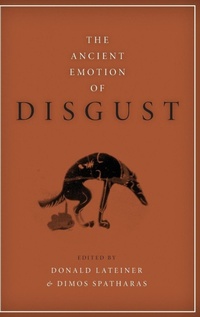
The Ancient Emotion of Disgust
Published on 1. December 2016
Book
Hardback
336 pages
978-0-19-060411-0 (ISBN)
Description
The study of emotions and emotional displays has achieved a deserved prominence in recent classical scholarship. The emotions of the classical world can be plumbed to provide a valuable heuristic tool. Emotions can help us understand key issues of ancient ethics, ideological assumptions, and normative behaviors, but, more frequently than not, classical scholars have turned their attention to "social emotions" requiring practical decisions and ethical judgments in public and private gatherings. The emotion of disgust has been unwarrantedly neglected, even though it figures saliently in many literary genres, such as iambic poetry and comedy, historiography, and even tragedy and philosophy.
This collection of seventeen essays by fifteen authors features the emotion of disgust as one cutting edge of the study of Greek and Roman antiquity. Individual contributions explore a wide range of topics. These include the semantics of the emotion both in Greek and Latin literature, its social uses as a means of marginalizing individuals or groups of individuals, such as politicians judged deviant or witches, its role in determining aesthetic judgments, and its potentialities as an elicitor of aesthetic pleasure. The papers also discuss the vocabulary and uses of disgust in life (Galli, actors, witches, homosexuals) and in many literary genres: ancient theater, oratory, satire, poetry, medicine, historiography, Hellenistic didactic and fable, and the Roman novel. The Introduction addresses key methodological issues concerning the nature of the emotion, its cognitive structure, and modern approaches to it. It also outlines the differences between ancient and modern disgust and emphasizes the appropriateness of "projective or second-level disgust" (vilification) as a means of marginalizing unwanted types of behavior and stigmatizing morally condemnable categories of individuals. The volume is addressed first to scholars who work in the field of classics, but, since texts involving disgust also exhibit significant cultural variation, the essays will attract the attention of scholars who work in a wide spectrum of disciplines, including history, social psychology, philosophy, anthropology, comparative literature, and cross-cultural studies.
This collection of seventeen essays by fifteen authors features the emotion of disgust as one cutting edge of the study of Greek and Roman antiquity. Individual contributions explore a wide range of topics. These include the semantics of the emotion both in Greek and Latin literature, its social uses as a means of marginalizing individuals or groups of individuals, such as politicians judged deviant or witches, its role in determining aesthetic judgments, and its potentialities as an elicitor of aesthetic pleasure. The papers also discuss the vocabulary and uses of disgust in life (Galli, actors, witches, homosexuals) and in many literary genres: ancient theater, oratory, satire, poetry, medicine, historiography, Hellenistic didactic and fable, and the Roman novel. The Introduction addresses key methodological issues concerning the nature of the emotion, its cognitive structure, and modern approaches to it. It also outlines the differences between ancient and modern disgust and emphasizes the appropriateness of "projective or second-level disgust" (vilification) as a means of marginalizing unwanted types of behavior and stigmatizing morally condemnable categories of individuals. The volume is addressed first to scholars who work in the field of classics, but, since texts involving disgust also exhibit significant cultural variation, the essays will attract the attention of scholars who work in a wide spectrum of disciplines, including history, social psychology, philosophy, anthropology, comparative literature, and cross-cultural studies.
Reviews / Votes
In the introduction, Lateiner and Spatharas ground the topic and the critical debates, so the volume as a whole is accessible ... The volume is directed toward scholars of classics and ancient history and those interested in the psychology and philosophy of emotions. ... Summing Up: Recommended. Upper-division undergraduates, graduate students, researchers, faculty. * P. E. Ojennus, CHOICE *More details
Series
Language
English
Place of publication
New York
United States
Target group
College/higher education
Dimensions
Height: 240 mm
Width: 161 mm
Thickness: 23 mm
Weight
672 gr
ISBN-13
978-0-19-060411-0 (9780190604110)
Copyright in bibliographic data and cover images is held by Nielsen Book Services Limited or by the publishers or by their respective licensors: all rights reserved.
Schweitzer Classification
Other editions
Additional editions
Donald Lateiner | Dimos Spatharas
The Ancient Emotion of Disgust
E-Book
10/2016
1st Edition
OUP eBook
€72.99
Available for download
Donald Lateiner | Dimos Spatharas
The Ancient Emotion of Disgust
E-Book
10/2016
1st Edition
OUP eBook
€56.99
Available for download
Persons
Donald Lateiner is an author, editor, and the Professor of Humanities in Classics, Emeritus at Ohio Wesleyan University. He has published numerous works on Classical antiquity.
Dimos Spatharas is Assistant Professor in Ancient Greek Literature at the University of Crete. He has an extensive background in study and translation of Ancient Greek history and culture.
Dimos Spatharas is Assistant Professor in Ancient Greek Literature at the University of Crete. He has an extensive background in study and translation of Ancient Greek history and culture.
Content
Preface
Introductory: Theory and Practice of an Ambivalent Emotion
Donald Lateiner (Ohio Wesleyan University)
Dimos Spatharas (University of Crete)
1. Empathy and the Limits of Disgust in the Hippocratic Corpus
George Kazantzidis (University of Patras/Open University of Cyprus)
2. Moral Disgust in Sophocles' Philoctetes
Emily Allen-Hornblower (Rutgers University)
3. Disgust and Delight: The Polysemous Exclamation Aiboi in Attic Comedy
Daniel Levine (University of Arkansas)
4. Demosthenes and the use of disgust
Nick Fisher (Cardiff University)
5. Sex, politics and disgust in Aeschines' Against Timarchus
Dimos Spatharas (University of Crete)
6. Beauty in suffering: disgust in Nicander's Theriaca
Floris Overduin (Radboud University)
7. Not Tonight, Dear-I'm Feeling a Little /pig/
Robert Kaster (Princeton University)
8. Beyond Disgust: The Politics of Fastidium in Livy's AUC
Ayelet Haimson Lushkov (University of Texas at Austin)
9. Witches, Disgust, and Anti-abortion Propaganda in Imperial Rome
Debbie Felton (University of Massachusetts, Amherst)
10. Evoking Disgust in the Latin Novels of Petronius and Apuleius
Donald Lateiner (Ohio Wesleyan University)
11. Obscena Galli praesentia: Dehumanizing Cybele's Eunuch Priests through Disgust
Marika Rauhala (University of Oulu)
12. Monstrum in fronte, monstrum in animo?: Sublate disgust and pharmakos logic in the Aesopic vitae
Tom Hawkins (The Ohio State University)
13. Smelly bodies on stage: disgusting actors of the Roman imperial period
Mali Skotheim (Princeton University)
Bibliography
Index Rerum
Index Auctorum Antiquorum et locorum
Introductory: Theory and Practice of an Ambivalent Emotion
Donald Lateiner (Ohio Wesleyan University)
Dimos Spatharas (University of Crete)
1. Empathy and the Limits of Disgust in the Hippocratic Corpus
George Kazantzidis (University of Patras/Open University of Cyprus)
2. Moral Disgust in Sophocles' Philoctetes
Emily Allen-Hornblower (Rutgers University)
3. Disgust and Delight: The Polysemous Exclamation Aiboi in Attic Comedy
Daniel Levine (University of Arkansas)
4. Demosthenes and the use of disgust
Nick Fisher (Cardiff University)
5. Sex, politics and disgust in Aeschines' Against Timarchus
Dimos Spatharas (University of Crete)
6. Beauty in suffering: disgust in Nicander's Theriaca
Floris Overduin (Radboud University)
7. Not Tonight, Dear-I'm Feeling a Little /pig/
Robert Kaster (Princeton University)
8. Beyond Disgust: The Politics of Fastidium in Livy's AUC
Ayelet Haimson Lushkov (University of Texas at Austin)
9. Witches, Disgust, and Anti-abortion Propaganda in Imperial Rome
Debbie Felton (University of Massachusetts, Amherst)
10. Evoking Disgust in the Latin Novels of Petronius and Apuleius
Donald Lateiner (Ohio Wesleyan University)
11. Obscena Galli praesentia: Dehumanizing Cybele's Eunuch Priests through Disgust
Marika Rauhala (University of Oulu)
12. Monstrum in fronte, monstrum in animo?: Sublate disgust and pharmakos logic in the Aesopic vitae
Tom Hawkins (The Ohio State University)
13. Smelly bodies on stage: disgusting actors of the Roman imperial period
Mali Skotheim (Princeton University)
Bibliography
Index Rerum
Index Auctorum Antiquorum et locorum