

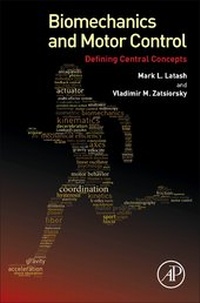
Biomechanics and Motor Control
Defining Central Concepts
Published on 22. October 2015
Book
Hardback
426 pages
978-0-12-800384-8 (ISBN)
Description
Biomechanics and Motor Control: Defining Central Concepts provides a thorough update to the rapidly evolving fields of biomechanics of human motion and motor control with research published in biology, psychology, physics, medicine, physical therapy, robotics, and engineering consistently breaking new ground.
This book clarifies the meaning of the most frequently used terms, and consists of four parts, with part one covering biomechanical concepts, including joint torques, stiffness and stiffness-like measures, viscosity, damping and impedance, and mechanical work and energy. Other sections deal with neurophysiological concepts used in motor control, such as muscle tone, reflex, pre-programmed reactions, efferent copy, and central pattern generator, and central motor control concepts, including redundancy and abundance, synergy, equilibrium-point hypothesis, and motor program, and posture and prehension from the field of motor behavior.
The book is organized to cover smaller concepts within the context of larger concepts. For example, internal models are covered in the chapter on motor programs. Major concepts are not only defined, but given context as to how research came to use the term in this manner.
This book clarifies the meaning of the most frequently used terms, and consists of four parts, with part one covering biomechanical concepts, including joint torques, stiffness and stiffness-like measures, viscosity, damping and impedance, and mechanical work and energy. Other sections deal with neurophysiological concepts used in motor control, such as muscle tone, reflex, pre-programmed reactions, efferent copy, and central pattern generator, and central motor control concepts, including redundancy and abundance, synergy, equilibrium-point hypothesis, and motor program, and posture and prehension from the field of motor behavior.
The book is organized to cover smaller concepts within the context of larger concepts. For example, internal models are covered in the chapter on motor programs. Major concepts are not only defined, but given context as to how research came to use the term in this manner.
More details
Language
English
Place of publication
San Diego
United States
Publishing group
Elsevier Science Publishing Co Inc
Target group
College/higher education
Professional and scholarly
Dimensions
Height: 229 mm
Width: 152 mm
Weight
790 gr
ISBN-13
978-0-12-800384-8 (9780128003848)
Copyright in bibliographic data and cover images is held by Nielsen Book Services Limited or by the publishers or by their respective licensors: all rights reserved.
Schweitzer Classification
Other editions
Additional editions
E-Book
10/2015
Academic Press
€57.95
Available for download
Persons
Mark Latash is a Distinguished Professor of Kinesiology and Director of the Motor Control Laboratory at the Pennsylvania State University. He received equivalents of B.S. in Physics and M.S. in Physics of Living Systems from the Moscow Institute of Physics and Technology, and a Ph.D. in Physiology from Rush University in Chicago. His research interests are focused on the control and coordination of human voluntary movements, movement disorders in neurological disorders, and effects of rehabilitation. He is the author of "Control of Human Movement? (1993) "The Neurophysiological Basis of Movement? (1998, 2008), "Synergy? (2008), and "Fundamentals of Motor Control? (2012). In addition, he edited eight books and published about 350 papers in refereed journals. Mark Latash served as the Founding Editor of the journal "Motor Control? (1996-2007) and as President of the International Society of Motor Control (2001-2005). He has served as Director of the annual Motor Control Summer School series since 2004. He is a recipient of the Bernstein Prize in motor control. Vladimir M. Zatsiorsky (b. 1932, Leningrad, USSR) is a professor at the Department of Kinesiology at Penn State University. He has authored and co-authored more than 400 scientific papers and 15 books that are published in English, Russian, German, Italian, Spanish, Portuguese, Chinese, Japanese, Polish, Bulgarian, Romanian, Czech, Hungarian and Serbo-Croatian. Among his books are Kinematics of Human Motion (1998), Kinetics of Human Motion (2002) and Biomechanics of Skeletal Muscles (2012, co-authored with B.I. Prilutsky).
Content
Preface
Part One: Biomechanical Concepts
Chapter 1. Joint Torque
Chapter 2. Stiffness and Stiffness-Like Measures
Chapter 3. Velocity-Dependent Resistance
Chapter 4. Mechanical Work and Energy
Part Two: Neurophysiological Concepts
Chapter 5. Muscle tone
Chapter 6. Reflexes
Chapter 7. Preprogrammed Reactions
Chapter 8. Efferent Copy
Chapter 9. Central Pattern Generator
Part Three: Motor Control Concepts
Chapter 10. Redundancy and Abundance
Chapter 11. Motor Synergy
Chapter 12. Equilibrium-Point Hypothesis
Chapter 13. Motor Program
Part Four: Examples of Motor Behaviors
Chapter 14. Posture
Chapter 15. Grasping
Glossary
Part One: Biomechanical Concepts
Chapter 1. Joint Torque
Chapter 2. Stiffness and Stiffness-Like Measures
Chapter 3. Velocity-Dependent Resistance
Chapter 4. Mechanical Work and Energy
Part Two: Neurophysiological Concepts
Chapter 5. Muscle tone
Chapter 6. Reflexes
Chapter 7. Preprogrammed Reactions
Chapter 8. Efferent Copy
Chapter 9. Central Pattern Generator
Part Three: Motor Control Concepts
Chapter 10. Redundancy and Abundance
Chapter 11. Motor Synergy
Chapter 12. Equilibrium-Point Hypothesis
Chapter 13. Motor Program
Part Four: Examples of Motor Behaviors
Chapter 14. Posture
Chapter 15. Grasping
Glossary