

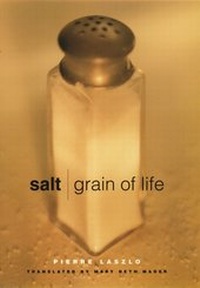
Salt
Grain of Life
Published on 27. June 2001
Book
Hardback
256 pages
978-0-231-12198-9 (ISBN)
Description
For the sake of salt, Rome created a system of remuneration (from which we get the word "salary"), nomads domesticated the camel, the Low Countries revolted against their Spanish oppressors, and Gandhi marched against the tyranny of the British. Through the ages, salt has conferred status, preserved foods, and mingled in the blood, sweat, and tears of humanity. Today, chefs of haute cuisine covet it in its most exotic forms-underground salt deposits, Hawaiian black lava salt, glittery African crystals, and pink Peruvian salt from the sea carried in bricks on the backs of llamas. From proverbs to technical arguments, from anecdotes to examples of folklore, chemist and philosopher Pierre Laszlo takes us through the kingdom of "white gold." With "enthusiasm and freshness" (Le Monde) he mixes literary analysis, history, anthropology, biology, physics, economics, art history, political science, chemistry, ethnology, and linguistics to create a full body of knowledge about the everyday substance that rocked the world and brings zest to the ordinary. Laszlo explains the history behind Morton Salt's slogan "When it rains, it pours!" and looks into the plight of the salt miner, as well as spectroscopy and nuclear magnetic resonance.
Salt is a tour de force about a chemical compound that is one of the very foundations of civilization.
Salt is a tour de force about a chemical compound that is one of the very foundations of civilization.
Reviews / Votes
Rich in fact and analysis...takes the seemingly trivial subject of salt and implies that it is not merely an essential element of life but that it is perhaps the veritable motor of human history. Gastronomica Offers a rich pickle barrel of facts and anecdotes about salt. London Review of Books Readers will never again think of salt... in the same simple way. The Washington Post Book World A breathless read... because of the suprising appeal and importance of the subject itself. Houston Chronicle History, chemistry, physics, economics, anthropology, technology... linguistics, art history... and culinary arts are all explored in this wonderful, multicultural Renaissance approach to the subject of salt... Salt is not just plain, and this book is a pleasure to read. Choice A slender, impish concoction... To say this is a quirky book is like saying Rita Hayworth was an okay-looking gal... Calvinesque in many ways-filled with lightness, delightful tangents, postmodernist hijinks. The Globe and Mail A weirdly compelling blend of chemical analysis and anecdotal history. -- Teresa Weaver The Atlanta Journal-Constitution I have been darting, delightedly, from one section to another-from Salting Herring to extreme halophiles, to Spectroscopy. It is a marvellous mosaic leavened with great charm and lightness. -- Oliver Sacks The distinction between the scientific and the nonscientific blurs. One becomes astonished that every day one samples a chemical with such a rich cultural aura-which is to say the wager by the author is a success. Le Monde Takes us through the astonishing history of this substance with lightness as well as learning... [his] observations are fascinating. -- Roy Herbert NewScientist.comMore details
Series
Language
English
Place of publication
New York
United States
Target group
Professional and scholarly
Product notice
Trade binding
Illustrations
10 halftones
Weight
425 gr
ISBN-13
978-0-231-12198-9 (9780231121989)
Copyright in bibliographic data and cover images is held by Nielsen Book Services Limited or by the publishers or by their respective licensors: all rights reserved.
Schweitzer Classification
Other editions
Additional editions
E-Book
06/2001
1st Edition
De Gruyter
from
€36.95
Available for download
Persons
Pierre Laszlo is an emeritus professor of chemistry at the University of Liege, Belgium, and the Ecole polytechnique near Paris, France. Of his many published works six have been translated into English, including Organic Reactions: Logic and Simplicity and Organic Chemistry Using Clays.
Content
Foreword, by Albert Sonnenfeld, series editor The Proverb of Salt on Lettuce Osmosis and Salt Curing Salting Herring The Cossacks of the Don The Proverb of Friendship Over Salt Food Preservation Flavor Concentrates Saucing Saumandises Cookery The Proverb on Success in Love The Salting Tub From the Salty to the Sweet: Saint Nicholas Settled and Nomadic Peoples On Camelback Mind of Salt Saint-John Perse West Salt Story, 1650-1850 Salt Routes The Proverb of the Tardy Salt Alpine Salt Lick Like the Dawn Technical Vocabularies The Proverb of the Bland Egg Salt Domes Mining The Proverb of Rejecting the Bland Solar-Evaporation Saltworks The Beginning of "Catrix" Onondaga, Success, and Decay Desalination of Seawater Technology and Social Structure National Sovereignty The Proverb of the Marsh Purchase Venice The Seeds of Modern Times The Dutch Revolt The Gabelle An Admonishment to a King Taxation A Mine Near Krakow The Warrior's Saying Citadel of Salt The Proverb of the Cardinal Points Gandhi The Salinity of the Ocean A Marine Origin? What Osmosis Consists Of The Two Kinds of Organisms Fish Thirst and Lack of Salt The Nerve Impulse Extreme Halophiles A Frenchman's Look at the Great Salt Lake Alchemy Michigan Salt Raw Material for an Industry The Age of Vinyl Salt and Cold Salt and Water The Wine Stain Slippages Water Softening Salt Glazing Invention of Spectroscopy Variation on the Same Old Tune The Saying About the Red Herring The Saugrenu Punning in the Rain From Salt to Salts Ritual and Liturgical Uses of Salt in the Bible Salt and Dance Aztec Bacchus The Proverb of the Aspersion Saltcellars Benvenuto Cellini Decorative Arts: From Colbert to Queyras The Saying on the Pinch of Salt Stendhalian Crystallization Ramakrishna's Emblem Conclusion: Ethics and Politics Popularization The Representation of History Afterword: The Union of Earth and Sea 1. Salt-Cured Foods 2. Nomads 3. Harvesting 4. Abuse of Power 5. Biology 6. Other Science Insights 7. Myths