

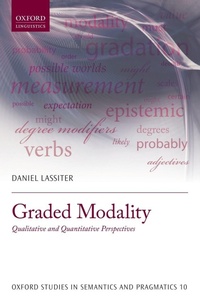
Graded Modality
Qualitative and Quantitative Perspectives
Published on 1. June 2017
Book
Hardback
296 pages
978-0-19-870134-7 (ISBN)
Description
This book explores graded expressions of modality, a rich and underexplored source of insight into modal semantics. Studies on modal language to date have largely focussed on a small and non-representative subset of expressions, namely modal auxiliaries such as must, might, and ought. Here, Daniel Lassiter argues that we should expand the conversation to include gradable modals such as more likely than, quite possible, and very good. He provides an introduction to qualitative and degree semantics for graded meaning, using the Representational Theory of Measurement to expose the complementarity between these apparently opposed perspectives on gradation. The volume explores and expands the typology of scales among English adjectives and uses the result to shed light on the meanings of a variety of epistemic and deontic modals. It also demonstrates that modality is deeply intertwined with probability and expected value, connecting modal semantics with the cognitive science of uncertainty and choice.
More details
Series
Language
English
Place of publication
Oxford
United Kingdom
Target group
College/higher education
Professional and scholarly
Dimensions
Height: 250 mm
Width: 175 mm
Thickness: 21 mm
Weight
694 gr
ISBN-13
978-0-19-870134-7 (9780198701347)
Copyright in bibliographic data and cover images is held by Nielsen Book Services Limited or by the publishers or by their respective licensors: all rights reserved.
Schweitzer Classification
Other editions
Additional editions
Book
06/2017
Oxford University Press
€63.14
Shipment within 15-20 days
E-Book
05/2017
1st Edition
OUP eBook
€28.49
Available for download
Person
Daniel Lassiter is Assistant Professor in the Department of Linguistics at Stanford University. His research combines formal tools and experimental methods from linguistics, philosophy, and computational cognitive science to work towards a unified theory of language understanding as a cognitive phenomenon. His work has appeared in journals including Natural Language Semantics, Journal of Semantics, and Cognition.
Content
Series preface
Preface
Acknowledgments
List of abbreviations
1: Gradation, scales, and degree semantics
2: Measurement theory and the typology of scales
3: Previous work on graded modality: Lewis and Kratzer
4: Epistemic adjectives: likely and probable
5: Certainty and possibility
6: Implications for the epistemic auxiliaries
7: Scalar goodness
8: Ought and should
9: Concluding remarks
References
Index
Preface
Acknowledgments
List of abbreviations
1: Gradation, scales, and degree semantics
2: Measurement theory and the typology of scales
3: Previous work on graded modality: Lewis and Kratzer
4: Epistemic adjectives: likely and probable
5: Certainty and possibility
6: Implications for the epistemic auxiliaries
7: Scalar goodness
8: Ought and should
9: Concluding remarks
References
Index