

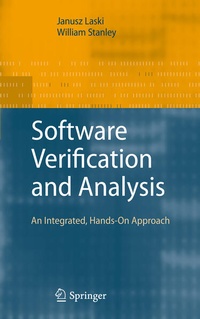
Software Verification and Analysis
An Integrated, Hands-On Approach
Published on 3. April 2009
Book
Hardback
XVIII, 234 pages
978-1-84882-239-9 (ISBN)
Description
"The situation is good, but not hopeless" (Polish folk wisdom) The text is devoted to the Software Analysis and Testing (SAT) methods and s- porting tools for assessing and, if possible, improving software quality, specifically its correctness. The term quality assurance is avoided for it is this author's firm belief that in the current state of the art that goal is unattainable, a plethora of "gu- anteed" solutions to the problem notwithstanding. Therefore, the rather awkward phrase "improving correctness" is to be understood as an effort to minimize the number of residual programming faults ("bugs") and their impact on the software's behavior, that is, to make the faults tolerable. It is clear that such a minimalist approach is a result of frustration. Indeed, having spent years developing software and teaching (preaching?) "How to do it right," I still do not know how to go about it with any degree of certainty! It appears then I probably should stop right now, for who with a modicum of common sense would reach for a text that does not offer salvation but (as will be seen) hard work and misery? If I intend to continue, it is only that I suspect there are many professionals out there who have similar doubts. And they are the intended audience of this project. The philosophical underpinning of the text is the importance of sound engine- ing practices in software development.
Reviews / Votes
From the reviews:
"Software verification is a set of important activities in the software development process that leads to determining whether the software product fulfills requirements. . It could also be very useful to software engineering researchers and practitioners. The quality of the book is enhanced by the wide range of examples that illustrate various problems and offer appropriate solutions. The physical quality of the book is extremely high." (M. Ivanovic, ACM Computing Reviews, June, 2009)
"Software verification and validation are conducted to help ensure that programs perform correctly. . While this book's subtitle indicates a 'hands-on approach,' it really takes a formal mathematical approach to describing software verification. . The book includes plenty of diagrams and figures, and it explains verification concepts with examples. This work is useful as a complement to hands-on testing books to detail the mathematical foundations of software verification. Summing Up: Recommended. Upper-division undergraduates through professionals." (H. J. Bender, Choice, Vol. 47 (3), November, 2009)More details
Edition
2009 ed.
Language
English
Place of publication
London
United Kingdom
Target group
Professional and scholarly
Professional/practitioner
Product notice
sewn/stitched
Cloth over boards
Illustrations
62 s/w Abbildungen
XVIII, 234 p. 62 illus. With online files/update.
Dimensions
Height: 242 mm
Width: 167 mm
Thickness: 28 mm
Weight
509 gr
ISBN-13
978-1-84882-239-9 (9781848822399)
DOI
10.1007/978-1-84882-240-5
Schweitzer Classification
Other editions
Additional editions
Book
10/2010
Springer
€53.49
Shipment within 15-20 days
E-Book
04/2009
1st Edition
Springer
€53.49
Available for download
Content
The Semantic Analysis.- Why Not Write Correct Software the First Time?.- How to Prove a Program Correct: Programs Without Loops.- How to Prove a Program Correct: Iterative Programs.- Prepare Test for Any Implementation: Black-Box Testing.- Static Analysis.- Intermediate Program Representation.- Program Dependencies.- What Can One Tell About a Program Without Its Execution: Static Analysis.- Dynamic Analysis.- Is There a Bug in the Program? Structural Program Testing.- Dynamic Program Analysis.