

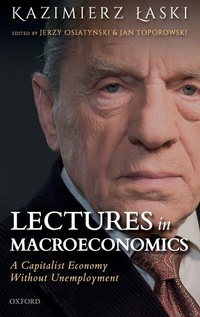
Lectures in Macroeconomics
A Capitalist Economy Without Unemployment
Published on 4. July 2019
Book
Hardback
240 pages
978-0-19-884211-8 (ISBN)
Description
Lectures in Macroeconomics: A Capitalist Economy Without Unemployment provides a systematic account of the principle of aggregate demand based on the work of Polish economist Michal Kalecki, best known as one of the originators of the Keynesian Revolution in macroeconomics.The lectures demonstrate the importance of aggregate demand in determining total output and employment in the capitalist economy. They show how the investment decisions of firms affect economic growth, arguing that due to the unstable nature of investment it is important that the government has a central role in stabilizing the economy.
This English translation of Kazimierz Laski's final work brings up to date fundamental concepts to give a picture of the twenty-first capitalist economy, and the obstacles that must be overcome in bringing it to full employment. It introduces the role of money and finance in the contemporary capitalist economy, as well as the central role of the labour market and wages. The analysis is illustrated with statistics and discussion around the evolution of capitalist economies and the rise of economic inequality since the Second World War, culminating in the 2008 crisis and the economic deflation affecting Europe since that crisis. Lectures in Macroeconomics remarks critically upon the neo-classical approach to economics that has brought about slow economic growth, unemployment, and inequality.
This English translation of Kazimierz Laski's final work brings up to date fundamental concepts to give a picture of the twenty-first capitalist economy, and the obstacles that must be overcome in bringing it to full employment. It introduces the role of money and finance in the contemporary capitalist economy, as well as the central role of the labour market and wages. The analysis is illustrated with statistics and discussion around the evolution of capitalist economies and the rise of economic inequality since the Second World War, culminating in the 2008 crisis and the economic deflation affecting Europe since that crisis. Lectures in Macroeconomics remarks critically upon the neo-classical approach to economics that has brought about slow economic growth, unemployment, and inequality.
More details
Language
English
Place of publication
Oxford
United Kingdom
Target group
College/higher education
Dimensions
Height: 240 mm
Width: 161 mm
Thickness: 17 mm
Weight
514 gr
ISBN-13
978-0-19-884211-8 (9780198842118)
Copyright in bibliographic data and cover images is held by Nielsen Book Services Limited or by the publishers or by their respective licensors: all rights reserved.
Schweitzer Classification
Other editions
Additional editions
Kazimierz Laski | Jerzy Osiatynski | Jan Toporowski
Lectures in Macroeconomics
A Capitalist Economy Without Unemployment
E-Book
07/2019
1st Edition
OUP eBook
€39.49
Available for download
Kazimierz Laski | Jerzy Osiatynski | Jan Toporowski
Lectures in Macroeconomics
A Capitalist Economy Without Unemployment
E-Book
06/2019
1st Edition
OUP eBook
€39.49
Available for download
Persons
Kazimierz Laski (1921-2015), was born in Czestochowa in Poland. Despite his Jewish origins, he survived the Second World War, fighting in the Warsaw Uprising of 1944. He studied Economics with Oskar Lange and went on to hold the Chair in Political Economy at Warsaw's Economics University, where he organized lectures by Poland's other internationally-renowned economist, Michal Kalecki. Laski was expelled from Poland in 1968 during the anti-Semitic purge, and eventually settled in Austria, where he taught at the University in Linz and researched at the Vienna Institute for Comparative Economic Studies. Even after his formal retirement Kazimierz Laski remained active, lecturing in Poland and presenting his research all over the world.
Jerzy Osiatynski studied at Warsaw School of Economics (1959-64) and at the University of Cambridge (1971-73). He has worked at the Warsaw School of Economics and at the Institute of Economics of the Polish Academy of Sciences. His research focuses on economic theory and policy, public finance, and economic development.
Jan Toporowski studied economics at Birkbeck College, University of London, and the University of Birmingham, UK. He has worked in fund management, international banking, and central banking. He has been a consultant for the Economist Intelligence Unit and various UN agencies. Jan Toporowski has published nearly three hundred papers, books and reviews on monetary theory and policy, finance, and the work of Michal Kalecki, whose biography he has recently completed.
Jerzy Osiatynski studied at Warsaw School of Economics (1959-64) and at the University of Cambridge (1971-73). He has worked at the Warsaw School of Economics and at the Institute of Economics of the Polish Academy of Sciences. His research focuses on economic theory and policy, public finance, and economic development.
Jan Toporowski studied economics at Birkbeck College, University of London, and the University of Birmingham, UK. He has worked in fund management, international banking, and central banking. He has been a consultant for the Economist Intelligence Unit and various UN agencies. Jan Toporowski has published nearly three hundred papers, books and reviews on monetary theory and policy, finance, and the work of Michal Kalecki, whose biography he has recently completed.
Content
Editor's Introduction
Preface
1: Macroeconomic concepts and analytical tools
2: Surplus of consumer goods and how it can be turned into a profit
3: Prices and the distribution of national income
4: Profits and GDP in the basic model
5: Income and GDP in the model with government
6: GDP in an open economy model
7: Endogenous money
8: Economic growth and the growth of effective demand
9: Stylized features of economic growth after World War II
Preface
1: Macroeconomic concepts and analytical tools
2: Surplus of consumer goods and how it can be turned into a profit
3: Prices and the distribution of national income
4: Profits and GDP in the basic model
5: Income and GDP in the model with government
6: GDP in an open economy model
7: Endogenous money
8: Economic growth and the growth of effective demand
9: Stylized features of economic growth after World War II