

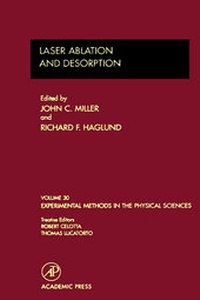
Laser Ablation and Desorption: Volume 30
Academic Press
Published on 10. December 1997
Book
Hardback
672 pages
978-0-12-475975-6 (ISBN)
Description
This volume introduces the subject of laser ablation and desorption to scientists and engineers. It covers fundamental experimental and theoretical tools, models, and techniques, and introduces the most important applications. Clearly written and organized in a straightforward manner, Laser Ablation and Desorption lead the reader straight through the fundamentals of laser-surface interactions. Each chapter is self-contained and includes references to other chapters as necessary, so that readers may begin with the topic of greatest interest and follow the references to other aspects of the subject contained within the book.
More details
Series
Language
English
Place of publication
San Diego
United States
Publishing group
Elsevier Science Publishing Co Inc
Target group
College/higher education
Professional and scholarly
Dimensions
Height: 229 mm
Width: 152 mm
Weight
1070 gr
ISBN-13
978-0-12-475975-6 (9780124759756)
Copyright in bibliographic data and cover images is held by Nielsen Book Services Limited or by the publishers or by their respective licensors: all rights reserved.
Schweitzer Classification
Other editions
Additional editions
Persons
Content
J.C. Miller, Introduction to Laser Desorption and Ablation. R.F. Haglund, Mechanisms of Laser Ablation. J.T. Dickinson, Low Fluence Laser Desorption and Plume Formation from Wide Bandgap Crystalline Materials.C. Grigoropoulos, Lasers, Optics, and Thermal Considerations in Ablation Experiments. R. Kelly, Gas Dynamics and the Characterization of Ablation Plumes. S. Schleberger, S. Speller, and W. Heiland, Surface Characterization. Z. Ball and R. Sauerbrey, Surface Modification with Lasers. R.E. Russo, Chemical Analysis by Laser Ablation. J.A. Carroll and R.C. Beavis, Matrix-Assisted Laser Desorption and Ionization. G. Edwards, Physical Mechanisms Governing the Ablationof Biological Tissue. D.H. Lowndes, Growth and Doping of Compound Semiconductor Films by Pulsed Laser Ablation. M. Reichling, Laser Ablation in Optical Components and Thin Films. R.F. Haglund, Industrial Applications of Laser Ablation. Subject Index.