

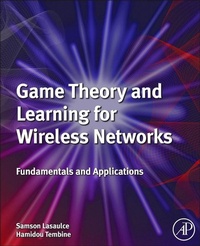
Game Theory and Learning for Wireless Networks
Fundamentals and Applications
Published on 19. August 2011
Book
Hardback
336 pages
978-0-12-384698-3 (ISBN)
Description
Written by leading experts in the field, Game Theory and Learning for Wireless Networks Covers how theory can be used to solve prevalent problems in wireless networks such as power control, resource allocation or medium access control. With the emphasis now on promoting 'green' solutions in the wireless field where power consumption is minimized, there is an added focus on developing network solutions that maximizes the use of the spectrum available.
With the growth of distributed wireless networks such as Wi-Fi and the Internet; the push to develop ad hoc and cognitive networks has led to a considerable interest in applying game theory to wireless communication systems. Game Theory and Learning for Wireless Networks is the first comprehensive resource of its kind, and is ideal for wireless communications R&D engineers and graduate students.
Samson Lasaulce is a senior CNRS researcher at the Laboratory of Signals and Systems (LSS) at Supelec, Gif-sur-Yvette, France. He is also a part-time professor in the Department of Physics at Ecole Polytechnique, Palaiseau, France.
Hamidou Tembine is a professor in the Department of Telecommunications at Supelec, Gif-sur-Yvette, France.
Merouane Debbah is a professor at Supelec, Gif-sur-Yvette, France. He is the holder of the Alcatel-Lucent chair in flexible radio since 2007.
With the growth of distributed wireless networks such as Wi-Fi and the Internet; the push to develop ad hoc and cognitive networks has led to a considerable interest in applying game theory to wireless communication systems. Game Theory and Learning for Wireless Networks is the first comprehensive resource of its kind, and is ideal for wireless communications R&D engineers and graduate students.
Samson Lasaulce is a senior CNRS researcher at the Laboratory of Signals and Systems (LSS) at Supelec, Gif-sur-Yvette, France. He is also a part-time professor in the Department of Physics at Ecole Polytechnique, Palaiseau, France.
Hamidou Tembine is a professor in the Department of Telecommunications at Supelec, Gif-sur-Yvette, France.
Merouane Debbah is a professor at Supelec, Gif-sur-Yvette, France. He is the holder of the Alcatel-Lucent chair in flexible radio since 2007.
More details
Language
English
Place of publication
San Diego
United States
Publishing group
Elsevier Science Publishing Co Inc
Target group
Professional and scholarly
University researchers and R&D engineers in the industry, graduate and PhD students in wireless communications
Product notice
Unsewn / adhesive bound
Paper over boards
Illustrations
Approx. 200 illustrations
Dimensions
Height: 243 mm
Width: 197 mm
Thickness: 20 mm
Weight
849 gr
ISBN-13
978-0-12-384698-3 (9780123846983)
Copyright in bibliographic data and cover images is held by Nielsen Book Services Limited or by the publishers or by their respective licensors: all rights reserved.
Schweitzer Classification
Other editions
Additional editions
Samson Lasaulce | Hamidou Tembine
Game Theory and Learning for Wireless Networks
Fundamentals and Applications
Book
10/2018
Academic Press
€79.22
The article will not be published
MSc Lasaulce BSc | MSc Tembine BSc
Game Theory and Learning for Wireless Networks
Fundamentals and Applications
E-Book
09/2011
Academic Press
€78.95
Available for download
Persons
Samson received his BSc and Agregation degree in Applied Physics from Ecole Normale Superieure (Cachan) and his MSc and PhD in Signal Processing from Ecole Nationale Superieure des Telecommunications (Paris). Professional experience. He has been working with Motorola Labs for three years (1999, 2000, 2001) and with France Telecom R&D for two years (2002, 2003). Since 2004, he has joined the CNRS and Supelec. Since 2004, he is also Charge d'Enseignement at Ecole Polytechnique. His broad interests lie in the areas of communications, signal processing and information theory with a special emphasis on game theory for wireless communications. Samson Lasaulce is the recipient of the 2007 ACM/ICST International Conference on Performance Evaluation Methodologies and Tools (VALUETOOLS) and 2009 International Conference on Cognitive Radio Oriented Wireless Networks and Communications (CROWNCOM) best student paper awards. Elena Veronica Belmega, who is a PhD student under my supervision, was awarded with the 2009 Academy of Sciences - L'Oreal - Unesco award for young women in sciences in France. Hamidou Tembine (born November 4, 1982, in Orsongo, Dogon Country, West Africa) is a French game theorist and researcher specializing in evolutionary games and co-opetitive mean-field-type games. He has been a Global Network Assistant Professor at New York University. He has been also the principal investigator and director of the Game Theory and Learning Laboratory (L&G Lab) at New York University.[1] Tembine has written about 300 research articles, 5 books, and co-edited 3 books. His research is focused in the areas of auto-regulation, self-regulation, knowledge-based economy and variance minimization of tokens in emerging markets.[
Content
Preface and Introduction.
Part A Games with Complete Information
A1 A short tour of game theory
A2 Playing with equilibria in wireless non-cooperative games
A3 Moving from static to dynamic game
A4 Coalitional games
Part B Games with complete information and learning
B1 Bayesian games
B2 Partially distributed learning algorithms
B3 Fully distributed learning algorithms
Part C Case Studies
C1 Fundamentals of wireless communications
C2 Energy-efficient power control games
C3 Rate-efficient power allocation games
C4 Medium access control games
Part D Appendices
Bibliography and index
Part A Games with Complete Information
A1 A short tour of game theory
A2 Playing with equilibria in wireless non-cooperative games
A3 Moving from static to dynamic game
A4 Coalitional games
Part B Games with complete information and learning
B1 Bayesian games
B2 Partially distributed learning algorithms
B3 Fully distributed learning algorithms
Part C Case Studies
C1 Fundamentals of wireless communications
C2 Energy-efficient power control games
C3 Rate-efficient power allocation games
C4 Medium access control games
Part D Appendices
Bibliography and index