

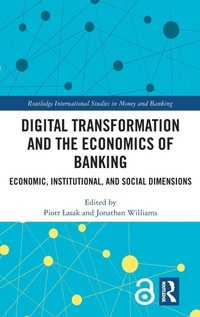
Digital Transformation and the Economics of Banking
Economic, Institutional, and Social Dimensions
1st Edition
Published on 7. November 2023
Book
Hardback
226 pages
978-1-032-37493-2 (ISBN)
Description
The book provides deep insight into the processes of digital transformation of banking according to economic, institutional, and social dimensions. Together with the transformation of incumbent banks, the processes result in changes in the scope of existing banking services. Moreover, new entities (FinTech firms) partner with incumbent banks and reshape the banking sector and its financial environment.
The far-reaching transformation of banks and the banking sectors is accompanied by some institutional and socioeconomic processes. Regarding institutional processes, the book provides insight into the digitalization of the banking sector from a legal point of view. Traditionally, banking is strongly regulated by norms and rules and this status should be maintained when new entities are entering the sector and/or when new technological solutions contribute to the provision of banking services. Regarding socioeconomic processes, it must be highlighted that digitalization is exerting a powerful impact on societies. One significant example, among others, is the increase in the financial inclusion of disadvantaged groups (especially customers either underserved by the traditional financial sector or unbanked). The socioeconomic aspect, however, has a much greater dimension and its selected aspects are described in this book.
The principal audience of the book will be scholars in the fields of banking and finance, but also other related disciplines in the social sciences that are of particular relevance to the banking sector's digital transformation. This includes legal science, management, and psychology. The book also targets professionals in the financial industry interested in the impact of new financial technologies on banking sectors and bank services, particularly with a main focus on legal and socioeconomic dimensions.
Chapter 10 of this book is freely available as a downloadable Open Access PDF at http://www.taylorfrancis.com under a Creative Commons Attribution-Non Commercial-No Derivatives (CC-BY-NC-ND) 4.0 license.
The far-reaching transformation of banks and the banking sectors is accompanied by some institutional and socioeconomic processes. Regarding institutional processes, the book provides insight into the digitalization of the banking sector from a legal point of view. Traditionally, banking is strongly regulated by norms and rules and this status should be maintained when new entities are entering the sector and/or when new technological solutions contribute to the provision of banking services. Regarding socioeconomic processes, it must be highlighted that digitalization is exerting a powerful impact on societies. One significant example, among others, is the increase in the financial inclusion of disadvantaged groups (especially customers either underserved by the traditional financial sector or unbanked). The socioeconomic aspect, however, has a much greater dimension and its selected aspects are described in this book.
The principal audience of the book will be scholars in the fields of banking and finance, but also other related disciplines in the social sciences that are of particular relevance to the banking sector's digital transformation. This includes legal science, management, and psychology. The book also targets professionals in the financial industry interested in the impact of new financial technologies on banking sectors and bank services, particularly with a main focus on legal and socioeconomic dimensions.
Chapter 10 of this book is freely available as a downloadable Open Access PDF at http://www.taylorfrancis.com under a Creative Commons Attribution-Non Commercial-No Derivatives (CC-BY-NC-ND) 4.0 license.
More details
Series
Language
English
Place of publication
London
United Kingdom
Publishing group
Taylor & Francis Ltd
Target group
College/higher education
Postgraduate
Illustrations
17 s/w Abbildungen, 17 s/w Zeichnungen, 8 s/w Tabellen
8 Tables, black and white; 17 Line drawings, black and white; 17 Illustrations, black and white
Dimensions
Height: 240 mm
Width: 161 mm
Thickness: 18 mm
Weight
537 gr
ISBN-13
978-1-032-37493-2 (9781032374932)
Copyright in bibliographic data and cover images is held by Nielsen Book Services Limited or by the publishers or by their respective licensors: all rights reserved.
Schweitzer Classification
Other editions
Additional editions
Piotr Lasak | Jonathan Williams
Digital Transformation and the Economics of Banking
Economic, Institutional, and Social Dimensions
Book
05/2025
1st Edition
Routledge
€67.40
Shipment within 10-20 days
Piotr Lasak | Jonathan Williams
Digital Transformation and the Economics of Banking
Economic, Institutional, and Social Dimensions
E-Book
11/2023
1st Edition
Routledge
€52.49
Available for download
Piotr Lasak | Jonathan Williams
Digital Transformation and the Economics of Banking
Economic, Institutional, and Social Dimensions
E-Book
11/2023
1st Edition
Routledge
€52.49
Available for download
Persons
Piotr Lasak is Associate Professor at the Institute of Economics, Finance and Management, Jagiellonian University in Krakow, Poland.
Jonathan Williams is Professor of Banking and Finance in the Department of Finance and Accounting and Centre for Sustainable and Explainable FinTech at Surrey Business School.
Jonathan Williams is Professor of Banking and Finance in the Department of Finance and Accounting and Centre for Sustainable and Explainable FinTech at Surrey Business School.
Content
1. Introduction (Piotr Lasak, Jonathan Williams) 2. The Redesign of the Internal Governance of Financial Institutions in Times of Artificial Intelligence: New Challenges, New Approaches, Old Issues (Michal Nowakowski) 3. From Digital Technologies to New Economics in Banking: How to Drive the Future of Digital Money and Data Information Knowledge (Anna Omarini) 4. Banking-as-a-Service and Embedded Banking as Innovative Methods of Providing Banking Services (Krzysztof Waliszewski) 5. Financial Inclusion: Is Financial Technology the Solution? (Danilo Abis, Patrizia Pia) 6. Ethical FinTech. The Importance of Ethics in Creating Secure Financial Products and Services (Michal Nowakowski) 7. Gender Disparity in the FinTech Sector: Systematic Literature Review (Blazej Prusak, Lukasz Waclawek) 8. FinTech and Sustainability: Does FinTech Firms' SDG-orientation Play a Role in the Bank-FinTech Relationship? (Stefano Cosma, Daniela Pennetta) 9. FinTech and ESG: A Happy Union? (Timothy King) 10. Sustainability, Public Security, and Privacy Concerns regarding Central Bank Digital Currency (CBDC) (Robert Rybski) 11. Electronic Money Institution as an Example of FinTech Sector Regulation: The Case of Poland (Grzegorz Kuca, Pawel Woroniecki) 12. Legal Guarantees of Access to a Payment Account - Analysis from the Perspective of the Account Information Service Provider (Jan Byrski, Michal Synowiec) 13. The Role of Blockchain Governance in Banks' Transformation Toward Ecosystem-based Banking (Piotr Lasak)