

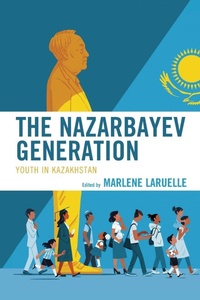
The Nazarbayev Generation
Youth in Kazakhstan
Published on 2. July 2021
Book
Paperback/Softback
354 pages
978-1-7936-0915-1 (ISBN)
Description
This social and cultural analysis provides a new understanding of Kazakhstan's younger generations that emerged during the rule of Nursultan Nazarbayev, who has been presiding over Kazakhstan for the thirty years since the collapse of the Soviet Union. Half of Kazakhstan's population was born after he took power and have no direct memory of the Soviet regime. Since the early 2000s, they have lived in a world of political stability and relative material affluence, and have developed a strong consumerist culture. Even with growing government restrictions on media, religion, and formal public expression, they have been raised in a comparatively free country. This book offers the first collective study of the "Nazarbayev Generation," illuminating the diversity of the country's younger generations and the transformations of social and cultural norms that have taken place over the course of three decades. The contributors to this collection move away from state-centric, top-down perspectives in favor of grassroots realities and bottom-up dynamics in order to better integrate sociological data.
Reviews / Votes
What Marlene Laruelle's book does is to help us make sense of this and think critically about Kazakhstan and the reception of globalised norms and liberal values in non-Western societies. Such an intervention is not only informative, but also necessary for anyone trying to make sense of underlying forces shaping our world today. * Middle East Monitor * In this timely volume edited by Marlene Laruelle, various aspects of Nazarbayev's legacy are examined in fifteen separate chapters engaged with understanding Kazakhstani youth attitudes, behaviors, and experiences. Through its multifaceted perspectives on the 50 percent of the country's population that was born during Nazarbayev's reign, the book offers keen insights into the cultural, social, and political context of the current transitional moment. Collectively, the chapters in this book delineate the attitudinal differences between the younger and older generations in Kazakhstan, while also tempering the expectation that the youth will uniformly push for more political liberalization as they gain political and social power in the coming years. * The Russian Review * This impressive and timely volume provides us with survey data and cross-disciplinary analysis of Kazakhstan's independence generations. Its focus on social transformations of the last three decades is an important contribution to breaking with established, and increasingly irrelevant, narratives about the region of Central Asia. -- Nargis Kassenova, Harvard UniversityMore details
Series
Language
English
Place of publication
United States
Publishing group
Bloomsbury Publishing Plc
Target group
Professional and scholarly
Illustrations
21 b/w illustrations;22 tables;
Dimensions
Height: 229 mm
Width: 152 mm
Thickness: 18 mm
Weight
496 gr
ISBN-13
978-1-7936-0915-1 (9781793609151)
Copyright in bibliographic data and cover images is held by Nielsen Book Services Limited or by the publishers or by their respective licensors: all rights reserved.
Schweitzer Classification
Other editions
Additional editions
The Nazarbayev Generation
Youth in Kazakhstan
E-Book
08/2019
1st Edition
Lexington Books
€40.99
Available for download
Persons
Marlene Laruelle is research professor, director of the Central Asia Program, and associate director of the Institute for European, Russian, and Eurasian Studies (IERES) at the Elliott School of International Affairs of George Washington University.
Content
Introduction: "The Nazarbayev Generation: A Sociological Portrait," by Marlene Laruelle
Part I: Kazakhstani Youth and National Identity
Chapter 1: "Are Youth Different? The Nazarbayev Generation and Public Opinion," by Barbara Junisbai and Azamat Junisbai
Chapter 2: "Youth and National Identity: Then and Now," by Aziz Burkhanov
Chapter 3: "Youth and Civic National Identity," by Dina Sharipova
Chapter 4: "Mankurts, Kazakh 'Russians' and 'Shala' Kazakhs: Language, National Identity, and Ethnicity Revisited," by Diana T. Kudaibergenova
Part II: Youth Voices on Moral Changes
Chapter 5: "'We Love Our Country in Our Own Way': Youth, Gender, and Nationalism," by Ulan Bigozhin
Chapter 6: "'Cognitive Unconscious,' 'Modern Conservatism,' and 'Core Liberal Values' in the Context of Chapter 7: "Youth's National Identity," by Galym Zhussipbek and Zhanar Nagayeva
Chapter 8: "Contours of Ethnonational Landscapes in Three Cities: Youths' Perspectives on Ethnic and Social Integration," by Reuel R. Hanks
Part I
Part I: Kazakhstani Youth and National Identity
Chapter 1: "Are Youth Different? The Nazarbayev Generation and Public Opinion," by Barbara Junisbai and Azamat Junisbai
Chapter 2: "Youth and National Identity: Then and Now," by Aziz Burkhanov
Chapter 3: "Youth and Civic National Identity," by Dina Sharipova
Chapter 4: "Mankurts, Kazakh 'Russians' and 'Shala' Kazakhs: Language, National Identity, and Ethnicity Revisited," by Diana T. Kudaibergenova
Part II: Youth Voices on Moral Changes
Chapter 5: "'We Love Our Country in Our Own Way': Youth, Gender, and Nationalism," by Ulan Bigozhin
Chapter 6: "'Cognitive Unconscious,' 'Modern Conservatism,' and 'Core Liberal Values' in the Context of Chapter 7: "Youth's National Identity," by Galym Zhussipbek and Zhanar Nagayeva
Chapter 8: "Contours of Ethnonational Landscapes in Three Cities: Youths' Perspectives on Ethnic and Social Integration," by Reuel R. Hanks
Part I