

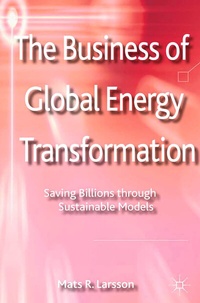
The Business of Global Energy Transformation
Saving Billions through Sustainable Models
Published on 25. September 2012
Book
Paperback/Softback
XVII, 222 pages
978-1-349-43854-9 (ISBN)
Description
One of the first books to analyze business and financial aspects of sustainable transport and fuels systems and provides novel insights for researchers, managers, and politicians who work in energy and sustainability related areas.
Reviews / Votes
"Mats Larsson has written an important book with wide scope and a precise message we must organise for a potentially dire future. It is a future without enough energy if we continue to pretend it is OK to do 'business as usual'. His important insight is that we, globally, must develop new organisational capacities to manage massive change if we are to survive. A must read!" -John Kidd, Research Fellow, Aston Business School
More details
Edition
1st ed. 2012
Language
English
Place of publication
London
United Kingdom
Target group
Professional and scholarly
Illustrations
XVII, 222 p.
Dimensions
Height: 235 mm
Width: 155 mm
Thickness: 14 mm
Weight
376 gr
ISBN-13
978-1-349-43854-9 (9781349438549)
DOI
10.1057/9781137024497
Schweitzer Classification
Other editions
Additional editions
Book
09/2012
Palgrave Macmillan
€106.99
Shipment within 10-20 days
Person
MATS R. LARSSON has worked for 20 years as a business consultant and is also the founder of the Global Energy Transformation Institute. He is an expert in business strategy, innovations and entrepreneurship, and has worked extensively both with large companies and individual entrepreneurs in several technology and business areas. In the past six years he has worked with large scale energy systems transformation.
Content
List of Tables List of Figures Acknowledgements Target Audiences I Mean 'Business!' PART I: EMERGING TRANSPORT AND ENERGY SYSTEMS - A FOUNDATION FOR GROWTH The Need for Large Scale Energy Systems Transformation Not Technology, but 'Orgware,' Business, and Financing What Will Happen if We Fail? How to Identify Lack of Business 'Orgware' The Contents of Business 'Orgware'? Four Categories of 'Orgware' Geographical Aspects of 'Orgware' PART II: EMERGING ENERGY SYSTEMS - SUSTAINABLE BUSINESS MODELS Business Situations Business Situations, Technologies, and Emerging Business Models Smart Grids and New and Visionary Materials Technologies Development Opportunities for Well Established Technologies PART III: THE DEVELOPMENT OF KNOWLEDGE AND 'ORGWARE' Development of a Visual Model and Decision Making Method The Role of 'Orgware' in Energy Systems Transformation Doing the Right Thing Important Aspects of Change Management Conclusions