

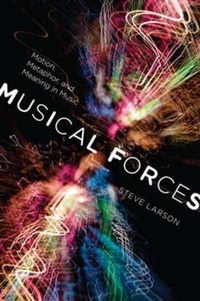
Musical Forces
Motion, Metaphor, and Meaning in Music
Published on 31. January 2012
Book
Hardback
390 pages
978-0-253-35682-6 (ISBN)
Description
Steve Larson drew on his 20 years of research in music theory, cognitive linguistics, experimental psychology, and artificial intelligence-as well as his skill as a jazz pianist-to show how the experience of physical motion can shape one's musical experience. Clarifying the roles of analogy, metaphor, grouping, pattern, hierarchy, and emergence in the explanation of musical meaning, Larson explained how listeners hear tonal music through the analogues of physical gravity, magnetism, and inertia. His theory of melodic expectation goes beyond prior theories in predicting complete melodic patterns. Larson elegantly demonstrated how rhythm and meter arise from, and are given meaning by, these same musical forces.
Reviews / Votes
Musical: Forces: Motion, Metaphor, and Meaning in Music will find a ready place in academic collections supporting study in advanced theory and musical cognition. It is well written, easy to understand, and full of good examples. The introduction by itself is a fine survey of the dialogue concerning musical meaning. By giving such an introduction, Larson's theories may well be understood as a part of an ongoing discussion.(Music Reference Services Quarterly) The potential benefits of Larson's theory of musical forces include a more explicit understanding of how we make meaning from musical experience, which in turn includes a richer understanding of the aspects of music cognition and metaphoric reasoning . . . .
(Music Theory Online) It's hard to talk about music without using the language of motion. . . Steve Larson thoughtfully integrates several seemingly disparate disciplinary threads in music theory and cognitive science in an attempt to understand why we experience music this way. His account places three musical forces-gravity, magne- tism, and inertia-at the center of the explanation. April 2013
(Music Perception) One can read between the lines that the publication of this book was a labor-of-love for Editor Robert S. Hatten, who describes it as 'a fitting memorial to his (Steve Larson's) visionary ideas, his love of music, and his passion for sharing both.'August 2013
(TRIANGLE MAGAZINE)
More details
Language
English
Place of publication
Bloomington, IN
United States
Target group
Professional and scholarly
College/higher education
Product notice
Paper over boards
Illustrations
10 b&w illus., 71 music exx.
Dimensions
Height: 233 mm
Width: 159 mm
Thickness: 38 mm
Weight
762 gr
ISBN-13
978-0-253-35682-6 (9780253356826)
Copyright in bibliographic data and cover images is held by Nielsen Book Services Limited or by the publishers or by their respective licensors: all rights reserved.
Schweitzer Classification
Other editions
Additional editions
E-Book
01/2012
1st Edition
Indiana University Press
from
€57.79
Available for download
Person
Steve Larson (1955-2011) was the Robert M. Trotter Professor of Music at the University of Oregon and a member of its Institute of Cognitive and Decision Sciences. He was author of Analyzing Jazz: A Schenkerian Approach.
Content
Acknowledgments
Preface
1. Introduction
I. A Theory of Musical Forces
2. Thinking about Music and Thinking in Music-Pattern, Meaning, Analogy, Metaphor, and Hierarchies
3. Something in the Way She Moves-The Metaphor of Musical Motion
4. Melodic Forces-Gravity, Magnetism, and Inertia
5. A Theory of Melodic Expectation
6. Rhythm, Meter, and Musical Forces
7. Analyses
II. Evidence for Musical Forces
8. Converging Evidence-An Introduction to Part Two
9. Evidence from Experiments in Visual-Perception and Neuroscience
10. Evidence from Compositions and Improvisations
11. Evidence from Music-Theoretical Misunderstandings
12. Evidence from a Listener-Judgment Experiment
13. Evidence from Comparing Computer Models With Production-Experiment Results
III. Conclusion
14. Summary and Prospects
Glossary
Notes
Bibliography
Index
Preface
1. Introduction
I. A Theory of Musical Forces
2. Thinking about Music and Thinking in Music-Pattern, Meaning, Analogy, Metaphor, and Hierarchies
3. Something in the Way She Moves-The Metaphor of Musical Motion
4. Melodic Forces-Gravity, Magnetism, and Inertia
5. A Theory of Melodic Expectation
6. Rhythm, Meter, and Musical Forces
7. Analyses
II. Evidence for Musical Forces
8. Converging Evidence-An Introduction to Part Two
9. Evidence from Experiments in Visual-Perception and Neuroscience
10. Evidence from Compositions and Improvisations
11. Evidence from Music-Theoretical Misunderstandings
12. Evidence from a Listener-Judgment Experiment
13. Evidence from Comparing Computer Models With Production-Experiment Results
III. Conclusion
14. Summary and Prospects
Glossary
Notes
Bibliography
Index