

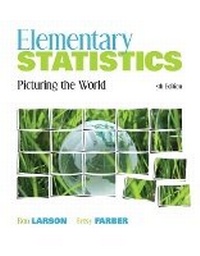
Elementary Statistics
Picturing the World
5th Edition
Published on 24. December 2010
Book
Mixed media product
784 pages
978-0-321-69362-4 (ISBN)
Description
Elementary Statistics: Picturing the World, Fifth Edition, offers our most accessible approach to statistics-with more than 750 graphical displays that illustrate data, readers are able to visualize key statistical concepts immediately. Adhering to the philosophy that students learn best by doing, this book relies heavily on examples-25% of the examples and exercises are new for this edition. Larson and Farber continue to demonstrate that statistics is all around us and that it's easy to understand. Note: This is the standalone Book/CD, if the customer wants the Book/CD and Access Card they should order the ISBN below: 0321891872 / 9780321891877 Elementary Statistics: Picturing the World Plus MyStatLab with Pearson eText -- Access Card Package Package consists of: 0321693620 / 9780321693624 Elementary Statistics: Picturing the World 0321847997 / 9780321847997 My StatLab Glue-in Access Card 032184839X / 9780321848390 MyStatLab Inside Sticker for Glue-In Packages
More details
Edition
5th edition
Language
English
Place of publication
United States
Publishing group
Pearson Education (US)
Target group
College/higher education
Dimensions
Height: 241 mm
Width: 267 mm
Thickness: 33 mm
Weight
1750 gr
ISBN-13
978-0-321-69362-4 (9780321693624)
Copyright in bibliographic data is held by Nielsen Book Services Limited or its licensors: all rights reserved.
Schweitzer Classification
Other editions
New editions
Book
06/2014
6th Edition
Pearson
€236.94
Article exhausted; check different version
Previous edition
Book
01/2008
4th Edition
Pearson
€77.85
Article exhausted; check for reprint
Persons
Ron Larson received his PhD in mathematics from the University of Colorado in 1970. At that time he accepted a position with Penn State University, and he currently holds the rank of professor of mathematics at the University. Dr. Larson is the lead author of more than two dozen mathematics textbooks that range from sixth grade through calculus levels. Betsy Farber received her Bachelor's degree in mathematics form Penn State University and Master's degree in mathematics from the College of New Jersey. Since 1976, she has been teaching all levels of mathematics at Bucks County Community College in Newton, Pennsylvania, where she currently holds the rank of professor. She is particularly interested in developing new ways to make statistics relevant and interesting to her students and has been teaching statistics in many different modes - with TI-83/84, with MINITAB, and by distance learning as well as in the traditional classroom.
Content
Part One. Descriptive Statistics 1. Introduction to Statistics1.1. An Overview of Statistics1.2. Data Classification1.3. Data Collection and Experimental Design 2. Descriptive Statistics2.1. Frequency Distributions and Their Graphs2.2. More Graphs and Displays2.3. Measures of Central Tendency2.4. Measures of Variation2.5. Measures of Position Part Two. Probability & Probability Distributions 3. Probability3.1. Basic Concepts of Probability and Counting3.2. Conditional Probability and the Multiplication Rule3.3. The Addition Rule3.4. Additional Topics in Probability and Counting 4. Discrete Probability Distributions4.1. Probability Distributions4.2. Binomial Distributions4.3. More Discrete Probability Distributions 5. Normal Probability Distributions5.1. Introduction to Normal Distributions and the Standard Normal Distribution5.2. Normal Distributions: Finding Probabilities5.3. Normal Distributions: Finding Values5.4. Sampling Distributions and the Central Limit Theorem5.5. Normal Approximations to Binomial Distributions Part Three. Statistical Inference 6. Confidence Intervals6.1. Confidence Intervals for the Mean (Large Samples)6.2. Confidence Intervals for the Mean (Small Samples)6.3. Confidence Intervals for Population Proportions6.4. Confidence Intervals for Variance and Standard Deviation 7. Hypothesis Testing with One Sample7.1. Introduction to Hypothesis Testing7.2. Hypothesis Testing for the Mean (Large Samples)7.3. Hypothesis Testing for the Mean (Small Samples)7.4. Hypothesis Testing for Proportions7.5. Hypothesis Testing for Variance and Standard Deviation 8. Hypothesis Testing with Two Samples8.1. Testing the Difference Between Means (Large Independent Samples)8.2. Testing the Difference Between Means (Small Independent Samples)8.3. Testing the Difference Between Means (Dependent Samples)8.4. Testing the Difference Between Proportions Part Four. More Statistical Inference 9. Correlation and Regression9.1 Correlation9.2. Linear Regression9.3. Measures of Regression and Prediction Intervals9.4. Multiple Regression 10. Chi-Square Tests and the F-Distribution10.1. Goodness-of-Fit Test10.2. Independence10.3. Comparing Two Variances10.4. Analysis of Variance 11. Nonparametric Tests11.1. The Sign Test11.2. The Wilcoxon Tests11.3. The Kruskal-Wallis Test11.4. Rank Correlation11.5. The Runs Test Appendix A. Alternative Presentation of the Standard Normal Distribution Standard Normal Distribution Table (0-to-z) Alternative Presentation of the Standard Normal DistributionAppendix B. Tables Table 1 Random Numbers Table 2 Binomial Distribution Table 3 Poisson Distribution Table 4 Standard Normal Distribution Table 5 t-Distribution Table 6 Chi-Square Distribution Table 7 F-Distribution Table 8 Critical Values for the Sign Test Table 9 Critical Values for the Wilcoxon Signed-Rank Test Table 10 Critical Values for the Spearman Rank Correlation Table 11 Critical Values for the Pearson Correlation Coefficient Table 12 Critical Values for the Number of RunsAppendix C. Normal Probability Plots and Their Graphs Answers to the Try It Yourself ExercisesOdd AnswersIndexPhoto Credits