

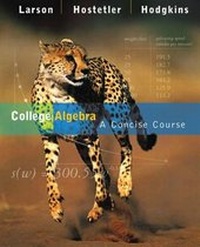
College Algebra
A Concise Course
Published on 1. February 2005
Book
Hardback
560 pages
978-0-618-49276-3 (ISBN)
Description
College Algebra: A Concise Course provides a solid understanding of algebra, using modeling techniques and real-world data applications. The text is effective for students who will continue on in mathematics, as well as for those who will end their mathematics education with college algebra. Instructors may also take advantage optional discovery and exploration activities that use technology and are integrated throughout the text. A full version of this text, College Algebra: Concepts and Models, provides additional introductory review.
Reviews / Votes
Note: Each chapter includes an Opener, Mid-Chapter Quiz, Make a Decision Project, Summary, Review Exercises, and Test. 1. Functions and Graphs 1.1 Graphs of Equations 1.2 Lines in the Plane 1.3 Linear Modeling and Direct Variation 1.4 Functions 1.5 Graphs of Functions 1.6 Transformations of Functions 1.7 The Algebra of Functions 1.8 Inverse Functions 2. Polynomial and Rational Functions 2.1 Quadratic Functions and Models 2.2 Polynomial Functions of Higher Degree 2.3 Polynomial Division 2.4 Real Zeros of Polynomial Functions 2.5 Complex Numbers 2.6 The Fundamental Theorem of Algebra 2.7 Rational Functions 3. Exponential and Logarithmic Functions 3.1 Exponential Functions 3.2 Logarithmic Functions 3.3 Properties of Logarithms 3.4 Solving Exponential and Logarithmic Equations 3.5 Exponential and Logarithmic Models Cumulative Test: Chapters 1-3 4. Systems of Equations and Inequalities 4.1 Solving Linear Systems Using Substitution 4.2 Solving Linear Systems Using Elimination 4.3 Linear Systems in Three or More Variables 4.4 Systems of Inequalities 5. Matrices and Determinants 5.1 Matrices and Linear Systems 5.2 Operations with Matrices 5.3 The Inverse of a Square Matrix 5.4 The Determinant of a Square Matrix 5.5 Applications of Matrices and Determinants 6. Sequences, Series, and Probability 6.1 Sequences and Summation Notation 6.2 Arithmetic Sequences and Partial Sums 6.3 Geometric Sequences and Series 6.4 The Binomial Theorem 6.5 Counting Principles 6.6 Probability Cumulative Test: Chapters 4-6 Appendices A. An Introduction to Graphing Utilities B. Conic Sections B.1 Conic Sections B.2 Conic Sections and Translations Additional Topics Available on the Web and CD: Review Chapters Fundamental Concepts of Algebra Equations and Inequalities Optional Sections Linear Programming (to accompany Chapter 4) Mathematical Induction (to accompany Chapter 6) Optional Appendix Further Concepts in Statistics (For these additional topics and other resources, please visit math.college.hmco.com/instructors)More details
Language
English
Place of publication
Boston
United States
Publishing group
Cengage Learning, Inc
Target group
College/higher education
Dimensions
Height: 261 mm
Width: 206 mm
Thickness: 26 mm
Weight
1233 gr
ISBN-13
978-0-618-49276-3 (9780618492763)
Copyright in bibliographic data and cover images is held by Nielsen Book Services Limited or by the publishers or by their respective licensors: all rights reserved.
Schweitzer Classification
Persons
Anne Hodgkins received her Ed.D. in higher education from Texas A&M University at Commerce in 1990. She has taught at the secondary, community college and university levels. She currently teaches at Phoenix College in Phoenix, Arizona. She especially enjoys teaching intermediate and college algebra as well as calculus. Her interests include math education and research in mathematics teaching strategies. The Pennsylvania State University, The Behrend College Bio: Robert P. Hostetler received his Ph.D. in mathematics from The Pennsylvania State University in 1970. He has taught at Penn State for many years and has authored several calculus, precalculus, and intermediate algebra textbooks. His teaching specialties include remedial algebra, calculus, and math education, and his research interests include mathematics education and textbooks. Dr. Ron Larson is a professor of mathematics at The Pennsylvania State University, where he has taught since 1970. He received his Ph.D. in mathematics from the University of Colorado and is considered the pioneer of using multimedia to enhance the learning of mathematics, having authored over 30 software titles since 1990. Dr. Larson conducts numerous seminars and in-service workshops for math educators around the country about using computer technology as an instructional tool and motivational aid. He is the recipient of the 2013 Text and Academic Authors Association Award for CALCULUS, the 2012 William Holmes McGuffey Longevity Award for CALCULUS: AN APPLIED APPROACH, the 2011 William Holmes McGuffey Longevity Award for PRECALCULUS: REAL MATHEMATICS, REAL PEOPLE, and the 1996 Text and Academic Authors Association TEXTY Award for INTERACTIVE CALCULUS (a complete text on CD-ROM that was the first mainstream college textbook to be offered on the Internet). Dr. Larson authors numerous textbooks including the best-selling Calculus series published by Cengage Learning.
Content
Note: Each chapter includes an Opener, Mid-Chapter Quiz, Make a Decision Project, Summary, Review Exercises, and Test. 1. Functions and Graphs 1.1 Graphs of Equations 1.2 Lines in the Plane 1.3 Linear Modeling and Direct Variation 1.4 Functions 1.5 Graphs of Functions 1.6 Transformations of Functions 1.7 The Algebra of Functions 1.8 Inverse Functions 2. Polynomial and Rational Functions 2.1 Quadratic Functions and Models 2.2 Polynomial Functions of Higher Degree 2.3 Polynomial Division 2.4 Real Zeros of Polynomial Functions 2.5 Complex Numbers 2.6 The Fundamental Theorem of Algebra 2.7 Rational Functions 3. Exponential and Logarithmic Functions 3.1 Exponential Functions 3.2 Logarithmic Functions 3.3 Properties of Logarithms 3.4 Solving Exponential and Logarithmic Equations 3.5 Exponential and Logarithmic Models Cumulative Test: Chapters 1-3 4. Systems of Equations and Inequalities 4.1 Solving Linear Systems Using Substitution 4.2 Solving Linear Systems Using Elimination 4.3 Linear Systems in Three or More Variables 4.4 Systems of Inequalities 5. Matrices and Determinants 5.1 Matrices and Linear Systems 5.2 Operations with Matrices 5.3 The Inverse of a Square Matrix 5.4 The Determinant of a Square Matrix 5.5 Applications of Matrices and Determinants 6. Sequences, Series, and Probability 6.1 Sequences and Summation Notation 6.2 Arithmetic Sequences and Partial Sums 6.3 Geometric Sequences and Series 6.4 The Binomial Theorem 6.5 Counting Principles 6.6 Probability Cumulative Test: Chapters 4-6 Appendices A. An Introduction to Graphing Utilities B. Conic Sections B.1 Conic Sections B.2 Conic Sections and Translations Additional Topics Available on the Web and CD: Review Chapters Fundamental Concepts of Algebra Equations and Inequalities Optional Sections Linear Programming (to accompany Chapter 4) Mathematical Induction (to accompany Chapter 6) Optional Appendix Further Concepts in Statistics (For these additional topics and other resources, please visit math.college.hmco.com/instructors)