

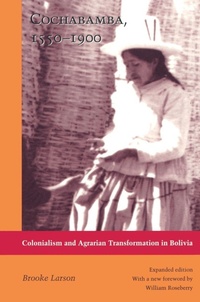
Cochabamba, 1550-1900
Colonialism and Agrarian Transformation in Bolivia
Will be published approx. on 18. March 1998
Book
Paperback/Softback
456 pages
978-0-8223-2088-3 (ISBN)
Description
Winner of the 1990 Best Book Award from the New England Council on Latin American StudiesThis study of Bolivia uses Cochabamba as a laboratory to examine the long-term transformation of native Andean society into a vibrant Quechua-Spanish-mestizo region of haciendas and smallholdings, towns and villages, peasant markets and migratory networks caught in the web of Spanish imperial politics and economics. Combining economic, social, and ethnohistory, Brooke Larson shows how the contradictions of class and colonialism eventually gave rise to new peasant, artisan, and laboring groups that challenged the evolving structures of colonial domination. Originally published in 1988, this expanded edition includes a new final chapter that explores the book's implications for understanding the formation of a distinctive peasant political culture in the Cochabamba valleys over the eighteenth and nineteenth centuries.
Reviews / Votes
"In light of the important reflections on the book by Roseberry and the author herself, and the quality and relevance of Cochabamba, 1550-1990, the decision to reissue it is clearly a good one." - Colonial Latin American Historical Review "This book makes it clear that the history of these valleys is unique, with its large forastero, cholo, and mestizo populations, who worked for the haciendas, supplied grain to the silver miners, and evolved into a commercially vibrant, bilingual people with a rich ethnic heritage." - Agriculture and Human Values "[A] magnificent work in social history. In terms of its historical scope, rich detail, and theoretical sophistication, [Larson's] work represents a model for social historians." - Erwin P. Grieshaber, The Americas "[Cochabamba] stands as an impressive and theoretically engaging study in historical anthropology and the political economy of colonialism." - Mark T. Berger, Latin American Research Review "In light of the important reflections on the book by Roseberry and the author herself, and the quality and relevance of Cochabamba, 1550-1990, the decision to reissue it is clearly a good one." - Colonial Latin American Historical Review "Larson's work is a major study in the Latin American field . . . magnificent and original. . . . 'Must' reading for all agrarian and social historians of Latin America."-Steve J. Stern, University of Wisconsin "[T]he work of a master historian, finding, analyzing, and interpreting archival sources with both discipline and insight."-William Roseberry, from the Foreword "[Cochabamba] stands as an impressive and theoretically engaging study in historical anthropology and the political economy of colonialism." - Mark T. Berger (Latin American Research Review) "[A] magnificent work in social history. In terms of its historical scope, rich detail, and theoretical sophistication, [Larson's] work represents a model for social historians." - Erwin P. Grieshaber (The Americas) "In light of the important reflections on the book by Roseberry and the author herself, and the quality and relevance of Cochabamba, 1550-1990, the decision to reissue it is clearly a good one." (Colonial Latin American Historical Review) "This book makes it clear that the history of these valleys is unique, with its large forastero, cholo, and mestizo populations, who worked for the haciendas, supplied grain to the silver miners, and evolved into a commercially vibrant, bilingual people with a rich ethnic heritage." (Agriculture and Human Values)More details
Language
English
Place of publication
North Carolina
United States
Target group
Professional and scholarly
Product notice
Paperback (trade)
Illustrations
26 tables, 7 maps, 7 figures
Dimensions
Height: 235 mm
Width: 156 mm
Thickness: 24 mm
Weight
685 gr
ISBN-13
978-0-8223-2088-3 (9780822320883)
Copyright in bibliographic data and cover images is held by Nielsen Book Services Limited or by the publishers or by their respective licensors: all rights reserved.
Schweitzer Classification
Other editions
Additional editions
E-Book
03/1998
1st Edition
Duke University Press Books
€228.99
Available for download
Previous edition

Book
05/1988
Princeton University Press
€26.00
Article exhausted; check for reprint
Person
Brooke Larson is Professor of History and Director of Latin American Center, State University of New York, Stony Brook. She is the coeditor of Ethnicity, Markets, and Migration in the Andes, also published by Duke University Press.
Content
List of Illustrations ix
List of Tables xi
Foreword / William Roseberry xiii
Preface to the Duke Edition xix
Acknowledgments xxiii
Abbreviations xxvii
Introduction 3
1. Along the Inca Frontier 13
2. The Emergence of a Market Economy 51
3. Declining State Power and the Struggle over Labor 92
4. Andean Village Society 133
5. Haciendas and the Rival Peasant Economy 171
6. The Landowning Class: Hard Times and Windfall Profits 210
7. The Spirit and Limits of Enterprise 242
8. The Ebb Tide of Colonial Rule 270
9. Colonial Legacies and Class Formation 295
10. Cochabamba: (Re)constructing a History 322
Appendix 391
Glossary 401
Archival Material 407
Index 413
List of Tables xi
Foreword / William Roseberry xiii
Preface to the Duke Edition xix
Acknowledgments xxiii
Abbreviations xxvii
Introduction 3
1. Along the Inca Frontier 13
2. The Emergence of a Market Economy 51
3. Declining State Power and the Struggle over Labor 92
4. Andean Village Society 133
5. Haciendas and the Rival Peasant Economy 171
6. The Landowning Class: Hard Times and Windfall Profits 210
7. The Spirit and Limits of Enterprise 242
8. The Ebb Tide of Colonial Rule 270
9. Colonial Legacies and Class Formation 295
10. Cochabamba: (Re)constructing a History 322
Appendix 391
Glossary 401
Archival Material 407
Index 413