

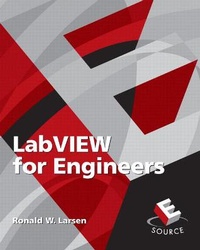
LabVIEW for Engineers
Published on 30. March 2010
Book
Paperback/Softback
416 pages
978-0-13-609429-6 (ISBN)
Description
Based on the most current release of LabVIEW, LabVIEW for Engineers is designed for readers with little to no experience using LabVIEW.
Part of Prentice Hall's ESource Program:
ESource enables instructors to choose individual chapters from published books in the Prentice Hall ESource Series. The content available in this online book-building system covers topics in engineering problem-solving and design, graphics, and computer applications. Using this program, instructors can create a unique text for the introduction to engineering course that exactly matches their content requirements and teaching approach. www.prenhall.com/esource.
Part of Prentice Hall's ESource Program:
ESource enables instructors to choose individual chapters from published books in the Prentice Hall ESource Series. The content available in this online book-building system covers topics in engineering problem-solving and design, graphics, and computer applications. Using this program, instructors can create a unique text for the introduction to engineering course that exactly matches their content requirements and teaching approach. www.prenhall.com/esource.
More details
Other editions
New editions
Book
03/2010
Pearson
€97.16
Article is exhausted; no reprint
Additional editions
Ronald W. Larsen
LabVIEW for Engineers uPDF eBook
E-Book
11/2015
1st Edition
Pearson
€77.49
Available for download
Person
Ronald W. Larsen, Ph.D., P.E., is the Department Head of the Chemical and Biological Engineering Department at Montana State University.
Content
CHAPTER 1 INTRODUCTION Sections
1.1 What is LabVIEW
1.2 Assumptions
1.3 Conventions in the Text
1.4 LabVIEW VIs
1.5 Starting LabVIEW
1.6 Creating a VI
1.7 LabVIEW Menus
1.8 Key Terms
1.9 Summary
1.10 Self-Assessment
CHAPTER 2 LABVIEW BASICS
Sections
1.1 Opening a VI
1.2 Basic Math in LabVIEW-Using Functions
1.3 Programming Preview: While Loops
1.4 Dataflow Programming
1.5 Data Types and Conversions
1.6 Documenting VIs
1.7 Printing a VI
1.8 Saving Your Work
1.9 Closing a VI
1.10 Key Terms
1.11 Summary
1.12 Self-Assessment
1.13 Problems
CHAPTER 3 LABVIEW MATH FUNCTIONS
Sections
1.1 Introduction
1.2 Basic Math Functions
1.3 Trigonometric and Hyperbolic Trig. Functions
1.4 Exponential and Logarithm Functions
1.5 Boolean and Comparison Functions
1.6 Programming Preview: Debugging
1.7 Key Terms
1.8 Summary
1.9 Self-Assessment
1.10 Problems
CHAPTER 4 MATRIX MATH USING LABVIEW
Sections
1.1 Working with Matrices and Arrays in LabVIEW
1.2 Extracting a Subarray from a Larger Array or Matrix
1.3 Adding Arrays
1.4 Transpose Array
1.5 Multiplying an Array by a Scalar
1.6 Matrix Multiplication
1.7 Element by Element Multiplication
1.8 Condition Number
1.9 Matrix Determinant
1.10 Inverse Matrix
1.11 Solving Simultaneous Linear Equations
1.12 Programming Preview: For Loops
1.13 Key Terms
1.14 Summary
1.15 Self-Assessment
1.16 Problems
CHAPTER 5 DATA ACQUISITION WITH LABVIEW
Sections
1.1 Overview of Data Acquisition
1.2 Sensors, Signals and Signal Conditioning
1.3 Data Acquisition Hardware
1.4 Using LabVIEW to Collect Data
1.5 Key Terms
1.6 Summary
1.7 Self-Assessment
1.8 Problems
CHAPTER 6 GETTING DATA INTO AND OUT OF LABVIEW WITHOUT DATA ACQUISITION
Sections
1.1 Introduction
1.2 Writing LabVIEW Data to a Spreadsheet File
1.3 Writing LabVIEW Data to a Measurement File
1.4 Reading a LabVIEW Measurement File
1.5 Reading a Spreadsheet File in LabVIEW
1.6 Using Spreadsheet Data to Initialize a Matrix Control
1.7 Key Terms
1.8 Summary
1.9 Self-Assessment
1.10 Problems
CHAPTER 7 GRAPHING WITH LABVIEW
Sections
1.1 Introduction
1.2 Using Waveform Charts
1.3 Using Waveform Graphs
1.4 Modifying Graph Features
1.5 Generating 1D Arrays for Graphing
1.6 Putting LabVIEW Graphs to Work
1.7 Using XY Graphs-2D Plotting
1.8 3D Graphing
1.9 Getting Graphs onto Paper and into Reports
1.10 Key Terms
1.11 Summary
1.12 Self-Assessment
1.13 Problems
CHAPTER 8 DATA ANALYSIS USING LABVIEW VIS
Sections
1.1 Introduction
1.2 Basic Statistics
1.3 Interpolation
1.4 Curve Fitting
1.5 Regression
1.6 Key Terms
1.7 Summary
1.8 Self-Assessment
1.9 Problems
CHAPTER 9 PROGRAMMING IN LABVIEW
Sections
1.1 Introduction
1.2 LabVIEW Programming Basics, Expanded
1.3 Structures
1.4 Key Terms
1.5 Summary
1.6 Self-Assessment
1.7 Problems
CHAPTER 10 LOOKING FORWARD: ADVANCED MATH USING LABVIEW VIS
Sections
1.1 Introduction
1.2 Working with Polynomials
1.3 Statistics: Hypothesis Testing
1.4 Differentiation
1.5 Integration
1.6 Runge-Kutta Integration
1.7 Exponential Filter
1.8 Spectral Analysis
1.9 Monte Carlo Simulation
1.10 PID Controller
1.1 What is LabVIEW
1.2 Assumptions
1.3 Conventions in the Text
1.4 LabVIEW VIs
1.5 Starting LabVIEW
1.6 Creating a VI
1.7 LabVIEW Menus
1.8 Key Terms
1.9 Summary
1.10 Self-Assessment
CHAPTER 2 LABVIEW BASICS
Sections
1.1 Opening a VI
1.2 Basic Math in LabVIEW-Using Functions
1.3 Programming Preview: While Loops
1.4 Dataflow Programming
1.5 Data Types and Conversions
1.6 Documenting VIs
1.7 Printing a VI
1.8 Saving Your Work
1.9 Closing a VI
1.10 Key Terms
1.11 Summary
1.12 Self-Assessment
1.13 Problems
CHAPTER 3 LABVIEW MATH FUNCTIONS
Sections
1.1 Introduction
1.2 Basic Math Functions
1.3 Trigonometric and Hyperbolic Trig. Functions
1.4 Exponential and Logarithm Functions
1.5 Boolean and Comparison Functions
1.6 Programming Preview: Debugging
1.7 Key Terms
1.8 Summary
1.9 Self-Assessment
1.10 Problems
CHAPTER 4 MATRIX MATH USING LABVIEW
Sections
1.1 Working with Matrices and Arrays in LabVIEW
1.2 Extracting a Subarray from a Larger Array or Matrix
1.3 Adding Arrays
1.4 Transpose Array
1.5 Multiplying an Array by a Scalar
1.6 Matrix Multiplication
1.7 Element by Element Multiplication
1.8 Condition Number
1.9 Matrix Determinant
1.10 Inverse Matrix
1.11 Solving Simultaneous Linear Equations
1.12 Programming Preview: For Loops
1.13 Key Terms
1.14 Summary
1.15 Self-Assessment
1.16 Problems
CHAPTER 5 DATA ACQUISITION WITH LABVIEW
Sections
1.1 Overview of Data Acquisition
1.2 Sensors, Signals and Signal Conditioning
1.3 Data Acquisition Hardware
1.4 Using LabVIEW to Collect Data
1.5 Key Terms
1.6 Summary
1.7 Self-Assessment
1.8 Problems
CHAPTER 6 GETTING DATA INTO AND OUT OF LABVIEW WITHOUT DATA ACQUISITION
Sections
1.1 Introduction
1.2 Writing LabVIEW Data to a Spreadsheet File
1.3 Writing LabVIEW Data to a Measurement File
1.4 Reading a LabVIEW Measurement File
1.5 Reading a Spreadsheet File in LabVIEW
1.6 Using Spreadsheet Data to Initialize a Matrix Control
1.7 Key Terms
1.8 Summary
1.9 Self-Assessment
1.10 Problems
CHAPTER 7 GRAPHING WITH LABVIEW
Sections
1.1 Introduction
1.2 Using Waveform Charts
1.3 Using Waveform Graphs
1.4 Modifying Graph Features
1.5 Generating 1D Arrays for Graphing
1.6 Putting LabVIEW Graphs to Work
1.7 Using XY Graphs-2D Plotting
1.8 3D Graphing
1.9 Getting Graphs onto Paper and into Reports
1.10 Key Terms
1.11 Summary
1.12 Self-Assessment
1.13 Problems
CHAPTER 8 DATA ANALYSIS USING LABVIEW VIS
Sections
1.1 Introduction
1.2 Basic Statistics
1.3 Interpolation
1.4 Curve Fitting
1.5 Regression
1.6 Key Terms
1.7 Summary
1.8 Self-Assessment
1.9 Problems
CHAPTER 9 PROGRAMMING IN LABVIEW
Sections
1.1 Introduction
1.2 LabVIEW Programming Basics, Expanded
1.3 Structures
1.4 Key Terms
1.5 Summary
1.6 Self-Assessment
1.7 Problems
CHAPTER 10 LOOKING FORWARD: ADVANCED MATH USING LABVIEW VIS
Sections
1.1 Introduction
1.2 Working with Polynomials
1.3 Statistics: Hypothesis Testing
1.4 Differentiation
1.5 Integration
1.6 Runge-Kutta Integration
1.7 Exponential Filter
1.8 Spectral Analysis
1.9 Monte Carlo Simulation
1.10 PID Controller