

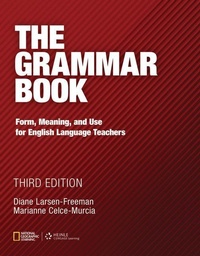
The Grammar Book
3rd Edition
Published on 16. March 2015
Book
Hardback
864 pages
978-1-111-35186-1 (ISBN)
Description
The Grammar Book introduces teachers and future teachers to English grammatical constructions. This highly acclaimed text, used both as a course book and as a grammar reference guide, is suitable for all teachers of English. What sets it apart from other grammar books is its unique pedagogical focus: It describes not only how each grammatical construction is formed, but also its meaning and its use. Grammar is seen to be a resource for making meaning in textually and socially appropriate ways.
More details
Edition
International Edition
Language
English
Place of publication
United States
Publishing group
Cengage Learning, Inc
Target group
ELT/ESL
Dimensions
Height: 260 mm
Width: 215 mm
Thickness: 43 mm
Weight
1875 gr
ISBN-13
978-1-111-35186-1 (9781111351861)
Copyright in bibliographic data and cover images is held by Nielsen Book Services Limited or by the publishers or by their respective licensors: all rights reserved.
Schweitzer Classification
Persons
Diane Larsen-Freeman is Professor Emerita of Education, Professor Emerita of Linguistics, and Former Director of the English Language Institute at the University of Michigan, Ann Arbor. She is also a Distinguished Senior Faculty Fellow at the School for International Training in Brattleboro, Vermont. Dr. Larsen-Freeman has been a conference speaker in over 60 countries of the world and has published over 100 articles in her areas of interest. Her Heinle/Cengage titles include "The Grammar Book: Form, Meaning, and Use for English Language Teachers" (third edition, 2015, co-authored with Marianne Celce-Murcia), "From Grammar to Grammaring" (2003, authored), and the fourth edition of "Grammar Dimensions: Form, Meaning, and Use" (2007, Series Director). From 1980-1985, Dr. Larsen-Freeman was Editor of the journal "Language Learning." In 1997, Dr. Larsen-Freeman was inducted into the Vermont Academy of Arts and Sciences. In 1999, she was selected by ESL Magazine as one of "the ESL pioneers." In 2000, she received the lifetime achievement award from Heinle & Heinle.
Content
Chapter 1 - Introduction
Chapter 2 - Grammatical Terminology
Chapter 3 - Lexicogrammar
Chapter 4 - Copular Verbs and Subject-Verb Agreement
Chapter 5 - Word Order and the Phrase Structure Rules for the Subject of a Sentence
Chapter 6 - More Phrase Structure Rules: The Predicate of a Sentence
Chapter 7 - The Tense-Aspect System
Chapter 8 - Modal Auxiliaries and Related Phrasal Forms
Chapter 9 - The Tense-Aspect-Modality System in Discourse
Chapter 10 - Negation
Chapter 11 - Yes/No Questions
Chapter 12 - Imperatives
Chapter 13 - Wh-Questions
Chapter 14 - Tag, Alternative, Exclamatory, and Rhetorical Questions
Chapter 15 - Articles
Chapter 16 - Reference and Possession
Chapter 17 - Partitives, Collectives, and Quantifiers
Chapter 18 - The Passive Voice
Chapter 19 - Sentences with Indirect Objects
Chapter 20 - Adjectives
Chapter 21 - Prepositions
Chapter 22 - Phrasal Verbs
Chapter 23 - Nonreferential Subjects: Ambient It and Existential There
Chapter 24 - Conjunction
Chapter 25 - Adverbials
Chapter 26 - Logical Connectors
Chapter 27 - Conditionals
Chapter 28 - Introduction to Relative Clauses
Chapter 29 - More on Relative Clauses: Nonrestrictive and Relative Adverb Clauses
Chapter 30 - Focus and Emphasis
Chapter 31 - Complementation
Chapter 32 - Other Aspects of Complementation
Chapter 33 - Reported Speech and Writing
Chapter 34 - Degree - Comparatives and Equatives
Chapter 35 - Degree - Complementations and Superlatives
Chapter 36 - Conculsion
Suggested Answers to Chapter Exercises
Indexes:
Index of Names
Index of Languages and Language Groups
Index of Words, Phrases, and Affixes
Index of Topics
Chapter 2 - Grammatical Terminology
Chapter 3 - Lexicogrammar
Chapter 4 - Copular Verbs and Subject-Verb Agreement
Chapter 5 - Word Order and the Phrase Structure Rules for the Subject of a Sentence
Chapter 6 - More Phrase Structure Rules: The Predicate of a Sentence
Chapter 7 - The Tense-Aspect System
Chapter 8 - Modal Auxiliaries and Related Phrasal Forms
Chapter 9 - The Tense-Aspect-Modality System in Discourse
Chapter 10 - Negation
Chapter 11 - Yes/No Questions
Chapter 12 - Imperatives
Chapter 13 - Wh-Questions
Chapter 14 - Tag, Alternative, Exclamatory, and Rhetorical Questions
Chapter 15 - Articles
Chapter 16 - Reference and Possession
Chapter 17 - Partitives, Collectives, and Quantifiers
Chapter 18 - The Passive Voice
Chapter 19 - Sentences with Indirect Objects
Chapter 20 - Adjectives
Chapter 21 - Prepositions
Chapter 22 - Phrasal Verbs
Chapter 23 - Nonreferential Subjects: Ambient It and Existential There
Chapter 24 - Conjunction
Chapter 25 - Adverbials
Chapter 26 - Logical Connectors
Chapter 27 - Conditionals
Chapter 28 - Introduction to Relative Clauses
Chapter 29 - More on Relative Clauses: Nonrestrictive and Relative Adverb Clauses
Chapter 30 - Focus and Emphasis
Chapter 31 - Complementation
Chapter 32 - Other Aspects of Complementation
Chapter 33 - Reported Speech and Writing
Chapter 34 - Degree - Comparatives and Equatives
Chapter 35 - Degree - Complementations and Superlatives
Chapter 36 - Conculsion
Suggested Answers to Chapter Exercises
Indexes:
Index of Names
Index of Languages and Language Groups
Index of Words, Phrases, and Affixes
Index of Topics