

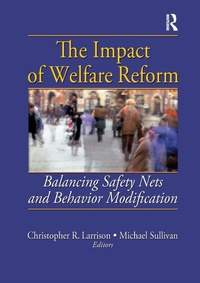
The Impact of Welfare Reform
Balancing Safety Nets and Behavior Modification
1st Edition
Published on 3. August 2006
Book
Paperback/Softback
308 pages
978-0-7890-3160-0 (ISBN)
Description
Get a balanced, comprehensive analysis of the effects from 1996 welfare reform
The Personal Responsibility and Work Opportunity Reconciliation Act of 1996 was aimed at repairing the welfare system of the United States. The Impact of Welfare Reform: Balancing Safety Nets and Behavior Modification comprehensively examines how this bill transformed the system and affected not only clients but also the organizations that implemented the reform. This text moves beyond traditional analyses of welfare reform to reveal a full range of viewpoints and issues while avoiding mere political rhetoric. Leading authorities present knowledgeable perspectives on the clients and their problems, the implementing organizations, the struggles to comply with the requirements, and the issues that remain unresolved.
The Impact of Welfare Reform presents revealing interviews with clients, organizational employees, and caseworkers. In-depth discussion topics include the value of emotional well-being on job status, the effects that the new time limit requirements have on clients, ways to facilitate the welfare-to-work transition for women with mental health issues, changes in the work environment of service-providing organizations, and the client's own experiences within and outside of the system. Qualitative and quantitative methods of study are used to effectively evaluate welfare reform while providing a direction for further research in the future. The text is extensively referenced and uses tables, charts, and figures to clearly illustrate data.
This book will bring you up to date on:
the impact of alcohol, drugs, and psychological well-being on successfully finding employment
the impact of welfare reform on children and adolescents
innovations by state welfare offices
community and alternative interventions that help those on Temporary Assistance for Needy Families (TANF) to comply with work requirements and time limits
the perceptions of caseworkers who implement TANF and the Personal Responsibility and Work Opportunity Reconciliation Act (PRWORA)
The Impact of Welfare Reform is enlightening reading for social workers, educators, graduate students, and public policy professionals.
The Personal Responsibility and Work Opportunity Reconciliation Act of 1996 was aimed at repairing the welfare system of the United States. The Impact of Welfare Reform: Balancing Safety Nets and Behavior Modification comprehensively examines how this bill transformed the system and affected not only clients but also the organizations that implemented the reform. This text moves beyond traditional analyses of welfare reform to reveal a full range of viewpoints and issues while avoiding mere political rhetoric. Leading authorities present knowledgeable perspectives on the clients and their problems, the implementing organizations, the struggles to comply with the requirements, and the issues that remain unresolved.
The Impact of Welfare Reform presents revealing interviews with clients, organizational employees, and caseworkers. In-depth discussion topics include the value of emotional well-being on job status, the effects that the new time limit requirements have on clients, ways to facilitate the welfare-to-work transition for women with mental health issues, changes in the work environment of service-providing organizations, and the client's own experiences within and outside of the system. Qualitative and quantitative methods of study are used to effectively evaluate welfare reform while providing a direction for further research in the future. The text is extensively referenced and uses tables, charts, and figures to clearly illustrate data.
This book will bring you up to date on:
the impact of alcohol, drugs, and psychological well-being on successfully finding employment
the impact of welfare reform on children and adolescents
innovations by state welfare offices
community and alternative interventions that help those on Temporary Assistance for Needy Families (TANF) to comply with work requirements and time limits
the perceptions of caseworkers who implement TANF and the Personal Responsibility and Work Opportunity Reconciliation Act (PRWORA)
The Impact of Welfare Reform is enlightening reading for social workers, educators, graduate students, and public policy professionals.
More details
Language
English
Place of publication
New York
United States
Publishing group
Taylor & Francis Inc
Target group
Professional and scholarly
Dimensions
Height: 210 mm
Width: 148 mm
Thickness: 17 mm
Weight
401 gr
ISBN-13
978-0-7890-3160-0 (9780789031600)
Copyright in bibliographic data and cover images is held by Nielsen Book Services Limited or by the publishers or by their respective licensors: all rights reserved.
Schweitzer Classification
Other editions
Additional editions
Christopher R. Larrison | Michael Sullivan
The Impact of Welfare Reform
Balancing Safety Nets and Behavior Modification
E-Book
02/2013
1st Edition
Routledge
€51.49
Available for download
Christopher R. Larrison | Michael Sullivan
The Impact of Welfare Reform
Balancing Safety Nets and Behavior Modification
E-Book
02/2013
1st Edition
Routledge
€51.49
Available for download
Christopher R. Larrison | Michael Sullivan
The Impact of Welfare Reform
Balancing Safety Nets and Behavior Modification
Book
08/2006
1st Edition
Routledge
€186.20
Shipment within 10-20 days
Persons
Christopher R. Larrison, Michael Sullivan
Content
Welfare Reform Transitions: The Effects of Emotional Well-Being on Job Status in Current TANF Recipients (Michael Sullivan)
Time's Up: Relative Disadvantages of Long-Term and Short-Term Urban Welfare Recipients (Andrea Hetling, Kirk Tracy, and Catherine E. Born)
Moving Towards Work: The Effects of Employment Experiences on Welfare-Dependent Women and Their Children (Phyllis Gyamfi, Jeanne Brooks-Gunn, and Aurora P. Jackson)
Adolescent Outcomes and Welfare Reform: An Analysis Based on the Survey of Program Dynamics (Eileen Trzcinski, Jerrold Brandell, Lynda Ferro, and Deborah Smith)
Children of Substance Abusing Women on Federal Welfare: Implications for Child Well-Being and TANF Policy (Kimberly A. Blanchard, Chris C. Sexton, Jon Morgenstern, Katharine H. McVeigh, Barbara S. McCrady, Thomas J. Morgan, and Thomas W. Irwin)
Addressing Substance Abuse Among TANF Recipients: Current Issues and Approaches (Susan L. Schoppelrey, Marcia Martinez, and Soo Mi Jang)
Facilitating the Welfare-to-Work Transition for Women with a Mental Health Work Barrier (Shawna J. Lee)
Health Insurance for Women Who Have Left the TANF Rolls (Roger A. Boothroyd, Julie A. Slay, Irene J. Kim, and Rhonda Ort)
Mentoring as a Strategy for Welfare Reform (Miguel Ferguson, Jessica Ritter, Diana M. DiNitto, Jinseok Kim, and A. James Schwab)
A Program Evaluation of Los Angeles ACORN's Welfare Case Advocacy (Fred Brooks and Elizabeth Brown)
The Relationship Between the Personal Responsibility and Work Opportunity Reconciliation Act of 1996 and Innovative Welfare Practices on a Local Level (Christopher R. Larrison, Larry Nackerud, Lea Lane-Crea, and Vanessa Robinson-Dooley)
Employees Amidst Welfare Reform: TANF Employees' Overall Job- and Organizational-Role Satisfaction (Stephen E. Condrey, Rex L. Facer II, and John A. Hamilton)
Caseworkers' Assessment of Welfare Reform: Report from the Front Lines (Holly Bell)
Local Welfare Reform: Challenges and Triumphs of the Comprehensive Support Services Intervention (Jocelyn Taliaferro)
Index
Reference Notes Included
Time's Up: Relative Disadvantages of Long-Term and Short-Term Urban Welfare Recipients (Andrea Hetling, Kirk Tracy, and Catherine E. Born)
Moving Towards Work: The Effects of Employment Experiences on Welfare-Dependent Women and Their Children (Phyllis Gyamfi, Jeanne Brooks-Gunn, and Aurora P. Jackson)
Adolescent Outcomes and Welfare Reform: An Analysis Based on the Survey of Program Dynamics (Eileen Trzcinski, Jerrold Brandell, Lynda Ferro, and Deborah Smith)
Children of Substance Abusing Women on Federal Welfare: Implications for Child Well-Being and TANF Policy (Kimberly A. Blanchard, Chris C. Sexton, Jon Morgenstern, Katharine H. McVeigh, Barbara S. McCrady, Thomas J. Morgan, and Thomas W. Irwin)
Addressing Substance Abuse Among TANF Recipients: Current Issues and Approaches (Susan L. Schoppelrey, Marcia Martinez, and Soo Mi Jang)
Facilitating the Welfare-to-Work Transition for Women with a Mental Health Work Barrier (Shawna J. Lee)
Health Insurance for Women Who Have Left the TANF Rolls (Roger A. Boothroyd, Julie A. Slay, Irene J. Kim, and Rhonda Ort)
Mentoring as a Strategy for Welfare Reform (Miguel Ferguson, Jessica Ritter, Diana M. DiNitto, Jinseok Kim, and A. James Schwab)
A Program Evaluation of Los Angeles ACORN's Welfare Case Advocacy (Fred Brooks and Elizabeth Brown)
The Relationship Between the Personal Responsibility and Work Opportunity Reconciliation Act of 1996 and Innovative Welfare Practices on a Local Level (Christopher R. Larrison, Larry Nackerud, Lea Lane-Crea, and Vanessa Robinson-Dooley)
Employees Amidst Welfare Reform: TANF Employees' Overall Job- and Organizational-Role Satisfaction (Stephen E. Condrey, Rex L. Facer II, and John A. Hamilton)
Caseworkers' Assessment of Welfare Reform: Report from the Front Lines (Holly Bell)
Local Welfare Reform: Challenges and Triumphs of the Comprehensive Support Services Intervention (Jocelyn Taliaferro)
Index
Reference Notes Included