

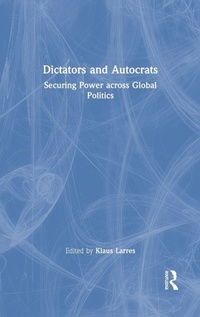
Dictators and Autocrats
Securing Power across Global Politics
1st Edition
Published on 1. November 2021
Book
Hardback
430 pages
978-0-367-60786-9 (ISBN)
Description
In order to truly understand the emergence, endurance, and legacy of autocracy, this volume of engaging essays explores how autocratic power is acquired, exercised, and transferred or abruptly ended through the careers and politics of influential figures in more than 20 countries and six regions.
The book looks at both traditional "hard" dictators, such as Hitler, Stalin, and Mao, and more modern "soft" or populist autocrats, who are in the process of transforming once fully democratic countries into autocratic states, including Recep Tayyip Erdogan in Turkey, Brazilian leader Jair Bolsonaro, Rodrigo Duterte in the Philippines, Narendra Modi in India, and Viktor Orban in Hungary. The authors touch on a wide range of autocratic and dictatorial figures in the past and present, including present-day autocrats, such as Vladimir Putin and Xi Jinping, military leaders, and democratic leaders with authoritarian aspirations. They analyze the transition of selected autocrats from democratic or benign semi-democratic systems to harsher forms of autocracy, with either quite disastrous or more successful outcomes.
An ideal reader for students and scholars, as well as the general public, interested in international affairs, leadership studies, contemporary history and politics, global studies, security studies, economics, psychology, and behavioral studies.
The book looks at both traditional "hard" dictators, such as Hitler, Stalin, and Mao, and more modern "soft" or populist autocrats, who are in the process of transforming once fully democratic countries into autocratic states, including Recep Tayyip Erdogan in Turkey, Brazilian leader Jair Bolsonaro, Rodrigo Duterte in the Philippines, Narendra Modi in India, and Viktor Orban in Hungary. The authors touch on a wide range of autocratic and dictatorial figures in the past and present, including present-day autocrats, such as Vladimir Putin and Xi Jinping, military leaders, and democratic leaders with authoritarian aspirations. They analyze the transition of selected autocrats from democratic or benign semi-democratic systems to harsher forms of autocracy, with either quite disastrous or more successful outcomes.
An ideal reader for students and scholars, as well as the general public, interested in international affairs, leadership studies, contemporary history and politics, global studies, security studies, economics, psychology, and behavioral studies.
More details
Language
English
Place of publication
London
United Kingdom
Publishing group
Taylor & Francis Ltd
Target group
College/higher education
Product notice
sewn/stitched
Cloth over boards
Illustrations
3 s/w Abbildungen, 3 s/w Zeichnungen, 1 s/w Tabelle
1 Tables, black and white; 3 Line drawings, black and white; 3 Illustrations, black and white
Dimensions
Height: 234 mm
Width: 156 mm
Thickness: 25 mm
Weight
826 gr
ISBN-13
978-0-367-60786-9 (9780367607869)
Copyright in bibliographic data and cover images is held by Nielsen Book Services Limited or by the publishers or by their respective licensors: all rights reserved.
Schweitzer Classification
Other editions
Additional editions
Book
11/2021
1st Edition
Routledge
€60.00
Shipment within 15-20 days
E-Book
10/2021
1st Edition
Routledge
€0.00
Available for download
E-Book
10/2021
1st Edition
Routledge
€0.00
Available for download
Person
Klaus Larres is the Richard M Krasno Distinguished Professor of History and International Affairs at the University of North Carolina at Chapel Hill. He served as Counselor and Senior Policy Adviser at the German Embassy in Beijing, held the Kissinger Chair in International Relations at the Library of Congress in Washington, DC, and was a Fellow at the Stiftung Wissenschaft und Politik (SWP) - German Institute for International Security and Affairs think tank in Berlin. Among his many publications are the books Churchill's Cold War: The Politics of Personal Diplomacy; Uncertain Allies: Nixon, Kissinger, and the Threat of a United Europe; and Understanding Global Politics: Actors and Themes in International Affairs (co-edited).
Content
Part 1: THE NOTORIOUS THREE 1. Joseph Stalin: Autocrat par excellence (The Soviet Union) 2. Adolf Hitler: From Democracy to Dictatorship (Germany) 3. Mao Zedong: Communist Party Dictatorship (China) Part 2: PATHBREAKING AUTOCRATS OF THE 20TH CENTURY 4. Fidel Castro: From Grassroots Dictatorship to Communist Autocracy (Cuba) 5. Augusto Pinochet: The Emergence of One-Man Rule (Chile) 6. Robert Mugabe: Ruthless Authoritarian who Preferred Democratic Clothing (Zimbabwe) 7. Joseph Kabila: the "Rais" of the Democratic Republic of Congo (DR Congo) 8. Hugo Chavez: Was he an Autocrat? (Venezuela) 9. Lee Kuan Yew: Autocracy, Elections, and Capitalism (Singapore) Part 3: 21ST CENTURY AUTOCRATS - THE MAJOR POWERS 10. Vladimir Putin: Russia's Neo-Patrimonial Facade Democracy (Russia) 11. Xi Jinping: The Rise of an Authoritarian Leader (China) 12. Narendra Modi: Elected Authoritarian (India) 13. Donald J. Trump: The Authoritarian Style in American Politics (USA) Part 4: 21ST CENTURY AUTOCRATS - OTHER INFLUENTIAL AUTOCRATS 14. Ali Hosseini Khamenei: Routinizing Revolution (Iran) 15. The Assad Dynasty: Quo Vadis Damascus? (Syria) 16. Kim Jong un: Rise to Power and Leadership Style (North Korea) 17. Abd al Fattah al Sisi: The One and Only Egyptian Dictator (Egypt) 18. Prayuth Chan-o-cha: From the Barracks to the Ballot Box (Thailand) 19. Muhammad bin Salman Al-Saud: King in All But Name (Saudi Arabia) 20. Janos Kadar and Viktor Orban: From Communist to Post-Communist Autocracy (Hungary) 21. Recep Tayyip Erdogan: From "Illiberal Democracy" to Electoral Authoritarianism (Turkey) 22. Rodrigo Duterte: Macho Populism and Authoritarian Practice (Philippines) 23. Jair Bolsonaro: Beyond the Pale, Above the Fray (Brazil)