

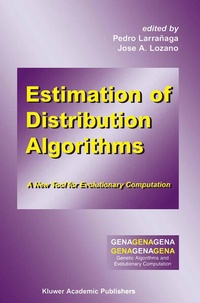
Estimation of Distribution Algorithms
A New Tool for Evolutionary Computation
Published on 30. October 2012
Book
Paperback/Softback
XXXIV, 382 pages
978-1-4613-5604-2 (ISBN)
Description
Estimation of Distribution Algorithms: A New Tool for Evolutionary
Computation
is devoted to a new paradigm for evolutionary computation, named estimation of distribution algorithms (EDAs). This new class of algorithms generalizes genetic algorithms by replacing the crossover and mutation operators with learning and sampling from the probability distribution of the best individuals of the population at each iteration of the algorithm. Working in such a way, the relationships between the variables involved in the problem domain are explicitly and effectively captured and exploited.
This text constitutes the first compilation and review of the techniques and applications of this new tool for performing evolutionary computation. Estimation of Distribution Algorithms: A New Tool for Evolutionary Computation is clearly divided into three parts. Part I is dedicated to the foundations of EDAs. In this part, after introducing some probabilistic graphical models - Bayesian and Gaussian networks - a review of existing EDA approaches is presented, as well as some new methods based on more flexible probabilistic graphical models. A mathematical modeling of discrete EDAs is also presented. Part II covers several applications of EDAs in some classical optimization problems: the travelling salesman problem, the job scheduling problem, and the knapsack problem. EDAs are also applied to the optimization of some well-known combinatorial and continuous functions. Part III presents the application of EDAs to solve some problems that arise in the machine learning field: feature subset selection, feature weighting in K-NN classifiers, rule induction, partial abductive inference in Bayesian networks, partitional clustering, and the search for optimal weights in artificial neural networks.
Estimation of Distribution Algorithms: A New Tool for Evolutionary Computation is a useful and interesting tool for researchers working in the field of evolutionary computation and for engineers who face real-world optimization problems. This book may also be used by graduate students and researchers in computer science.
` ... I urge those who are interested in EDAs to study this well-crafted book today.' David E. Goldberg, University of Illinois Champaign-Urbana.
This text constitutes the first compilation and review of the techniques and applications of this new tool for performing evolutionary computation. Estimation of Distribution Algorithms: A New Tool for Evolutionary Computation is clearly divided into three parts. Part I is dedicated to the foundations of EDAs. In this part, after introducing some probabilistic graphical models - Bayesian and Gaussian networks - a review of existing EDA approaches is presented, as well as some new methods based on more flexible probabilistic graphical models. A mathematical modeling of discrete EDAs is also presented. Part II covers several applications of EDAs in some classical optimization problems: the travelling salesman problem, the job scheduling problem, and the knapsack problem. EDAs are also applied to the optimization of some well-known combinatorial and continuous functions. Part III presents the application of EDAs to solve some problems that arise in the machine learning field: feature subset selection, feature weighting in K-NN classifiers, rule induction, partial abductive inference in Bayesian networks, partitional clustering, and the search for optimal weights in artificial neural networks.
Estimation of Distribution Algorithms: A New Tool for Evolutionary Computation is a useful and interesting tool for researchers working in the field of evolutionary computation and for engineers who face real-world optimization problems. This book may also be used by graduate students and researchers in computer science.
` ... I urge those who are interested in EDAs to study this well-crafted book today.' David E. Goldberg, University of Illinois Champaign-Urbana.
More details
Series
Edition
Softcover reprint of the original 1st ed. 2002
Language
English
Place of publication
New York
United States
Target group
Professional and scholarly
Research
Illustrations
XXXIV, 382 p.
Dimensions
Height: 235 mm
Width: 155 mm
Thickness: 23 mm
Weight
633 gr
ISBN-13
978-1-4613-5604-2 (9781461356042)
DOI
10.1007/978-1-4615-1539-5
Schweitzer Classification
Other editions
Additional editions
Pedro Larrañaga | José A. Lozano
Estimation of Distribution Algorithms
A New Tool for Evolutionary Computation
E-Book
12/2012
Springer
€213.99
Available for download
Pedro Larrañaga | José A. Lozano
Estimation of Distribution Algorithms
A New Tool for Evolutionary Computation
Book
10/2001
Kluwer Academic Publishers
€213.99
Shipment within 15-20 days
Content
I Foundations.- 1 An Introduction to Evolutionary Algorithms.- 2 An Introduction to Probabilistic Graphical Models.- 3 A Review on Estimation of Distribution Algorithms.- 4 Benefits of Data Clustering in Multimodal Function Optimization via EDAs.- 5 Parallel Estimation of Distribution Algorithms.- 6 Mathematical Modeling of Discrete Estimation of Distribution Algorithms.- II Optimization.- 7 An Empirical Comparison of Discrete Estimation of Distribution Algorithms.- 8 Results in Function Optimization with EDAs in Continuous Domain.- 9 Solving the 0-1 Knapsack Problem with EDAs.- 10 Solving the Traveling Salesman Problem with EDAs.- 11 EDAs Applied to the Job Shop Scheduling Problem.- 12 Solving Graph Matching with EDAs Using a Permutation-Based Representation.- III Machine Learning.- 13 Feature Subset Selection by Estimation of Distribution Algorithms.- 14 Feature Weighting for Nearest Neighbor by EDAs.- 15 Rule Induction by Estimation of Distribution Algorithms.- 16 Partial Abductive Inference in Bayesian Networks: An Empirical Comparison Between GAs and EDAs.- 17 Comparing K-Means, GAs and EDAs in Partitional Clustering.- 18 Adjusting Weights in Artificial Neural Networks using Evolutionary Algorithms.