

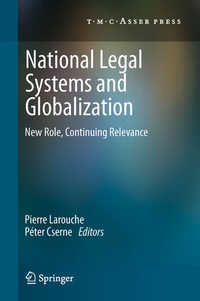
National Legal Systems and Globalization
New Role, Continuing Relevance
1st Edition
Published on 20. November 2012
Book
Hardback
X, 390 pages
978-90-6704-884-2 (ISBN)
Description
This book presents the results of research project financed by the Hague Institute for the Internationalization of Law (HiiL) and carried out at the Tilburg Law and Economics Center (TILEC) of Tilburg University. The project team shows that globalization, instead of threatening national legal systems, put them in a new role and gives them continuing relevance. First of all, once one takes a more functional view of the law, based on law and economics and comparative law literature, harmonization or unification of national legal systems is no longer a foregone conclusion. Secondly, fundamental constitutional principles continue to bear in the era of multi-level and transnational governance: they become governance principles, divorced from specific institutional settings. Finally, looking beyond regulatory competition and comparative law, legal emulation provides a rich and fruitful model to explain the interplay between legal systems. This book explores these three themes, both at a theoretical level and in the light of specific examples.
More details
Other editions
Additional editions
Pierre Larouche | Péter Cserne
National Legal Systems and Globalization
New Role, Continuing Relevance
Book
12/2014
T.M.C. Asser Press
€106.99
Shipment within 15-20 days
Pierre Larouche | Péter Cserne
National Legal Systems and Globalization
New Role, Continuing Relevance
E-Book
11/2012
1st Edition
T.M.C. Asser Press
€96.29
Available for download
Persons
Pierre Larouche is Professor of competition law, Tilburg University (the Netherlands) and a founding director of the Tilburg Law and Economics Center (TILEC). Péter Cserne is now Senior lecturer in law, University of Hull (United Kingdom) and an extramural fellow of TILEC.
Content
Introduction.- Convergence and divergence, in law and economics and comparative law.- The Draft Common Frame of Reference (DCFR): A giant with feet of clay .- The recodification of private law in Central and Eastern Europe.- Courts and expertise: Consequence-based arguments in judicial reasoning.- From a formalistic to an integrative model: the case of EU economic regulation.- The reform of EU electronic communications law: revolution or evolution? Networks of regulatory agencies in Europe.- Reinventing accountability: judicial control vs. participation.- Legal emulation between regulatory competition and comparative law .- Impact Assessment: the theory.- Impact Assessment: empirical evidence.- Judicial networks.- Conclusions.