


Competition Law and Regulation in European Telecommunications
Published on 1. May 2000
Book
Hardback
504 pages
978-1-84113-144-3 (ISBN)
Description
Using numerous practical examples,this book examines the evolution of EC telecommunications law following the achievement of liberalisation, the main policy goal of the 1990s. After reviewing the development of regulation in the run-up to liberalisation, the author identifies the methods used to direct the liberalisation process and tests their validity in the post-liberalisation context. A critical analysis is made of the claim that competition law will offer sufficient means to regulate the sector in the future. Particular emphasis is given to the way in which EC Competition Law changed in the 1990s using the essential facilities doctrine, an expansive non-discrimination principle and the policing of cross-subsidisation to tackle what were then thought of as regulatory matters. Also examined within the work is the procedural and institutional interplay between competition law and telecommunications regulation. In conclusion, Larouche explores the limits of competition law and puts forward a long-term case for sector-specific regulation, with a precise mandate to ensure that the telecommunications sector as a whole fulfils its role as a foundation for economic and social activity.
Reviews / Votes
Obviously, we have here a very serious, well grounded, solid and systematic analysis of an issue which proves essential in all legal systems where telecommunications are liberalised, together with other utility industries. Paul Nihoul Journal of Network Industries June 2002 Larouche's book probably constitutes one of the basic references just about everyone with an interest in European communications should have in his library. The structure is logical. The argumentation is crystal clear. The organisation is perfect Paul Nihoul, Rijksuniversiteit Groningen Yearbook of European Law July 2002More details
Language
English
Place of publication
Oxford
United Kingdom
Publishing group
Bloomsbury Publishing PLC
Target group
College/higher education
Professional and scholarly
Dimensions
Height: 240 mm
Width: 161 mm
Thickness: 32 mm
Weight
922 gr
ISBN-13
978-1-84113-144-3 (9781841131443)
Copyright in bibliographic data and cover images is held by Nielsen Book Services Limited or by the publishers or by their respective licensors: all rights reserved.
Schweitzer Classification
Other editions
Additional editions
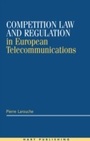
Pierre Larouche
Competition Law and Regulation in European Telecommunications
E-Book
05/2000
1st Edition
Hart Publishing
€189.99
Available for download
Person
Pierre Larouche is a Professor of Law at Tilburg University. is Reader in Law at University College London
Content
The successive regulatory models: the starting model (until 1990); the regulatory model of the 1987 green paper (1990-1996); the transitional model of the 1992 review and the 1994 green paper (1996-1997); the fully liberalized model (1998-); conclusion. The "hard core" of regulation and Article 86 EC: the integration of Articles 86 and 95 EC in the run-up to liberalization - the starting positions, the compromise of December 1989, the legal assessment of the ECJ, the use of Article 86(3) EC as a legal basis after 1990, the integration of Articles 86(3) and 95 EC in an original legislative procedure, concrete examples; the use of article 86(3) EC in a liberalized environment - Article 86(1) EC, Article 86(2) EC; conclusion. The new competition law as applied in the telecommunications sector: sources and epistemology - sources of EC competition law, a model for the legitimacy of EC competition law, the 1991 guidelines and 1998 access notice; relevant market definition - substitutability patterns, relevant markets in a network-based industry, resulting approach and assessment of the decision practice of the Commission; substantive principles - refusal to deal and the "essential facilities" doctrine, discrimination, pricing, cross-subsidization and accounting, unbundling; competitive assessment: general principles concerning multi-market cases, the competitive assessment in "Atlas", the competitive assessment in "BT/MCI II"; procedural and institutional framework: standard elements of the procedural and institutional framework - procedural and institutional framework by source, relationship between those frameworks; modifications resulting from competition law as applied in the telecommunications sector - integration of EC competition law and national sector-specific regulation, use of EC competition law to compensate for gaps in sector-specific regulation; resulting procedural and institutional framework; conclusion. Rethinking sector-specific regulation: the limits of competition law - the gaps of competition law, the challenges for competition law, the downsides of competition law, the legitimacy of using competition law as the core of EC telecommunication policy; the case for sector-specific economic regulation - the terms of the case, the dual role of telecommunications, the core regulatory mandate, the balance with competition law; sector-specific regulation at the EC level - the need for EC sector-specific regulation, current status, legal basis, institutional implications; conclusion. Postscript - the 1999 review.