

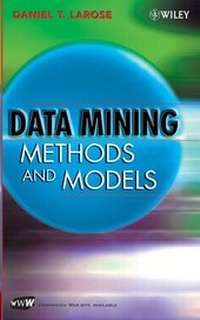
Data Mining Methods and Models
Published on 1. February 2006
Book
Hardback
344 pages
978-0-471-66656-1 (ISBN)
Description
Apply powerful Data Mining Methods and Models to Leverage your Data for Actionable Results
Data Mining Methods and Models provides:
* The latest techniques for uncovering hidden nuggets of information
* The insight into how the data mining algorithms actually work
* The hands-on experience of performing data mining on large data sets
Data Mining Methods and Models:
* Applies a "white box" methodology, emphasizing an understanding of the model structures underlying the softwareWalks the reader through the various algorithms and provides examples of the operation of the algorithms on actual large data sets, including a detailed case study, "Modeling Response to Direct-Mail Marketing"
* Tests the reader's level of understanding of the concepts and methodologies, with over 110 chapter exercises
* Demonstrates the Clementine data mining software suite, WEKA open source data mining software, SPSS statistical software, and Minitab statistical software
* Includes a companion Web site, www.dataminingconsultant.com, where the data sets used in the book may be downloaded, along with a comprehensive set of data mining resources. Faculty adopters of the book have access to an array of helpful resources, including solutions to all exercises, a PowerPoint(r) presentation of each chapter, sample data mining course projects and accompanying data sets, and multiple-choice chapter quizzes.
With its emphasis on learning by doing, this is an excellent textbook for students in business, computer science, and statistics, as well as a problem-solving reference for data analysts and professionals in the field.
Reviews / Votes
"...the latest techniques...insight into how data mining algorithms work..." (Materials World, April 2007)More details
Edition
1. Auflage
Language
English
Place of publication
New York
United States
Publishing group
John Wiley and Sons Ltd
Target group
Professional and scholarly
College/higher education
Illustrations
Illustrations
Dimensions
Height: 24.3 cm
Width: 16.3 cm
Thickness: 2 cm
Weight
591 gr
ISBN-13
978-0-471-66656-1 (9780471666561)
Schweitzer Classification
Other editions
New editions
Daniel T. Larose | Chantal D. Larose
Data Mining and Predictive Analytics
Book
04/2015
2nd Edition
Wiley
€145.00
Shipment within 15-20 days
Person
DANIEL T. LAROSE, PhD, received his PhD in statistics from the University of Connecticut. An associate professor of statistics at Central Connecticut State University, he developed and directs Data Mining@CCSU, the world's first online master of science program in data mining. He has also worked as a data mining consultant for Connecticut-area companies. He is the author of Discovering Knowledge in Data: An Introduction to Data Mining (Wiley), and is currently working on the third book of his three-volume set on data mining: Data Mining the Web: Uncovering Patterns in Web Content, Structure, and Usage (with Zdravko Markov, PhD), scheduled to be published by Wiley in 2006.
Content
Preface.
1. Dimension Reduction Methods.
Need for Dimension Reduction in Data Mining.
Principal Components Analysis.
Factor Analysis.
User-Defined Composites.
2. Regression Modeling.
Example of Simple Linear Regression.
Least-Squares Estimates.
Coefficient or Determination.
Correlation Coefficient.
The ANOVA Table.
Outliers, High Leverage Points, and Influential Observations.
The Regression Model.
Inference in Regression.
Verifying the Regression Assumptions.
An Example: The Baseball Data Set.
An Example: The California Data Set.
Transformations to Achieve Linearity.
3. Multiple Regression and Model Building.
An Example of Multiple Regression.
The Multiple Regression Model.
Inference in Multiple Regression.
Regression with Categorical Predictors.
Multicollinearity.
Variable Selection Methods.
An Application of Variable Selection Methods.
Mallows' C p Statistic.
Variable Selection Criteria.
Using the Principal Components as Predictors in Multiple Regression.
4. Logistic Regression.
A Simple Example of Logistic Regression.
Maximum Likelihood Estimation.
Interpreting Logistic Regression Output.
Inference: Are the Predictors Significant?
Interpreting the Logistic Regression Model.
Interpreting a Logistic Regression Model for a Dichotomous Predictor.
Interpreting a Logistic Regression Model for a Polychotomous Predictor.
Interpreting a Logistic Regression Model for a Continuous Predictor.
The Assumption of Linearity.
The Zero-Cell Problem.
Multiple Logistic Regression.
Introducing Higher Order terms to Handle Non-Linearity.
Validating the Logistic Regression Model.
WEKA: Hands-On Analysis Using Logistic Regression.
5. Naïve Bayes and Bayesian Networks.
The Bayesian Approach.
The Maximum a Posteriori (MAP) Classification.
The Posterior Odds Ratio.
Balancing the Data.
Naïve Bayes Classification.
Numeric Predictors for Naïve Bayes Classification.
WEKA: Hands-On Analysis Using Naïve Bayes.
Bayesian Belief Networks.
Using the Bayesian Network to Find Probabilities.
WEKA: Hands-On Analysis Using Bayes Net.
6. Genetic Algorithms.
Introduction to Genetic Algorithms.
The Basic Framework of a Genetic Algorithm.
A Simple Example of Genetic Algorithms at Work.
Modifications and Enhancements: Selection.
Modifications and enhancements: Crossover.
Genetic Algorithms for Real-Valued Variables.
Using Genetic Algorithms to Train a Neural Network.
WEKA: Hands-On Analysis Using Genetic Algorithms.
7. Case Study: Modeling Response to Direct-Mail Marketing.
The Cross-Industry Standard Process for Data Mining: CRISP-DM.
Business Understanding Phase.
Data Understanding and Data Preparation Phases.
The Modeling Phase and the Evaluation Phase.
Index.