

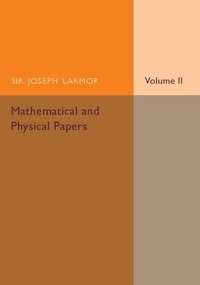
Mathematical and Physical Papers: Volume 2
Published on 13. November 2015
Book
Paperback/Softback
866 pages
978-1-107-53640-1 (ISBN)
Description
Joseph Larmour (1857-1942) was a theoretical physicist who made important discoveries in relation to the electron theory of matter, as espoused in his 1900 work Aether and Matter. Originally published in 1929, this is the second part of a two-volume set containing Larmour's collected papers. The papers are presented in chronological order across the volumes, enabling readers to understand their theoretical development and framing them in an accessible form for 'future historical interests'. Authorial notes and appendices are also included. This book will be of value to anyone with an interest in the word of Larmour, mathematics physics and the history of science.
More details
Language
English
Place of publication
Cambridge
United Kingdom
Target group
College/higher education
Product notice
Paperback (trade)
Dimensions
Height: 254 mm
Width: 178 mm
Thickness: 46 mm
Weight
1594 gr
ISBN-13
978-1-107-53640-1 (9781107536401)
Copyright in bibliographic data and cover images is held by Nielsen Book Services Limited or by the publishers or by their respective licensors: all rights reserved.
Schweitzer Classification
Content
part III; part II; 61. On the intensity of the natural radiation from moving bodies and its mechanical reaction; 62. On the ascertained absence of effects of motion through the aether, in relation to the constitution of matter, and on the FitzGerald-Lorentz hypothesis; 63. Josiah Willard Gibbs (1839-1903); 64. On the dynamical significance of Kundt's law of selective dispersion, in connection with the transmission of the energy of trains of dispersive waves; 65. Note on the mechanics of the ascent of sap in trees; 66. On the constitution of natural radiation; 67. The irregular movement of the Earth's axis of rotation; part II; 69. On the range of freedom of electrons in metals; 70. Note on the pressure displacement of spectral lines; 71. The physical aspect of the atomic theory; 72. The relation of the Earth's free precesional nutation to its resistance against tidal deformation; 73. The kinetic image of a convected electric system formed in a conducting plane sheet; 74. The statistical and thermodynamical relations of radiant energy; 75. On the statistical theory of radiation; 76. William Thomson (Lord Kelvin).