

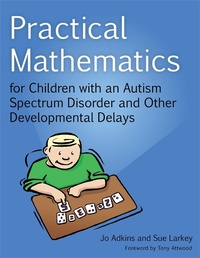
Practical Mathematics for Children with an Autism Spectrum Disorder and Other Developmental Delays
Published on 28. April 2013
Book
Paperback/Softback
144 pages
978-1-84905-400-3 (ISBN)
Description
It is a common misconception that children on the autism spectrum find mathematics easy. In fact the opposite is true for some, and exposure to basic mathematics in the early years can be crucial in establishing the foundations for understanding later in life.
This book provides practical strategies and tools for teaching key mathematics concepts to children with an autism spectrum disorder and other developmental delays. The authors emphasise the importance of incorporating a child's special interest into learning in order to help them engage fully with new concepts. Topics covered include colours, shapes, categories, numerals, sequencing, addition and subtraction and using money, and the book includes worksheets and activities for incorporating mathematics into daily living skills.
This is an essential resource for teachers, teaching assistants and parents who wish to develop mathematics skills in children with an autism spectrum disorder and other developmental delays.
This book provides practical strategies and tools for teaching key mathematics concepts to children with an autism spectrum disorder and other developmental delays. The authors emphasise the importance of incorporating a child's special interest into learning in order to help them engage fully with new concepts. Topics covered include colours, shapes, categories, numerals, sequencing, addition and subtraction and using money, and the book includes worksheets and activities for incorporating mathematics into daily living skills.
This is an essential resource for teachers, teaching assistants and parents who wish to develop mathematics skills in children with an autism spectrum disorder and other developmental delays.
Reviews / Votes
The writers suggest that teachers often struggle with the question of where to start; this guide is provided as an answer. The "no nonsense" style of the book mirrors the teaching approach advocated for the children - clear, deliberate and sequential... The book's precise approach and the uncomplicated format means that the programme is not reliant upon a teacher or an academic to deliver, and can be used in a range of settings. The book is written in a straightforward manner, using informal language... This is an easily accessible book which could be used by teachers of various experience levels, Teaching Assistants and parents. I would recommend this book to those with an interest in teaching maths in a practical, sequential manner, who are not concerned with a lack of underpinning knowledge and analysis. -- The International Journal of Developmental Disabilities This is book which aims to take the fear out of learning maths by teaching it in a very practical manner. Its contents are easily digestible and it will be of great interest to parents, teachers and support staff of pupils with ASD and other developmental delays. -- SNIP I have known the authors of these practical and effective mathematics programmes for many years and I have great admiration for their insight into the minds and learning styles of children with an ASD, as well as their knowledge of how to capture the child's attention and clearly explain mathematical concepts...I know this is the book that parents and teachers of young children with an ASD, from severe autism to Asperger's syndrome, have been seeking for a long time. -- from the foreword by Tony Attwood This book is great, a very welcome resource, one that will take the fear and confusion out of learning mathematics. I often say, 'you know how so many autistic people are great with numbers? I'm not one of them!' How I wish it had been around when I was growing up. Importantly, it shows how to utilise a child's interest. This is where our hearts are, this is how we learn best. This book will open doors for so many children and set them up for life-long learning. It's magic. -- Dr Wendy Lawson, author of Life Behind Glass: A Personal Account of Autism Spectrum DisorderMore details
Language
English
Place of publication
London
United Kingdom
Target group
Professional and scholarly
Product notice
Paperback (UK-trade)
Illustrations
178 colour illustrations
Dimensions
Height: 273 mm
Width: 215 mm
Thickness: 11 mm
Weight
390 gr
ISBN-13
978-1-84905-400-3 (9781849054003)
Copyright in bibliographic data and cover images is held by Nielsen Book Services Limited or by the publishers or by their respective licensors: all rights reserved.
Schweitzer Classification
Other editions
Additional editions
Sue Larkey | Jo Adkins
Practical Mathematics for Children with an Autism Spectrum Disorder and Other Developmental Delays
E-Book
04/2013
1st Edition
Jessica Kingsley Publishers
€47.99
Available for download
Persons
Sue Larkey is Director of Autism Consulting & Educational Services in southern Australia. She has taught both as a primary school teacher and as a special education teacher teaching students with ASD in a mainstream and at a specialist autism school. She combines this practical experience with extensive research, having completed a Masters in Special Education and currently undertaking a Doctorate in Education. Sue has spoken at the World Autism Congress and regularly runs workshops on educational strategies for children with ASD. Jo Adkins is the Director of Creating Success, a company which facilitates training seminars on autism spectrum disorders for parents and professionals living or working with children on the autism spectrum. Jo's eldest child was diagnosed with autism at the age of two. She lives in Napier, New Zealand. Tony Attwood, PhD, is a clinical psychologist from Brisbane, Australia, with over 30 years of experience with individuals with autism spectrum disorders. He is currently Adjunct Professor at Griffith University in Queensland.
Content
Foreword by Tony Attwood. Introduction. How to Use this Book. 1. Colours. 2. Shapes. 3. Categories. 4. Numerals. 5. Sequencing and Order. 6. Numbers. 7. Visual Maths Addition. 8. Size Attributes to Compare. 9. Positions. 10. Money. 11. Using Everyday Situations to Teach Maths - Generalising and Making Maths Fun. Conclusion. References. Index.