

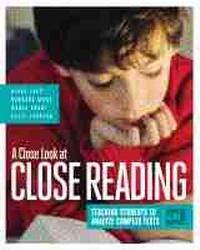
A Close Look at Close Reading
Teaching Students to Analyze Complex Texts, Grades K-5
Will be published approx. on 30. January 2015
Book
Paperback/Softback
200 pages
978-1-4166-1947-5 (ISBN)
Description
The Common Core State Standards have put close reading in the spotlight as never before. While elementary school teachers are certainly willing to teach students to closely read both literary and informational text, many are wondering what, exactly, this involves. Is there a process to follow? How is close reading different from guided reading or other common literacy practices? How do you prepare students to have their ability to analyze complex texts measured by Common Core assessments? Is it even possible for students in grades K-5 to ""read to learn"" when they're only just learning to read?
Literacy experts Diane Lapp, Barbara Moss, Maria Grant, and Kelly Johnson answer these questions and more as they explain how to teach young learners to be close readers and how to make close reading a habit of practice in the elementary classroom. Informed by the authors' extensive field experience and enriched by dozens of real-life scenarios and downloadable tools and templates, this book explores: - Text complexity and how to determine if a particular text is right for your learning purposes and your students.
- The process and purpose of close reading in the elementary grades, with an emphasis on its role in developing the 21st century thinking, speaking, and writing skills essential for academic communication and required by the Common Core.
- How to plan, teach, and manage close reading sessions across the academic disciplines, including the kinds of questions to ask and the kinds of support to provide.
- How to assess close reading and help all students-regardless of linguistic, cultural, or academic background-connect deeply with what they read and derive meaning from a complex text.
Equipping students with the tools and process of close reading sets them on the road to becoming analytical and critical thinkers-and empowered and independent learners. In this comprehensive resource, you'll find everything you need to start their journey.
Literacy experts Diane Lapp, Barbara Moss, Maria Grant, and Kelly Johnson answer these questions and more as they explain how to teach young learners to be close readers and how to make close reading a habit of practice in the elementary classroom. Informed by the authors' extensive field experience and enriched by dozens of real-life scenarios and downloadable tools and templates, this book explores: - Text complexity and how to determine if a particular text is right for your learning purposes and your students.
- The process and purpose of close reading in the elementary grades, with an emphasis on its role in developing the 21st century thinking, speaking, and writing skills essential for academic communication and required by the Common Core.
- How to plan, teach, and manage close reading sessions across the academic disciplines, including the kinds of questions to ask and the kinds of support to provide.
- How to assess close reading and help all students-regardless of linguistic, cultural, or academic background-connect deeply with what they read and derive meaning from a complex text.
Equipping students with the tools and process of close reading sets them on the road to becoming analytical and critical thinkers-and empowered and independent learners. In this comprehensive resource, you'll find everything you need to start their journey.
More details
Language
English
Place of publication
Alexandria
United States
Target group
Professional and scholarly
Dimensions
Height: 251 mm
Width: 200 mm
ISBN-13
978-1-4166-1947-5 (9781416619475)
Copyright in bibliographic data and cover images is held by Nielsen Book Services Limited or by the publishers or by their respective licensors: all rights reserved.
Schweitzer Classification