

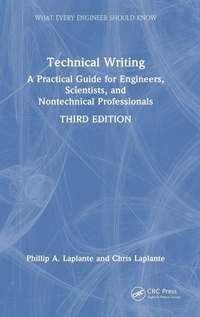
Technical Writing
A Practical Guide for Engineers, Scientists, and Nontechnical Professionals
3rd Edition
Will be published approx. on 25. November 2025
Book
Hardback
257 pages
978-1-032-84375-9 (ISBN)
Description
Technical Writing: A Practical Guide for Engineers, Scientists, and Nontechnical Professionals enables readers to write, edit, and publish materials of a technical nature, including books, articles, reports, and electronic media. Written by experienced practicing engineers, this guide complements traditional technical writing manuals through the presentation of firsthand examples that help readers understand practical considerations in writing and producing technical content. These examples illustrate how a publication originates as well as explain various challenges and solutions.
The third edition features the following:
New and updated exercises, examples, and case studies
New content on software/systems documentation
Treatment of plagiarism to incorporate issues in generative artificial intelligence (AI), open-access archiving, and more
Coverage of popular writing and collaboration tools such as Grammarly, Overleaf, and Google Docs
Increased conversation of writing for non-native English speakers
Latest standards and research
Written in an informal, conversational style, unlike traditional writing texts, this book contains many interesting vignettes and personal stories to add interest to otherwise stodgy lessons. It is aimed at students and professionals in the science and engineering domains.
The third edition features the following:
New and updated exercises, examples, and case studies
New content on software/systems documentation
Treatment of plagiarism to incorporate issues in generative artificial intelligence (AI), open-access archiving, and more
Coverage of popular writing and collaboration tools such as Grammarly, Overleaf, and Google Docs
Increased conversation of writing for non-native English speakers
Latest standards and research
Written in an informal, conversational style, unlike traditional writing texts, this book contains many interesting vignettes and personal stories to add interest to otherwise stodgy lessons. It is aimed at students and professionals in the science and engineering domains.
More details
Series
Edition
3rd edition
Language
English
Place of publication
London
United Kingdom
Publishing group
Taylor & Francis Ltd
Target group
College/higher education
Professional and scholarly
Professional Practice & Development and Undergraduate Advanced
Illustrations
18 s/w Tabellen, 53 s/w Abbildungen, 36 s/w Photographien bzw. Rasterbilder, 17 s/w Zeichnungen
18 Tables, black and white; 17 Line drawings, black and white; 36 Halftones, black and white; 53 Illustrations, black and white
Dimensions
Height: 240 mm
Width: 161 mm
Thickness: 19 mm
Weight
575 gr
ISBN-13
978-1-032-84375-9 (9781032843759)
Copyright in bibliographic data and cover images is held by Nielsen Book Services Limited or by the publishers or by their respective licensors: all rights reserved.
Schweitzer Classification
Other editions
Additional editions
Phillip A. Laplante | Chris Laplante
Technical Writing
A Practical Guide for Engineers, Scientists, and Nontechnical Professionals
Book
approx. 11/2025
3rd Edition
CRC Press
€68.90
Not yet published
Phillip A. Laplante | Chris Laplante
Technical Writing
A Practical Guide for Engineers, Scientists, and Nontechnical Professionals
E-Book
11/2025
3rd Edition
CRC Press
€63.49
Available for download
Phillip A. Laplante | Chris Laplante
Technical Writing
A Practical Guide for Engineers, Scientists, and Nontechnical Professionals
E-Book
11/2025
3rd Edition
CRC Press
€63.49
Available for download
Previous edition
Phillip A. Laplante
Technical Writing
A Practical Guide for Engineers, Scientists, and Nontechnical Professionals, Second Edition
Book
07/2018
2nd Edition
CRC Press
€230.27
Shipment within 10-20 days
Persons
Phillip A. Laplante, Professor Emeritus of Software and Systems Engineering (Penn State), is internationally renowned for his research, teaching, and service in areas such as artificial intelligence, critical infrastructure systems, image processing, and real-time systems. Phil has more than 40 years of experience as a senior technology leader in development, research, teaching, and administrative roles. He has worked in industry, academia, and government, where he wrote thousands of business communications and technical reports. His publications include 40 books and more than 350 papers in scholarly journals, magazines, conferences, and newsletters. He is the founding editor-in-chief of IEEE Reliability Magazine and the editor-in-chief of three Taylor & Francis book series, and he has served on dozens of editorial boards for other scholarly publications. His work includes definitive texts in requirements engineering, real-time systems, and technical writing. These and many of his other books are used in universities around the world. His recent book Chaos, Fractals, and Dynamical Systems, with Chris Laplante, was written for use in homeschooling. Phil earned a PhD in computer science, an MEng in electrical engineering, and a BS in systems planning and management, all at Stevens Institute of Technology. He also earned an MBA at the University of Colorado at Colorado Springs. He is available for speaking, teaching, and consulting.
Chris Laplante was introduced to the BASIC programming language at a very young age by his father, Phil. He quickly became fascinated by programming and computers in general. He is currently a software engineer at Agilent Technologies, where he works on embedded Linux systems for gas chromatographs and automated liquid samplers. He is the coauthor of the book Chaos, Fractals, and Dynamical Systems, with Phil Laplante, and an active contributor to various electronic media sites. He earned a BS in computer science with a minor in mathematics at Penn State.
Chris Laplante was introduced to the BASIC programming language at a very young age by his father, Phil. He quickly became fascinated by programming and computers in general. He is currently a software engineer at Agilent Technologies, where he works on embedded Linux systems for gas chromatographs and automated liquid samplers. He is the coauthor of the book Chaos, Fractals, and Dynamical Systems, with Phil Laplante, and an active contributor to various electronic media sites. He earned a BS in computer science with a minor in mathematics at Penn State.
Content
1. The Nature of Technical Writing. 2. Technical Writing Basics. 3. The Writing Process. 4. Scientific Writing. 5. Business Communications. 6. Technical Reporting. 7. Using Graphical Elements. 8. Publishing Your Work. 9. Writing for the Digital Age. 10. Writing with Collaborators.