


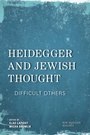
Heidegger and Jewish Thought
Difficult Others
Published on 15. November 2017
Book
Hardback
322 pages
978-1-78660-471-2 (ISBN)
Description
Once a prophet of critical, "other" thought, Heidegger has now for many become the epitome of the unthinkable, in the light of the Black Notebooks controversy. The unthinkable here is anti-Semitism. The encounter between Heidegger and the Jews has thus come to signify - very much in the spirit of Heidegger's own anti-Judaism - the end of thought. The present volume resists this view by positing not only Heidegger but also the Jewish people as representing thought. The encounter between Heidegger and various traditions of Jewish thought is conceived here as a conversation inter alia, an exchange between real or perceived "others": others to the philosophical tradition, to mainstream modernity, to Western Christian metaphysics, to each other, and even to themselves. The conversation takes shape in this volume as a symposium of seventeen essays by leading scholars both of Heidegger's philosophy and of Jewish Studies.
Reviews / Votes
. . . . this volume as a whole lives up to its own standard of being an "intervention" in the spirit of polemos. By assembling a wide array of approaches, it inter-venes in the most literal sense: It comes between dominant discursive positions that, while masquerading as neutral analyses of the ideological implications of Heidegger's thinking, too often are deeply factional in character. Without attempting to mediate between or reconcile said positions, let alone Heidegger and the Jewish intellectual tradition, it attests to the possibility of productive dialogical dispute between modes of thought generally deemed incompatible. In doing so, it opens up the space for alternative ways of accessing the complex relation between these modes that go beyond collecting evidence for or against Heidegger's anti-Semitism. * Journal of the Pacific Association for the Continental Tradition * "Difficult otherness" is how Elad Lapidot names and frames the chasm, the aggrieved juxtaposition of these two names, markers of traditions, and "figures of thought": Heidegger, the Jews. The expert scholars here assembled have collectively taken on the arduous and audacious task of looking into the abyss, this difficult alterity, reading and measuring it, exploring it, contesting or even bridging it. A remarkable and indispensable achievement. -- Gil Anidjar, Professor in the Departments of Religion, the Department of Middle Eastern, South Asian, and African Studies (MESAAS), and the Institute for Comparative Literature and Society (ICLS), Columbia University a creative and useful addition to conversation on the relation between Heidegger's legacy and Judaism. * ID: International Dialogue, A Multidisciplinary Journal of World Affairs *More details
Series
Language
English
Place of publication
United Kingdom
Publishing group
Bloomsbury Publishing PLC
Target group
Professional and scholarly
US School Grade: From College Junior to College Graduate Student
Dimensions
Height: 235 mm
Width: 157 mm
Thickness: 24 mm
Weight
678 gr
ISBN-13
978-1-78660-471-2 (9781786604712)
Copyright in bibliographic data and cover images is held by Nielsen Book Services Limited or by the publishers or by their respective licensors: all rights reserved.
Schweitzer Classification
Other editions
Additional editions
E-Book
11/2017
1st Edition
Rowman & Littlefield International
€49.49
Available for download
Persons
Micha Brumlik is professor emeritus at the Goethe University of Frankfurt am Main and senior professor at the Center for Jewish Studies Berlin-Brandenburg.
Elad Lapidot is a lecturer and researcher at the Freie Universitat Berlin and the Center for Jewish Studies Berlin-Brandenburg. He is the author of Etre sans mot dire (2010).
Elad Lapidot is a lecturer and researcher at the Freie Universitat Berlin and the Center for Jewish Studies Berlin-Brandenburg. He is the author of Etre sans mot dire (2010).
Content
Introduction, Elad Lapidot / Part I: Heidegger Thinks the Jews / 1. Beyond Apocalyptic Logos, Joseph Cohen & Raphael Zagury-Orly / 2. Heidegger and Marx: A Phantasmatic Dialectic, Peter Trawny / 3. Everyday Life, Hatred of Jews, and the Identitarian Movement, Micha Brumlik, translated by Daniel Fischer / 4. 'Whitewashed with Moralism': On Heidegger's Anti-Americanism and Anti-Semitism, Gregory Fried / 5. Being and the Jew: Between Heidegger and Levinas, Donatella Di Cesare, translated by Richard Polt / Part II: Heidegger and Jewish Thinkers / 6. Den Anderen Denken - Being, Time and the Other in Emmanuel Levinas and Martin Heidegger, Eveline Goodman-Thau / 7. Groundlessness and Worldlessness: Heidegger's Anti-Semitism and Jewish Thought, Dieter Thomae / 8. Heidegger's Judenfrage, Babette Babich / 9. Heidegger as a Secularized Kierkegaard: Martin Buber and Hugo Bergmann Read Sein und Zeit, Daniel Herskowitz / Part III: Heideggerian and Jewish Thought / 10. Heidegger's Seyn/Nichts and the Kabbalistic Ein Sof, Ell